

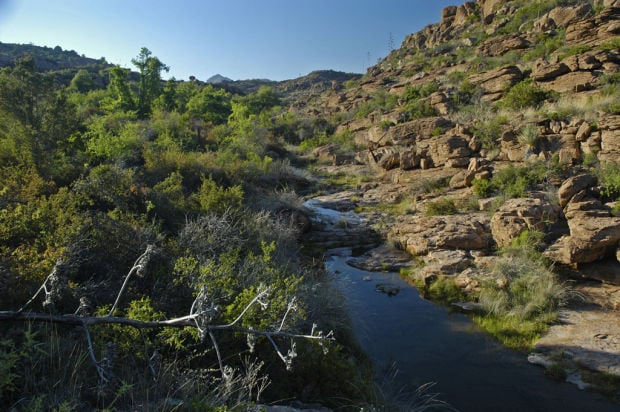
A controversial land-swap bill attached to national defense spending legislation passed the U.S. House of Representatives on Thursday, bringing a foreign mining company one step closer to a massive copper deposit near Superior.
The long-stalled land-swap bill was added to the must-pass National Defense Authorization Act this week at the urging of supporters in the House and Sen. John McCain, R-Ariz., said Rep. Paul Gosar, R-Ariz., a supporter of the bill. McCain’s office did not respond to requests for comment on Thursday.
The Senate is expected to consider the defense spending bill next week, before the lame-duck session ends.
The land swap would transfer ownership of 2,400 acres of Tonto National Forest in Arizona to Resolution Copper Mining, which is jointly owned by U.K.-based Rio Tinto Group and Australia-based BHP Billiton Ltd. The mining company wants to establish a major copper mine on the land, which sits 7,000 feet above an ore body.
People are also reading…
The mine would bring in $220 million per year in salaries and wages, Gosar said on Thursday.
“These are good jobs,” he said. “Hopefully the Senate will act … and then we can have a copper Christmas in Arizona.”
Supporters of the mining project in Congress have been trying to pass the land-swap bill for almost a decade.
But opposition from the U.S. Forest Service; conservationists; Native American tribes; town officials in Superior, where the mining operation will be based; and Rep. Raul Grijalva, D-Ariz., has helped stall the bill. Grijalva could not be reached for comment Thursday.
Critics say the land transfer would allow the mining company to avoid critical oversight and environmental analysis required for proposed mines on public land.
Residents of the historic mining town of Superior are divided on whether to support the mining project, which would bring 1,400 direct jobs to the area.
Supporters say the struggling town desperately needs the jobs. Opponents worry about the destruction of the natural resources, riparian habitats and recreational opportunities around the mine site.
“We can do a lot less to protect endangered species on private land than on public land,” said Roger Featherstone, director of the Arizona Mining Reform Coalition, which has long fought the land-swap bill. “And you can do a lot less to protect cultural sites.”
Rep. Ann Kirkpatrick, D-Ariz., issued a statement on Thursday praising the bill’s passage.
“Rural Arizona and our entire state won big today. Superior and the Copper Corridor have more than a century’s legacy of mining, with generations of families working in local copper mines. And today, they have a future that includes more jobs and economic stability,” she said.
Her statement noted that the bill was modified to ensure Native American tribes can still access the parcel’s Oak Flat campground — which the San Carlos Apache tribe considers sacred — unless the area is deemed unsafe.
COMPROMISES
Opponents say concessions included in the most recent version of the land-swap bill don’t go far enough. The bill doesn’t ensure the mining company will have to respect the Forest Service’s orders to mitigate environmental impacts, once the land is private.
An environmental analysis, a public-comment period and time for objections to an environmental impact statement would all be required under the National Environmental Policy Act, or NEPA, if the land remains public.
The latest version of the bill added a requirement that a final environmental impact statement must be issued before the mining company can get the title to the land. But the bill still guarantees the title will be transferred after that statement is published. Featherstone says title transfer should be predicated upon Forest Service approval of the mine project.
Dave Richins, a spokesman for Resolution Copper said the NEPA process leading up to the environmental impact statement gives plenty of opportunity for public input.
“I have great faith in the process,” Richins said Thursday.
More than a year ago, the company submitted its mine plan of operations to the Forest Service, which is reviewing it.
“The mine plan that we submitted had tremendous public input on it,” Richins said.
Featherstone said the bill’s language takes the teeth out of the NEPA process.
“You can write a final impact statement, but no matter what it says, the land still gets transferred to Rio Tinto,” he said. “The decision is preordained. You can talk all you want before you’re executed, but if there’s not a chance to stay the execution, what’s the point?”
Gosar said the project will generate 25 percent of the U.S. demand for copper and bring $1 billion a year for 50 years into Arizona. He dismissed concerns that much of the copper would get sold to China. A Chinese company owns a stake in Rio Tinto, Resolution’s parent company.
“As a commodity, I’d love to sell China some copper at our price. But America first,” he said.
Contact reporter Emily Bregel at 807-7774 or ebregel@tucson.com. On Twitter: @EmilyBregel

Emily Bregel
Border reporter
