

A Tucson company will help build shelters for some of the victims in Haiti, where January's earthquake left more than 1 million people homeless and vulnerable to a hurricane season that begins in June.
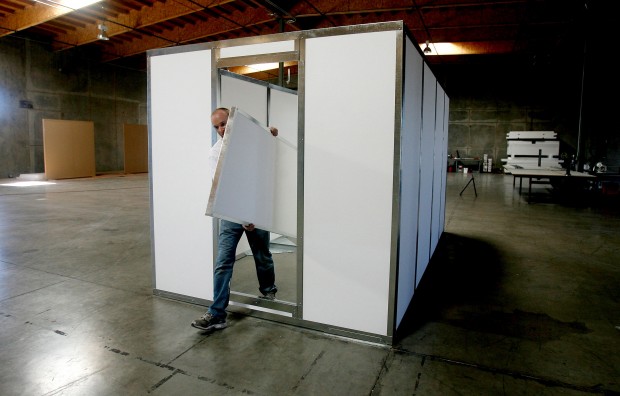
Tucson-based Energy Panel Systems and the Canadian charity On Guard for Humanity have established a partnership to manufacture and supply rapid-deployment emergency shelters that can be packed into a shipping container and built on-site with minimal tools.
Although the exact number of shelters is still being decided, Energy Panel Systems has already prepared 40 for transport in two large shipping containers. Neither partner could estimate an overall dollar figure for the plan.
Conceived as a replacement for the tents usually used in refugee camps, the shelters built by EPS use structural insulated panels. The modular-wall construction system incorporates styrofoam sandwiched between two pieces of polymer stucco. Unlike stucco used in Tucson, this material is flexible and won't crack when the panels are moved.
People are also reading…
The construction method provides a steel frame, which adds strength yet can be easily broken down and moved to a new location. Each shelter will be a 7-by-14-foot rectangle with a ceiling 7 1/2feet high, a door and a small cutout for a back window.
Although the shelters are estimated to be slightly more expensive than tents normally used to house refugee families, the life-span of each is much longer and the shelter can be reused as needed, said Alberto de Sousa Costa, president and CEO of On Guard for Humanity.
"Most tents last 75 days for a family. Maybe 125 days, depending on the location. The rate of replacement is just brutal," he said.
The cost for tents used by refugees varies depending on size and durability. The common four-person tent used in Haiti ranges from $400 to $1,500, said Lisa Hopper, founder and CEO of World Care, a relief organization based in Tucson.
The EPS design costs $1,500 to $2,000, but economies of scale and a decline in the cost of materials can help close the gap, said EPS President Graham McGinnis. "Beyond materials and labor, we're not charging much for them," he said.
The donor-supported On Guard for Humanity requested EPS' help because of the Tucson company's experience in building homes using similar techniques for Habitat for Humanity and an affordable-housing project in New Mexico.
"On Guard asked us to design something as an emergency shelter. We've worked with Habitat for Humanity and other groups on similar designs, so we know how to do it and we put together a design they liked," said McGinnis. "A regular tent ... won't offer the shelter people need against hurricanes, rainstorms and mudslides."
The design came quickly and On Guard was impressed with the results. "We look for companies that have the competency for what we need. We look for the best, and we were impressed with their work ethic, which is very important," said de Sousa Costa.
Currently, McGinnis and a two-man crew can build a hundred or so shelters a week, but they're developing a plan to build more as needed. This will include hiring additional builders in Tucson.
"We're setting up shop and getting ready to hire people once we know what volume would we need to provide," McGinnis said.
Pending approval by the Haitian government, On Guard hopes to deploy the shelters in three communities. The first shipment should arrive in Haiti by the beginning of June, just as tropical storms are building.
"We're just trying to build at a fast rate," said McGinnis. The rainy season may begin any day and they need shelter."
DID YOU KNOW
Last May, Tucson-based Energy Panel Systems provided the exterior walls for a Tucson home built as part of the television show "Extreme Makeover: Home Edition."
Paul Ingram is a University of Arizona journalism student apprenticing at the Star. Contact him at starapprentice@azstarnet.com