

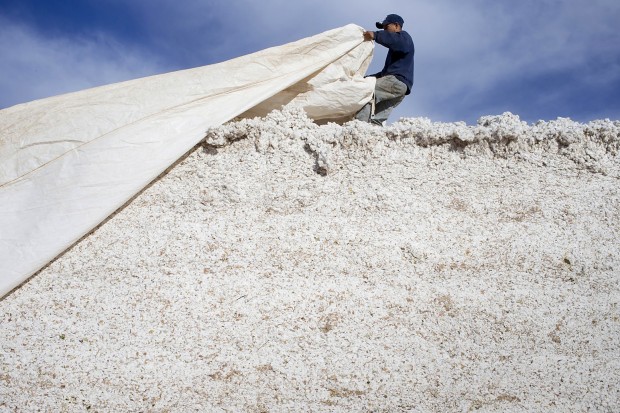
PHOENIX - For Arizona cotton growers, the annual harvest is more than just a reminder of the state's agricultural tradition - it's all about business, the global economy and adapting to a changing landscape.
Over the past several weeks, every day at 7 a.m., the employees of Associated Farms, for example, have fired up large harvest equipment on the Salt River Pima-Maricopa Indian Community east of Scottsdale.
The farm is owned and operated by Adam Hatley; his father, Sonny; and a handful of other family members who harvest 12 hours a day, seven days a week through much of November and into December.
"My dad's 78 now, and he says he's semiretired because he takes Sundays off," Adam Hatley said.
Hatley expects his cotton yield this year to be around 1,400 pounds per acre, up from last year's disappointing 1,250-pound-per-acre harvest. One bale of cotton weighs about 500 pounds.
People are also reading…
"Two months ago I would have thought the yields would be below average, but it has proved me wrong," Hatley said.
Although production is higher, prices in the world market are down, something partly attributable to the growth of cotton farming in China and India.
As those countries increase cotton production on a large scale, and global demand does not keep pace, prices drop, hurting business for farmers like Hatley.
Futures for upland cotton, the most commonly grown variety, have been trading in the range of 75 to 80 cents per pound this week. In 2011, the average price was more than 88 cents a pound, according to the U.S. Department of Agriculture.
Higher-quality Pima cotton also is grown in Arizona, and typically trades at a higher price.
Hatley sees another side to the foreign competition.
As production and growth in India and China continue, their populations may see growth of a middle class that has the means and desire to shop for more clothing made of - what else? - cotton. That could drive up demand.
"I have heard about China and India planning to focus more on consumables for their country to support their immediate needs and then outsourcing for things like cotton," Hatley said.
Knowledge of the global economy is something that cotton farmers in Arizona will need to adopt in order to be successful, said Brent Murphree, western region communications director for the Cotton Board, a national group that oversees cotton research and promotion efforts.
"Local growers need to be aware of what is going on in the world market and decide best use of the land for the price," Murphree said. "It really is a balancing act."
The cash value of cotton grown in Arizona in 2011 was $362 million, according to the Arizona Farm Bureau.
At its peak decades ago, 400,000 acres of Arizona farmland was used to grow cotton, but that acreage now is closer to 200,000 acres a year, as more land was sold for developments and urban sprawl took hold.
Depending on market prices and potential for profitability, Hatley divides his land among cotton, alfalfa, barley or corn.
The Hatleys harvest cotton from nearly 2,000 acres on the reservation, on land leased from the Salt River Pima-Maricopa Indian Community just off Loop 101, near Scottsdale Community College.
It is just a portion of the more than 3,000 acres that Associated Farms leases from the tribal community, the rest of which is used to grow other crops.
Cotton on Hatley's farm has been given less and less acreage each year.
"We used to give cotton a lot more land, but now we're just under 2,000 acres, and next year I might cut it down to 1,500 if the prices stay where they are," Hatley said.
The lower prices are troublesome in themselves, but paired with that fact that cotton is a more difficult crop to grow than the others, it seems that scaling back is inevitable, he said.
"Cotton is much more management-intensive than some of the other crops, and on top of that it is the most expensive," Hatley said.
The short-staple cotton that farms such as Hatley's produce remains some of the highest quality.
"The quality of Arizona cotton is just amazing," Murphree said. "There are few other places in the world that produce the optimum type of cotton that we produce."
DID YOU KNOW?
Arizona's warm, dry weather means that the cotton remains in its purest form until harvest time.
If it does rain, the hot Arizona sun is able to bleach out most of the cotton's imperfections, leading to a product of higher quality.
The Arizona Republic