

In recent months, a wave of new smart phones has hit the market, giving consumers plenty of choices if they are interested in an all-in-one mobile device that can make calls, check messages and plan a vacation.
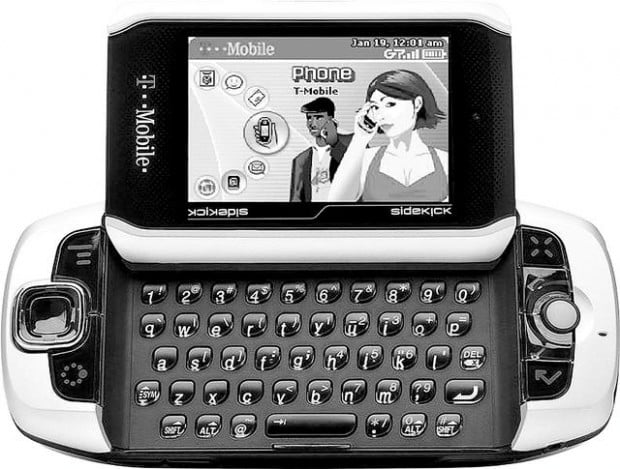
Earlier this month, another entrant joined the increasingly crowded field when T-Mobile introduced to stores the latest version of the popular Sidekick. Along with the Palm Treo, the original Sidekick was an early entrant into the smart phone market, and one that garnered a lot of attention as the gadget of choice for Hollywood's in-crowd.
But the new Sidekick 3, much like the Treo 700, suffers from a problem that may crimp sales: The device is a lot like its predecessor. Granted, there are some improvements, including a 20 percent reduction in size, but that may not be enough to draw new users as the smart phone market heats up.
New devices from Motorola and Nokia and slimmer versions of the BlackBerry offer a fresh, and often smaller, form factor.
People are also reading…
For instance, Motorola's Q weighs 4.06 ounces and is 12 millimeters thick. The Sidekick 3, meanwhile, weighs 6.7 ounces and is 22 mm thick. That may not sound like much, but it makes a noticeable difference if you like to carry your phone in your pocket or on a geeky belt clip.
Most of the new smart phones target the business user while the Sidekick remains a device dedicated to the on-the-go hipster. That should remain a strong selling point.
The Sidekick 3 is essentially a messaging device that also makes calls. T-Mobile smartly markets the Sidekick to 20-somethings who already are connected in so many ways. They send instant messages, e-mails and text messages just as much as, or more than, they use the phone to talk.
"Our customers do everything," said Sam Bell, senior marketing manager for the Sidekick. "It enhances all the communications options they have."
The slimmer Sidekick 3 is fun to play with. It has a track ball to scroll through menu choices, messages and songs. Its 2-inch-wide screen is nice for viewing Web pages (for a mobile device) or photos taken with its upgraded 1.3-megapixel camera.
Like its predecessor, the Sidekick 3 has a nifty swivel design where the screen twists open to access the keypad.
Most important for a messaging device, the Qwerty keypad is reasonably spaced and the keys have a hard touch, as opposed to the Sidekick 2's soft-touch design. This makes typing messages more efficient and less prone to error.
Another improvement is a memory card slot accessed through the same back panel that holds the removable battery.
It took me a while to find the memory slot, but housing it inside the device is a clever way to protect the card. On the Treo, for instance, the memory card slot is exposed on top of the device and the card easily falls out if the device is dropped.
A pleasant surprise was how easy it was to transfer music into the Sidekick 3 and how good it sounded through the headphones. The sound was as crisp as — perhaps a touch better than — my iPod.
I was able to transfer 15 songs into the device in a matter of minutes. The files must be in the MP3 format, however, so if you load songs onto your computer from a CD, make sure they are in the MP3 file format and not WMA (Windows) or AAC (Apple).
To really enjoy the music player, though, you'll want to buy a bigger card than the 64-megabyte one that comes with the Sidekick. It won't hold much more than 15 songs —even fewer if you also store photos.
I was disappointed in the camera.
The standard for mobile phones is quickly bypassing 1.3-megapixel imaging, as more models have 2 megapixels and, within weeks, there will be several camera phones sporting 3-megapixel capabilities.
This dramatically improved on-the-go imaging will be a boon for people who like to take pictures with a phone, like the 20-somethings T-Mobile targets with the Sidekick.
The Sidekick 3 costs $299 with a two-year contract, falling right between the Q's attractive $199 price at Verizon and the Treo 700's $399 cost at Sprint and Verizon.
A data plan is needed when you purchase a smart phone, and T-Mobile's $20 monthly cost is very reasonable.
Also, the Sidekick 3 runs on an EDGE network. That is a stopgap solution to get higher data speeds until T-Mobile catches up with the rest of the U.S. wireless carriers and introduces its third-generation network in 2007. Beware: The Sidekick 3 won't be able to upgrade to the faster 3G network.
The Sidekick 3 is better and slimmer than its predecessor, but despite a few nice touches, such as the track ball and music player, it seems to be keeping pace with the crowd instead of providing true innovation.
That could be dangerous as the competition escalates.