

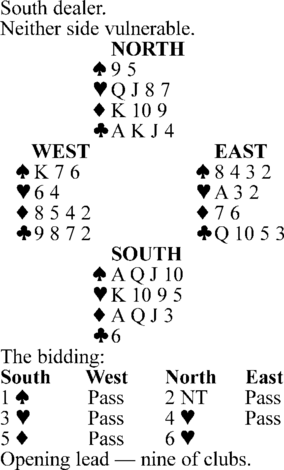
Very few plays are overlooked more often by declarer than the one featured here. Six hearts can be made if handled correctly, but it's very easy to go astray and finish down one.
A superficial glance might lead one to conclude that, in addition to a sure trump loser, South also has a potential spade loser that can be averted only if a finesse against East succeeds.
But the fact is that the spade finesse is entirely unnecessary. Twelve tricks can be made by normal play without risking the loss of a spade trick. Observe that in the actual deal, the slam would fail if declarer relied on the spade finesse to get him home.
South's best method of play is to start by cashing dummy's A-K of clubs and discarding a spade. A club can then be ruffed with the king, followed by a low trump to dummy's seven. Let's assume East wins with the ace (his play doesn't really matter) and returns a spade.
People are also reading…
South puts up the ace and leads the trump nine to the jack. He then ruffs dummy's last club with his last trump, the 10.
A diamond to the king allows declarer to cash dummy's Q-8 of trumps and discard his Q-J of spades. South's three remaining cards are the A-Q-J of diamonds, and the slam is easily made. The potential spade loser thus turns out to be a mirage.
The play utilized here is what is known as a dummy reversal. Instead of declarer trumping his losers in dummy, which is what happens in most cases, South reverses the usual procedure and trumps dummy's losers — here, the J-4 of clubs — in his own hand. In effect, dummy becomes declarer, and South plays his cards as though he were actually seated on the other side of the table.


