

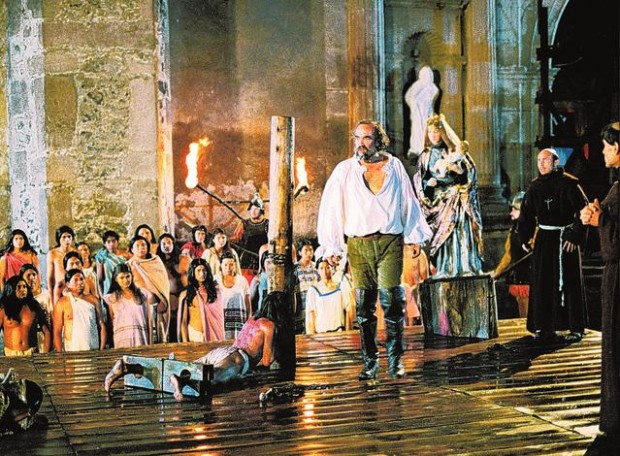
After nine years, "The Other Conquest" is finally here.
Unfortunately, the drama about 16th-century Spaniards attempting to impose Christianity on the last of the Aztecs isn't worth the wait. You'll be able to do without its crass melodrama and thudding symbolism for another decade at least.
The backstory is more interesting and mysterious than the aloof period drama. Writer/director Salvador Carrasco finished the film in 1998, and it premiered at that year's American Film Institute Film Festival. "The Other Conquest" opened in Mexico in 1999 and then in 2000 in the United States in a tiny, 74-screen release, earning an impressive $886,410. The original distributor ran out of money, forcing the movie to languish on the dark for years.
The film is finally now getting a wider release, focusing on the Southwest.
People are also reading…
The low-budget film, shot on location in Mexico City, is bogged down by a washed-out look that fails to capture the beauty and majesty of its surroundings.
The drama opens with promise, readying to take on stark tragedies and engaging themes it never quite tackles.
After the Spaniards slaughtered Aztecs at the Great Temple of Mexico, the only Aztec survivor is Topiltzin (Damián Delgado), love child of Emperor Moctezuma. He lives because he takes cover under a pile of bodies, and is captured by soldiers soon after he finds his family has been slaughtered.
An interpreter persuades conquistador Hernando Cortés (Iñaki Aierra), who ordered the massacre, to let Topiltzin live. Cortés determines to show his influence by "civilizing" Topiltzin, sending him to a monastery to live and study under stalwart Friar Diego (José Carlos Rodríguez). Topiltzin is redubbed Tomás. His unruly locks are chopped into a close-cropped, bald-on-top monk tonsure to match that of Diego, and his loincloth is replaced with a church tunic. But the Spaniards cannot change, as the endless orchestral swells emphasize, his heart.
Topiltzin is in an interesting situation because he can't trust his own gods, who abandoned him and his people, nor can he worship a new god whose worshippers advocate senseless genocide. This is fertile ground for some soul-searching, but the film devolves into an escape/ chase flick in which redemption for the heroes comes in twisting his tunic into a loincloth, bashing through a window protected by an iron cross and kidnapping a Virgin Mary statue. There is symbolism, and then there is cinematic bludgeoning.
Carrasco delivers his message with all the grace of Cortés.
The Other Conquest
**
• Rated: R for scenes of violence and some strong sexuality/nudity.
• Cast: Damián Delgado, Elpidia Carrillo, Iñaki Aierra.
• Writer/director: Salvador Carrasco.
• Family call: Too sexually graphic for kids.
• Et cetera: In Spanish, with subtitles.
• Running time: 105 minutes.


