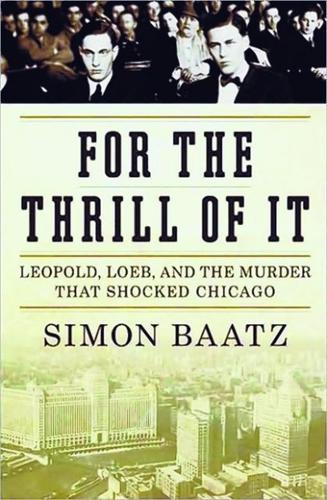
'For the Thrill of it: Leopold, Loeb and the Murder That Shocked Chicago'
By Simon Baatz (Harper, $27.95.)
The brutal murder in Chicago in 1924 of a 14-year-old boy named Bobby Franks fascinated people of the time and remains one of the most familiar and intriguing murder cases in American history.
We know without a shadow of a doubt who murdered Franks. It was Nathan Leopold and his friend Richard Loeb. What makes the Leopold and Loeb case so enduringly fascinating is not the who but the why.
Leopold and Loeb had no trouble telling right from wrong; they were unusually intelligent. They had entered the University of Chicago at the ages of 14 (Loeb) and 15 (Leopold). At the time of the murder both were, while only 18 and 19, already in graduate school. Nor was money the motive. Leopold and Loeb came from two of the richest families in Chicago.
People are also reading…
So why did they murder a 14-year-old schoolboy, stuff his naked body in a drainage pipe and send his parents a ransom note demanding $10,000?
The answer is in the title of Simon Baatz's altogether absorbing history of the case, "For the Thrill of It." It was that, and they wanted to prove to themselves that they were smart enough quite literally to get away with murder.
Baatz, a professor at John Jay College of Criminal Justice in New York City, has done meticulous research, and he writes extremely well. As a result he brings to vivid life the major characters. Not just the two murderers, but also the judges and lawyers. He also gives us a picture of the crime-ridden, bootleg-liquor-fueled Jazz Age city of Chicago and its spectacularly corrupt political culture.
— The New York Times
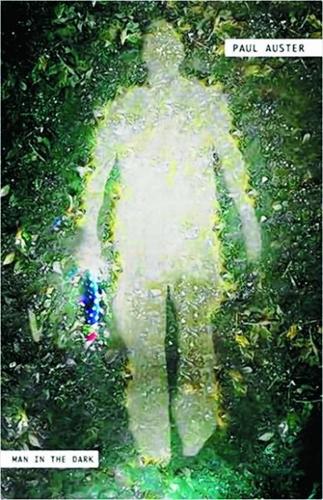
'Man in the Dark'
By Paul Auster (Henry Holt, $23)
An old man lies alone in the dark each night, hobbled by an auto accident and haunted by death. To fill the sleepless hours, he thinks up a story about a man who wakes up into an alternate America — one where there was no Sept. 11 and no Iraq war, but one where the controversial 2000 presidential election sparked a kind of blue-state/red-state civil war that has claimed millions of lives.
Auster's latest novel toggles between these two tales — one ruminative, the other fantastic. At night, Brill plots out the story of Owen Brick, a hapless magician who goes to bed one night with his wife in Queens and awakes in a hole in an America that is not the country he knows. George W. Bush is president of the United States, or at least the ones that didn't break off from the Union. The Independent States of America have their own prime minister, but society has broken down with the conflict. There's no TV, few cars and a lot of misery.
Before he can figure out where he is, Brick is given a mission to assassinate the mysterious man responsible for imagining this awful state of affairs.
Auster hits many of his favorite themes here. Characters struggle to move on after pulverizing losses. Solace is found in art. There is a story in a story and the rules of reality seem bendable.
— The Associated Press
'The Power of Place'
By Harm de Blij (Oxford University Press, $27.95)
Consider this: During the last two decades of the 20th century, Texas reported 64 cases of dengue fever.
By contrast, the three Mexican states bordering Texas reported 62,514 cases during the same time.
One big difference: Window screens and air conditioning were relatively rare on the Mexican side, making it easier for dengue-carrying mosquitoes to spread the disease.
"Extrapolate these circumstances to the availability of medical services on the two sides, and it is clear that even on the doorstep of the global core, the medical landscape is anything but flat," geographer Harm de Blij writes.
De Blij uses the dengue fever anecdote to argue that the place in which one is born and raised — and for most of the globe, this is the same place we'll live most of our lives — is still the chief factor in what types of lives we'll have.
"Earth may be a planet of shrinking functional distances," de Blij says, "but it remains a world of staggering situational differences."
De Blij, the author of 30 books, including "Why Geography Matters," says it's impossible to ignore the fact that only about 3 percent of the world's population lives in a country other than that of their birth.
As globalization marches on, de Blij concludes, the immediate challenge is to alleviate the local circumstances that still trap billions in places rife with violence, natural hazards, health threats, inadequate education and sexual discrimination.
— The Associated Press
The Tucson Festival of Books writing contest is officially under way.
The Youth Flash Fiction Writing Contest challenges all preschool and school-age children to tell a story and submit it for a chance to win prizes, including gift certificates.
Submissions may be mailed to: Tucson Festival of Books Young Authors Contest, P.O. Box 210019, 1209 E. University Blvd., Tucson, AZ 85721.
Submissions also may be e-mailed to tucsonfestivalofbookscontest@gmail.com.
The deadline to submit is Oct. 31.
The festival will be held March 13-15 on the University of Arizona campus and feature more than 350 authors. The contest will recognize the top five stories in each age category on March 14.
The Tucson Festival of Books is sponsored by the Arizona Daily Star and hosted and organized by the University of Arizona. Net proceeds will promote literacy in Southern Arizona through the Tucson Festival of Books Foundation, a nonprofit organization.
Go online to tucsonfestivalofbooks.org for more information and contest rules.