When Chef Maria Mazón first posted about the problems on North Fourth Avenue on Sept. 23, she had a suspect in sight.
“I’ve been in business for almost 17 years. But lately I’ve been seeing 4th Avenue kind of like going downhill. I hate that word, but that’s the reality,” said Mazón, owner of BOCA restaurant, 533 N. 4th Ave.
“My question is for all Tucsonans,” she went on. “What’s keeping you away from Fourth Avenue. Is it the parking? Is it the parking? Is it the meters? What is it?”
After getting a massive online response to that video, she followed up with two more, calling on city leaders to do something about the decline of the avenue. And by the time I caught up to her in BOCA’s kitchen on Friday, she was even more fired up, calling for free parking to return.
People are also reading…
Mazón isn’t the first Fourth Avenue business owner to call for changes to the city’s parking policies along the avenue to help businesses facing deteriorating conditions. The owners of the Surly Wench, 424 N. 4th Ave., started a petition in August to ask the city to roll back parking-meter hours that were expanded in July.

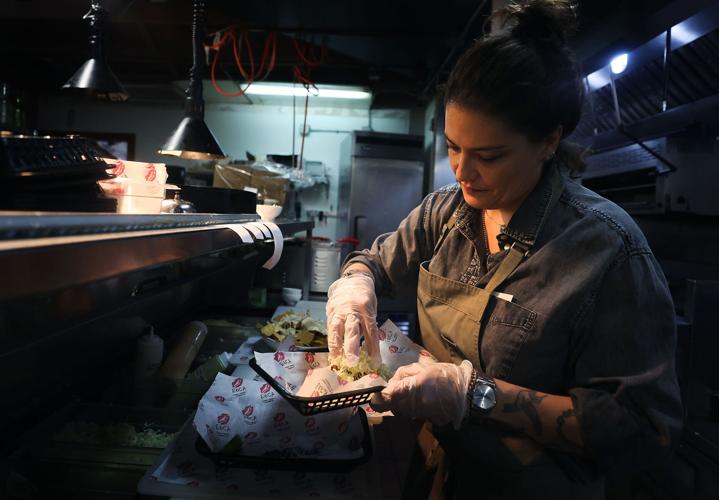
Chef Maria Mazón puts the finishing touches on an order as she works in her restaurant BOCA, 533 N. Fourth Ave. Mazón has been a leading voice raising concerns about a decline in business along North Fourth Avenue.
These business owners obviously have insight into what’s going wrong on the avenue, where more storefronts are empty, and the energy has diminished. But their arguments strike me as focusing a little too closely on the July 1 changes to metered parking hours.
Mazón told me that her business is down by about 40 percent going back about a year and a half. And parking meters were first installed on North Fourth Avenue in 2015. So it’s not just the existence of them on the avenue or the recent of expansion of hours that is causing the decline of businesses there.
Factors hammer business
What else is going on?
Most important, there’s what people call “the economy.” By that, people generally mean prices are high, and wages haven’t kept up. Nationwide, consumer confidence dropped to its lowest level in 12 years in September. People just don’t feel they have money to spend.
This is likely reflected in the low, 1% real sales growth in Pima County restaurants in the years ending July 2026, reported by the Arizona Restaurant Association.
Also, enrollment at the University of Arizona has fallen steeply over the last two years, by more than 7,000 total students. This is a sharp drop in the local population that makes up a major part of the avenue’s customer base.
In addition, international travel to Arizona and the rest of the United States has been declining. Canadians in particular, a significant part of our winter-visitor population, have slowed their travel to the United States in response to Pres. Trump’s threat to take over the country and his trade war with Canada. It’s also harder for travelers from some countries to get visas to visit events like the gem and mineral shows.
The number of passengers flying into and out of Tucson International Airport actually declined by 1% in the year ending July 2026, according to the Arizona Office of Tourism.
Along the streetcar corridor, investment in attractions has been focused more downtown than along North Fourth Avenue. Downtown is included in the Rio Nuevo tax-increment-financing district, which means there are millions of dollars to spread around to restaurants, hotels and other business projects. No such pot of money exists for Fourth Avenue.
Finally, there’s the related question of safety and attractiveness — a factor that Mazón also pointed to alongside parking. Fourth Avenue has long had a grittiness along with its hippyness, but the balance has shifted since the pandemic toward more drug use, begging and other bothersome street behavior.
DeeDee Koenen, owner of PopCycle, 422 N. 4th Ave., pointed toward the growing number of unhoused people as being “a little difficult,” noting that employees have to work as de facto social workers.
“It is still a hub of localism in Tucson,” Koenen said of Fourth Avenue. “But I feel like with no support it’s just going to continue to have folks move out. I think it’s probably in a precarious spot.”
Meters a concern
But what of the parking issue? It may seem like free parking would be great for business, but that’s not necessarily the case. Here’s how Andy Bemis, the deputy director of Tucson’s Department of Transportation and Mobility, explained it in an email:
“Metered and time-limited parking supports parking turnover. When space at the curb is free or not time-limited, the result is that people tend to park at the curb all day (in this area, that historically has been local residents, their guests, students, and the employees of the businesses) leaving little to no parking available for the customers trying to access these businesses for short trips.”
On July 1, the city lengthened the hours when parking meters are active on Fourth Avenue from 5-7 p.m., and added Saturday to the weekdays when meters are active. This came after a series of public meetings and the rejection of a plan to expand the hours till 10 p.m. and Sundays.
While the currentt hours add a new period of hassles for potential customers, people can still expect to start parking on the avenue at 5 p.m. and, if they pay for two hours of parking, leave the car there as late as they want.
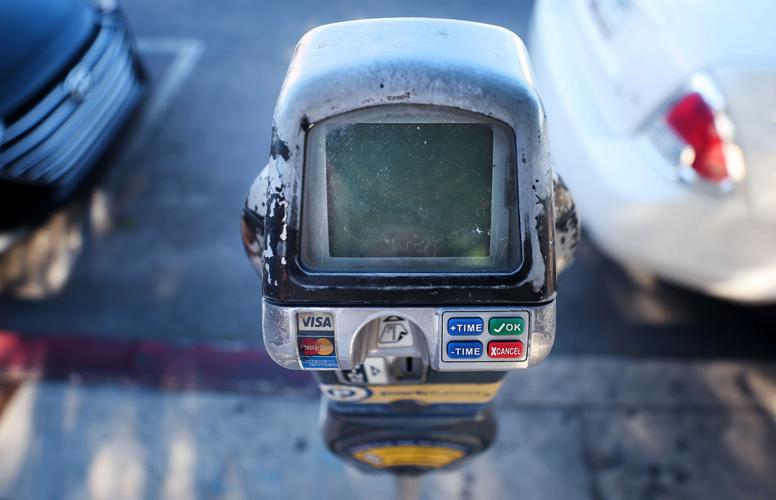
The biggest problem with the parking meters, I think, is that so many don’t work. Bemis said that 185 of the city’s 382 meters are inoperable in some way, usually meaning they can’t take coins.
“Park Tucson is currently awaiting an order of batteries to repair the meters on Fourth Avenue and plan to prioritize those meters as soon as the batteries arrive,” Bemis said.
Randy Koch told me, after I polished off a tea at his 1989 Bakehouse, that business has been pretty good since he started earlier this year, but the broken meters have been a problem.
“It’s just a hassle,” he said, noting that older people tend to have a harder time using the meters. “It’s going to be the older generation that have that disposable income.”
“If they are going to do meters, they need to work,” he said of the city.

On July 1, the city lengthened the hours when parking meters are active on North Fourth Avenue from 5 p.m. to 7 p.m., and added Saturday to the weekdays when meters are active. Further, 185 of the city’s 382 meters are inoperable in some way, the city says.
City action isn’t enough
The longer-term solution that Ward 6 Council Member Miranda Schubert is pushing for is to form a Business Improvement District on North Fourth Avenue. This would be like the Downtown Tucson Partnership, which is funded by an assessment on property taxes.
“A lot of the things that these business owners are concerned about what would be alleviated by setting up a BID (Business Improvement District),” Schubert said. “I really like the idea of the BID being formed by the businesses, driven by the business. But those services should be administered by the same purple shirt people.”
These are the well-known ambassadors who wear purple and maintain downtown Tucson while keeping an eye on security and other concerns. Of course, such a district would have to be supported by more than half the property owners — not necessarily the business owners — in the district.
The city certainly owes Fourth Avenue businesses, residents and visitors the basics — like working parking meters and police response to emergencies. That’s what Mazon has been demanding, telling me back in Boca’s kitchen, “I don’t want to leave because my own city didn’t support me.”
“I can guarantee you people will leave — and I will be one of them — if this isn’t resolved.”
But I think the broader responsibility may fall on the shoulders of property and business owners in the area. The landlords need to know that there may be no more business people willing to lease their storefronts if they don’t form a front to solve some of their other problems.
While there are ways to make Fourth Avenue better, it starts with recognizing the variety of problems afflicting them — not just parking.
Contact columnist Tim Steller at tsteller@tucson.com or 520-807-7789. On Bluesky: @timsteller.bsky.social

Tim Steller
Columnist


 Tim Steller’s column: Ciscomani ‘bipartisan’ except when it mattered most