PEORIA — Nested along the cliffs of Lake Pleasant is “America’s favorite” bird, the bald eagle. With about half a dozen nests populating the area, nest watchers were filled with excitement as hatchlings surpassed 5 weeks — the perfect age to band and measure.
“They’re old enough that they thermoregulate and they don’t have to have the adults protecting them in the nest,” said Kenneth ‘Tuk’ Jacobson, raptor management coordinator for the Arizona Game and Fish Department. “They’re also young enough that they haven’t quite figured out that they’re eagles, so they don’t want to jump on us.”
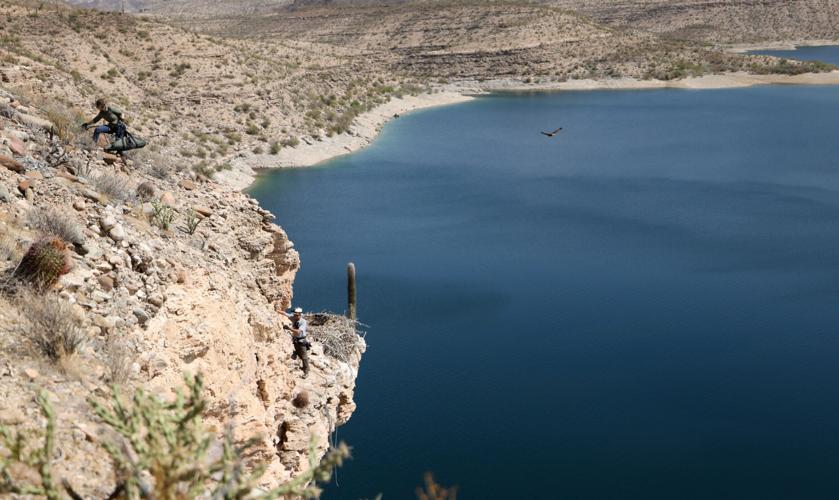
After a quick boat ride across the lake to an area closed to recreation users, Game and Fish employees and nest watchers from the Southwestern Bald Eagle Management Committee hiked along the ridge-line and dodged cactuses and loose rocks to reach the eaglets.
People are also reading…
“Eagles do not put their nests in the easiest places to get to,” Jacobson said of the climb to the nest. “But it is also definitely a rewarding experience to go through and work with these birds and see them respond so positively.”

An eagle circles the sky at Lake Pleasant while a trio of its young are brought to the top of a cliff by Arizona Game and Fish employees for veterinary testing and banding.
As AZGFD Eagle Field Project Manager Kyle McCarthy rappelled down to collect the trio of eaglets, a parent eagle circled the sky, squawking in confusion — though it never engaged.
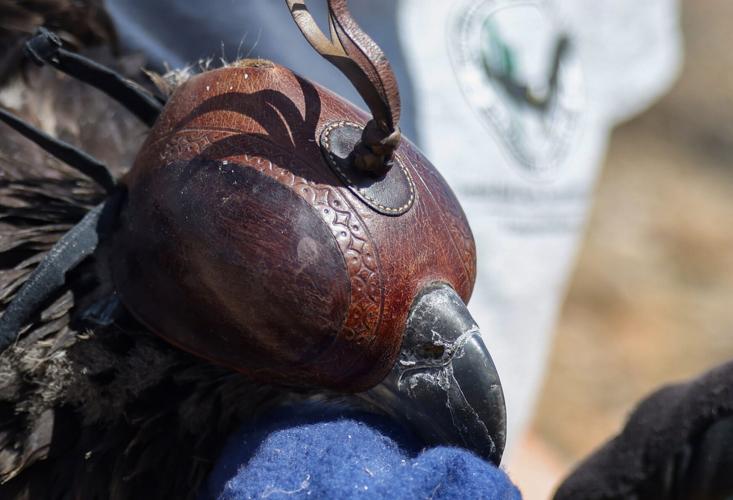
After placing booties on the eaglets’ talons to prevent them from hurting themselves or the handlers, McCarthy covered the two males and a female with a falconry hood to calm them, then placed them in a bag for Jennifer Presler, a biologist with the department, to hoist up.

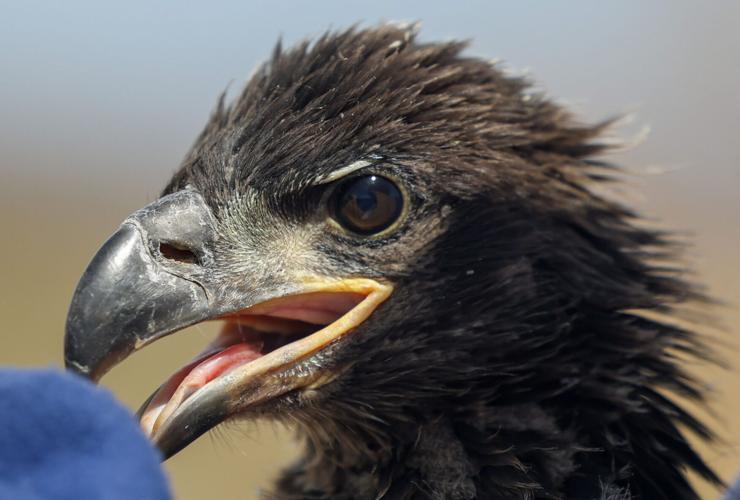
An eaglet gets its first look around outside its nest at Lake Pleasant last month during a veterinary checkup and banding by Arizona Game and Fish employees.
At the top, Presler and Jacobson banded each of the eaglets’ ankles, allowing the biologists to track them. They performed a variety of veterinary tasks, including measuring and disease testing, as nest watchers Griffin Lay and Audrey Jordon held them still.

Above: Jennifer Presler, a biologist with Arizona Game and Fish, carries a bag of eaglets up a cliff at Lake Pleasant as Kyle McCarthy, Eagle Field Project Manager, stands near their nest. At left: An eaglet gets its first look around outside its nest at Lake Pleasant last month during a veterinary checkup and banding by Arizona Game and Fish employees.
Lay and Jordon have worked almost nonstop since the eggs hatched in February to monitor the eaglets’ growth from afar, in 10-day shifts with four days off in between. The department coordinates the nest watching program to collect data on the local bald eagle population and educate the public on how to protect the species.
The bald eagle teetered on the edge of extinction in the 1960s. Programs like this have aided a steady recovery.

A hood is placed on eaglet’s head to calm the bird during an ankle banding and veterinary checkup last month at Lake Pleasant by state game officials.
“With all the conservation efforts making nest sites as productive as possible, we’ve been able to help see this bald eagle population grow immensely,” Jacobson said. “Nationwide, the bald eagle population has grown at about a 10% rate.”
For those hoping to see them take flight, Jacobson advises recreation enthusiasts to bring binoculars to “watch from a distance and let them be eagles.”
“We spent a lot of work breeding this population up from 25 nests in the late 1970s to the 100 or so nests we have now,” in Arizona, he said. “We want to make sure this population is as robust and stable as possible.”