Construction work will start at the Copper World mine south of Tucson before the end of 2026, and mining will start in the second half of 2029, the companies developing the mine said Wednesday.
Hudbay Minerals Inc. and its Copper World partner Mitsubishi Corp. have made the decision to proceed with the project and will invest close to $2.1 billion in building the mine, Hudbay said.
The mine, including four "primary" open pits, will be located on privately owned land, about 30 miles southeast of Tucson on the Santa Rita Mountains' west slope.
The plan is to operate the mine for at least 15 years and to produce an average of 110,000 tons of copper annually.
"Significant benefits for the community and local economy in Arizona" will occur through creation of more than 1,000 construction jobs, 500 permanent jobs and up to 3,000 jobs created indirectly through Copper World purchases of supplies and services from outside firms, among other things, Hudbay said in a written statement.
People are also reading…
Hudbay also said the mine will generate a total of $1.1 billion to $3.1 billion in local and state tax revenue, depending on how long it operates.

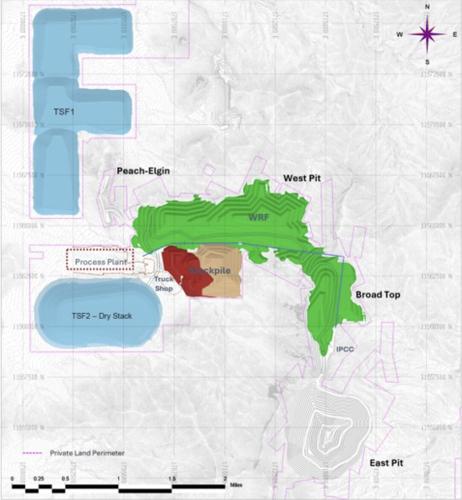
Copper World is designed as a conventional open-pit, truck-and-shovel mining operation across four primary pits, East, Broadtop, West and Peach-Elgin. The overall mine plan shown here integrates supporting infrastructure, including waste rock facilities (WRFs), grade-segregated ore stockpiles, a tailings storage facility (TSF), and an in-pit crushing and conveying (IPCC) system.
The mine's life could extend as long as 37 years, Hudbay said in its announcement. But that would involve the mine returning to federal land starting in year 10, "subject to obtaining federal permits," the company said.
Getting such permits, however, has proven to be a very difficult task for the company. It had planned to start construction of what was then called the Rosemont Mine on the Santa Ritas' east slope in 2019, only to be stopped by a U.S. District Court injunction, handed down the day before construction there was scheduled to start.
Long road to this juncture
The announcement comes after a 30-year saga over the future of mining in the Santa Ritas.
Starting with Asarco in 1996, three companies have sought access to the copper deposits at the north end of the Santa Ritas. The copper deposit is considered by experts to be of unusually high grade, and the mine is projected to be either the third or fourth biggest copper mine in the U.S.

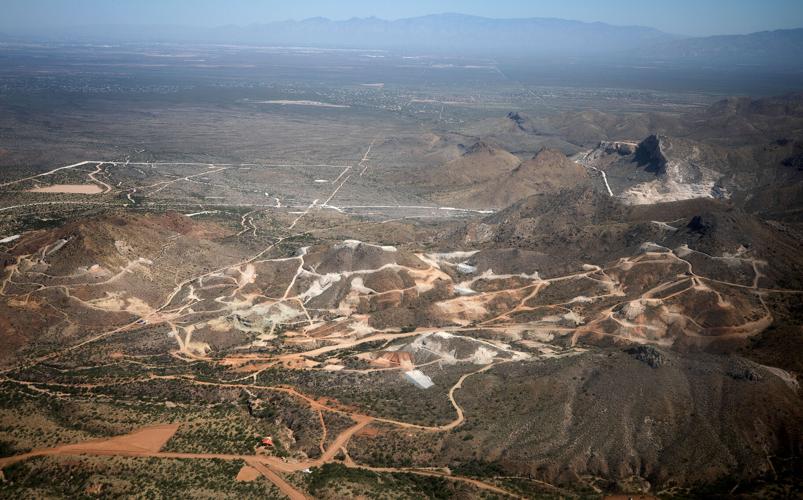
Aerial view of the planned Copper World mine project site in the Santa Rita Mountains south of Tucson, taken in May 2023. The flight was coordinated by Center for Biological Diversity and executed by EcoFlight.
But because the mountainous area where the mine would be built is also prized by environmentalists and naturalists for having very good wildlife habitat, the various proposals have hit numerous roadblocks and delays. Asarco, which first sought access to the site in the 1990s, eventually pulled out before the end of the decade.
Augusta Resource Corp., which bought much of the original Rosemont Mine site in 2005, sold its land and mineral rights in 2014 to Hudbay after continued delays in getting permits were straining its financial resources.
Hudbay has succeeded where the other companies failed in part because it bought thousands of acres of private land for the project and currently isn't relying on any federal land for its first phase of construction and operation.
The private land has far less regulatory oversight and control than the public land where Asarco and Augusta had proposed to put the mine.
High-grade ore touted
Today, Hudbay calls its Copper World mine site "one of the highest-grade open pit copper projects in the Americas."
The site contains about 390 million tons of proven and probable copper reserves, enough to support a 15-year mine life, Hudbay said. Those reserves contain an average copper grade of .47%, the company said.
If measured and indicated mineral resources are added to the reserves, that gives Copper World the potential to last the full 37 years, the company said.
Measured and indicated resources are parts of a mineral resource whose quality, grade, quantity and other factors can be estimated with sufficient confidence to allow for making detailed planning and evaluation of a mine deposit's economic viability, says the Canadian Institute of Mining, Metallurgy and Petroleum.
Proven and probable reserves are considered to be the economically mineable parts of mineral resources, the institute says.
Strong financial projections
The announcement of the new schedule for mine construction and operation by Hudbay comes with projections of not just healthy job growth, but of very strong financial returns for the two companies and their investors.
For instance, Hudbay projects that with a $5-per-pound copper price, for a 15-year mine operation, investors will receive a 17% rate of return. That's significantly higher than the 10% average rate of return for investors in all publicly traded companies, which Hudbay and Mitsubishi are.
At a $6-per-pound copper price, the Copper World project would have a 22% rate of return, Hudbay said.
The rates of return to investors would be slightly higher if the mine production continues for the full 37 years, Hudbay said.
Currently, copper prices are just above $6.50 a pound.
Hudbay also said the amount of debt it will need to take on to build this project is relatively small, less than 30% of the project's expected capital investment tab of $2.07 billion. The mine project has already raised $600 million in investments from Mitsubishi and $230 million from Wheaton Precious Metals.
Hudbay expects to invest about $500 million of its own money into Copper World construction. That's a little less than 25% of the project's initial capital cost. It will not have to make any of its own investment contributions until 2028, Hudbay said.
"Hudbay is well-positioned to fund capital contributions from its existing cash balance and liquidity, as well as projected strong free cash flow from its diversified operations during Copper World’s project development," the company said.
Opposition continues
Opposition to Copper World remains intense today from the same forces that opposed Rosemont — environmentalists led by the organizations Save the Scenic Santa Ritas and the Center for Biological Diversity, as well as by the city of Tucson and Pima County governments, and tribes.
Their concerns also remain the same as they were 15 or 20 years ago: the potential for habitat destruction of the privately owned forest lands, groundwater depletion and air pollution, among others.
Because of the shift in the mine locations from the Santa Ritas' east to west slopes, new concerns have also arisen, particularly regarding the potential impact of mine-based truck traffic passing through some environmentally sensitive areas and past some residential areas.
But opponents have been unable to stop the mine, in large part because its planned construction on private land has meant federal permits aren't needed.
Also, the Arizona Department of Environmental Quality has approved the two key environmental permits for the mine needed from state government. The permits cover air quality and groundwater quality protection.
Opponents still have three lawsuits pending against other state approvals for the mine, but even if they win them, it's highly uncertain at best as to whether any of them could stop the project.
They just this month lost a fourth suit, an attempt to overturn approval of the ADEQ air quality permit, in Superior Court, and say they are weighing whether to appeal it.

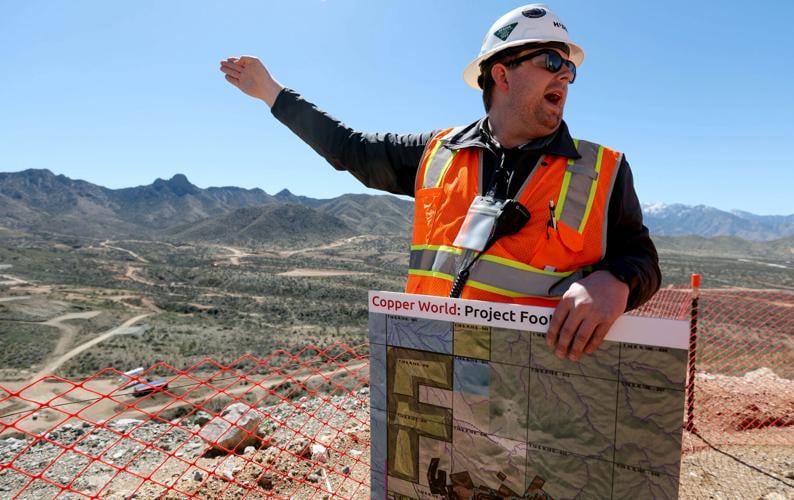
The Copper World site, shown here, is in the Santa Rita Mountains south of Tucson.
John Dougherty, director of Save the Scenic Santa Ritas, said the group members would delay commenting on Hudbay's and Mitsubishi's announced construction timetable for the mine until they have had time to review a new feasibility study on the project, prepared by Hudbay. It was released late last month.
For the same reason, Pima County officials said they are holding off for now on commenting on the decision to build the mine.
Contact Tony Davis at 520-349-0350 or tdavis@tucson.com. Follow Davis on Twitter@tonydavis987.

Tony Davis
Reporter


 Mitsubishi buys 30%, $600M stake in Copper World near Tucson