ABC accused President Donald Trump's administration of employing pressure tactics that forced the television network to make programming compromises such as refraining from booking political candidates on its popular daytime talk show, "The View," for fear of retaliation.
The network and its parent company, Disney, sued the Federal Communications Commission on Tuesday in an effort to block the agency's unusual early review of broadcast licenses for eight Disney-owned TV stations. They argue the administration unlawfully seeks to punish the network over its broadcast content and force changes in its programming.

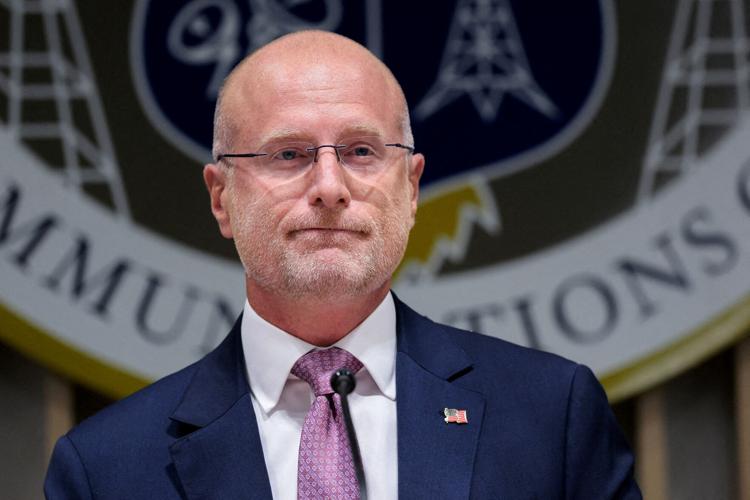
Federal Communications Commission Chairman Brendan Carr listens to a reporter's question during a July 22 news conference in Washington.
In a Reuters interview, FCC Chair Brendan Carr denied the agency infringed on Disney's free speech rights or responded to Trump's dislike of specific content.
Since 2024, Trump repeatedly called for the FCC to revoke the licenses of ABC stations, most recently after the network declined last month to air a prime-time address he gave on election security.
People are also reading…
Disney and ABC said FCC demands during the license review process and Trump's public threats chilled the network's editorial decision-making.
The lawsuit says the FCC "waged a retaliatory campaign" against ABC because the Republican president, among other grievances, disapproves of its news coverage and objects to on-air comments by its late-night host Jimmy Kimmel.
"Our job is to hold broadcasters accountable to the public interest standard," Carr told Reuters, citing how the government long granted stations free use of the airwaves in exchange for providing programming in the public interest. "You made a deal with the American people. You know, live up to your end of the deal."
"The president has obviously every right to express his view on these matters," Carr said, adding decisions will be "based on the facts and the law and the record."
Trump appointed Carr to the FCC in 2017 during his first term as president, and designated him as chair last year.

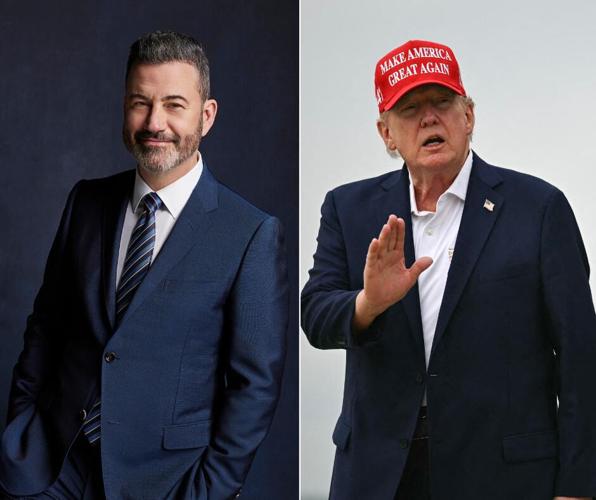
Jimmy Kimmel, left, who is campaigning for an Emmy, is seen in a montage with Donald Trump, who called for Kimmel’s show to be canceled.
'Policy of intimidation'
"The sad fact is that this policy of intimidation has already worked, to a certain extent, by forcing media organizations and others to cower and keep their heads down, rather than act as they normally would in accordance with their First Amendment rights," said journalism professor Gabriel Kahn of the University of Southern California's Annenberg School for Communication and Journalism.
The U.S. Constitution's First Amendment protects against government abridgment of free speech.
"The Administration has attacked ABC's speech — the stories its journalists report and the viewpoints its network programs air," the lawsuit states.
The FCC, created by Congress in 1934, issues licenses to local broadcast television stations, typically requiring renewal after a period of eight years. The licenses for the eight Disney-owned stations — including some of its most profitable ones in cities including New York, Los Angeles, Chicago and Houston — were not due to expire until 2028 to 2031.

The FCC had not conducted early license reviews like the one involving these stations in a half-century. The FCC made 600 requests for information, yielding 13,000 pages of documents, and sought data on political donations made by staff.
The FCC's license review means the network cannot afford to "ignore the consequences of any decision that might anger the Administration or the FCC Chairman," the lawsuit states.
For example, ABC decided not to broadcast Trump's July 16 speech in which he revived his long-running attacks on U.S. election security. Trump for years made false claims of widespread U.S. voting fraud, including in his 2020 election loss to Democrat Joe Biden.
ABC instead opted to carry the speech live on its streaming service — something it said it ordinarily would not have done — as it "considered the risk of resulting Administration retaliation" over its decision not to broadcast it live. NBC also did not broadcast Trump's speech live. Afterward, Trump called for both networks to lose their licenses.

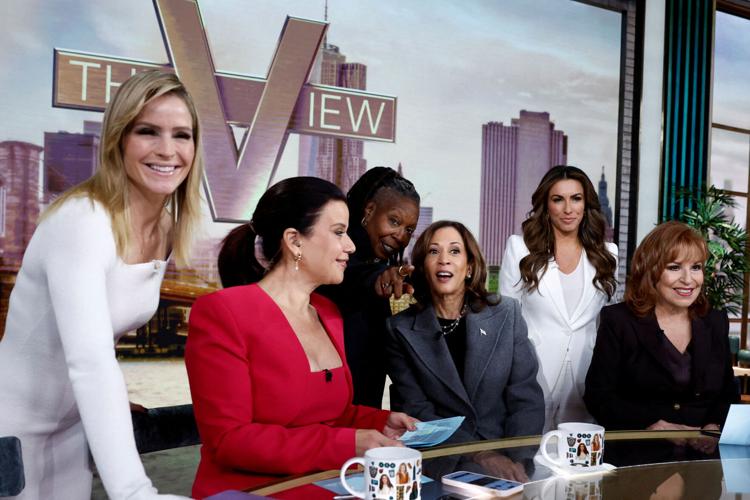
Whoopi Goldberg gestures next to then-Democratic presidential nominee and U.S. Vice President Kamala Harris as they appear Oct. 8, 2024, on ABC's "The View" in New York.
Guests on 'The View'
"The View," a show involving a regular panel of women discussing current events and entertainment along with guest interviewees, has not featured a political candidate since February, when James Talarico, a Democrat running for the U.S. Senate in Texas, appeared, according to the lawsuit.
"Historically, decisions about which candidates or public figures to invite as guests were made based on newsworthiness, audience interest, and scheduling alone," the lawsuit stated.
The lawsuit said that, in light of the FCC scrutiny, "ABC must now evaluate any invitation to a political candidate for its potential consequences."
Trump appeared multiple times as a guest on "The View" and Vice President JD Vance appeared as a guest in June, though he was not a candidate for office at the time.

Talarico's appearance triggered an FCC inquiry into whether it violated federal "equal-time" rules that require broadcasters to provide the same opportunity to all qualified candidates. The FCC during the Biden administration in 2022 exempted "The View" from the rule, deeming it a "bona fide" news program.
The FCC asked the Disney-owned station in Houston to produce all communications between its segment producers, the executive producer, its on-air hosts and the booking staff, about Talarico's appearance. The FCC also asked ABC to disclose the nature of political donations made by its co-hosts and individual employees, including an itemized list going back four years.
As a result, the network became "more circumspect" about booking political candidates as guests on "The View" or even broadcasting video clips that could constitute appearances, the lawsuit stated.
Kahn said the lawsuit illustrates how federal agencies under the Trump administration were "weaponized to go after perceived enemies."
"The only course that companies like Disney have is to engage in lengthy and costly litigation in the courts. These are not good-faith actors," Kahn said.