

HAMBURG Germany — Eva Decker can tell you everything you can imagine when it comes to Hamburg's storied red-light district — even though she is not a native.
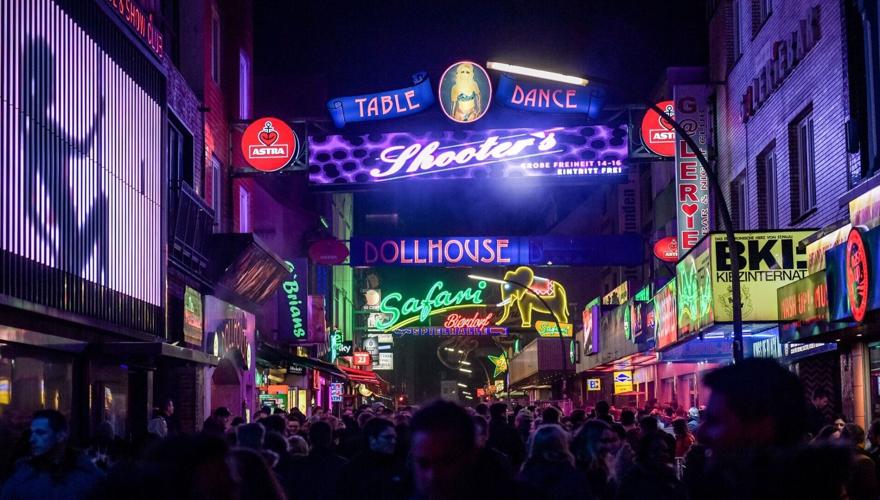
Decker has made it her life's work to introduce people to the port city's iconic street, known worldwide for its clubs, pubs and prostitution, earning it the nickname the "sinful mile."
It is called the Reeperbahn due to the shipping industry that dominated life in the port city. "Reep" means rope in Low German, referring to rope or a heavy ship's cable, while "Bahn" means track in German.
This street, celebrated for its theaters, bars and nightclubs, was once an open-air track where rope-makers made rigging for sailing ships - an activity that required straight, continuous tracks.
This year is a special anniversary for the legendary street which turns 400.
People are also reading…
Few people know more about the Reeperbahn than Decker. Originally from Vienna, she made the history of St Pauli, the legendary area of Hamburg that is home to the Reeperbahn, the widely loved left-wing football club FC St. Pauli and wider locality.
Historian Decker used to be the academic director of the St Pauli Museum. When it closed, she created a street tour, placing selected exhibits back in their original locations and telling their stories.
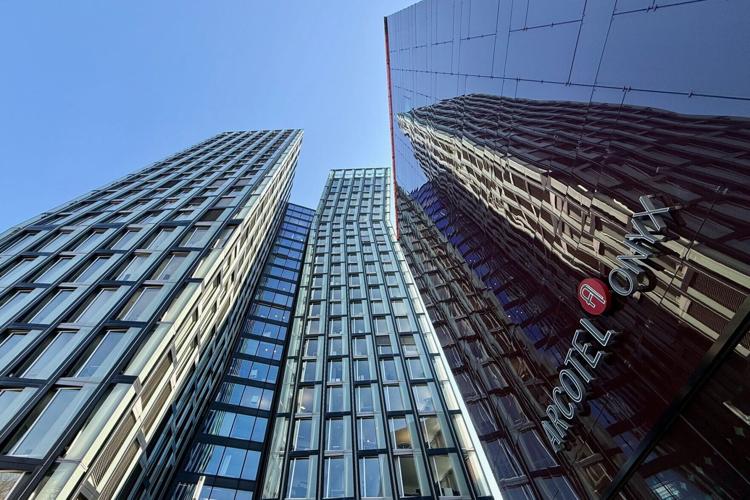
Her tour begins at the "Dancing Towers," two striking high-rises at the eastern entrance to the iconic street.
It is around 930 meters from here to the Nobistor, the other end of the Reeperbahn. People started making ship’s ropes here in 1626, says Decker, noting they were working to make the sturdy rigging for vessels set to sail around the world.
Decker shows early references to their work in a historic map drawn in 1786, when the street was still a dusty country road.
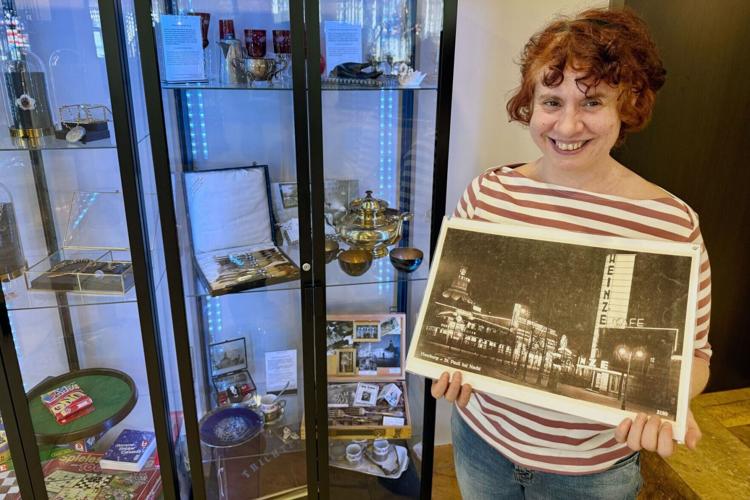
We then see an 1826 lithograph showing the "educated middle classes strolling along the street" with the Trichter in the background, Decker says. Once a simple pavilion, it later became a popular concert hall.
The Trichter marks the start of the area's culture of entertainment.
We head to the Arcotel Onyx Hotel, beside the Dancing Towers, and peer at a glass cabinet of fine cutlery once used by diners at the Trichter then look at programmes and pictures from the 1940s. They show the variety show programme that continued even through the Nazi era.
Part of gas station in underground car park
We head to the site of a bunker which, as the Nazis had planned, was to be used as an underground car park after the war. Decker guides us through the underground car park to a sign, all that is left of the legendary Esso petrol station, known by all locals as you could fill up at any hour.
Nearby, wooden huts once stood, set up by fairground operators in the 18th century. Now, we see venues more than a century old, such as the Panoptikum or St. Pauli Theatre.
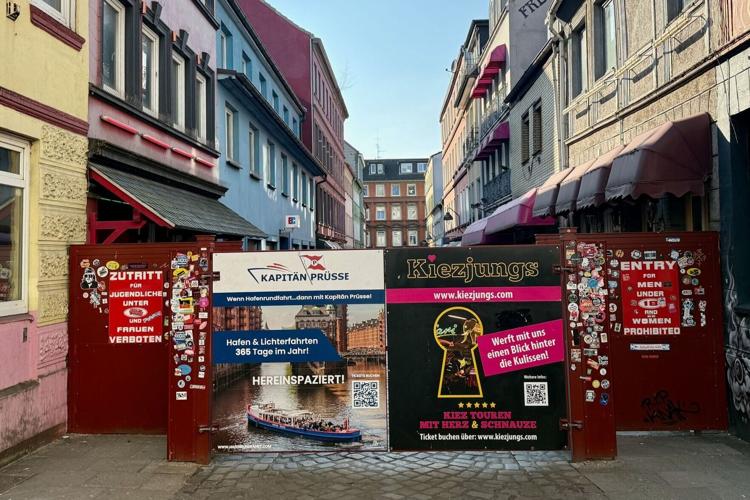
Opposite we see the area where brothels opened and expanded in line with the growth of the port that brought sailors to the city from all over the world.
By 1900, the city restricted brothels to just a few streets. We see one where screens were erected in 1933 by the Nazis, who wanted to curb and control the trade. These screens have been listed as historic monuments since 2024.
We then stop at a shop showing a pair of bright red Moonboots, once worn by a prostitute to keep her feet warm.
And yet, the street's image as "the world’s most sinful mile" no longer quite fits. These days, people come for the music and entertainment rather than red-light action.
That complex mix continues to draw fans from near and far, couples and punks, stag and hen parties - and those seeking a sense of the local community alive alongside the loud music and flashing lights.
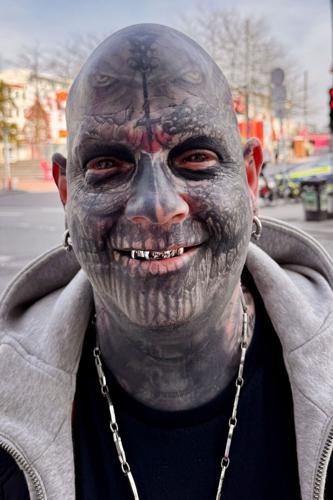
Locals all know each other, such as Marco Apfler, the tattoo artist inked from head to toe. He greets Decker and the group as he passes, showing off his skills on his skin.
Haircut like the Beatles
Many come here because of the Beatles who came to Hamburg in 1960, still completely unknown. They played rock ’n’ roll, clad in suits, with old-fashioned haircuts.
Astrid Kirchherr, a Hamburg-based photographer, not only took the first professional photos of the band, but is also said to have cut their hair herself.
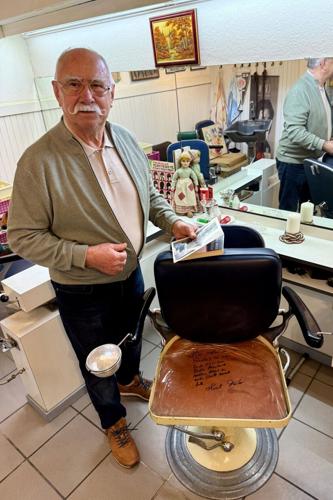
Their famous mop-top hairstyles were then perfected at Salon Harry, Hamburg’s oldest barber’s.
Even today, bands performing on the Reeperbahn come here to have their hair styled beforehand, says Franz Stenzel, one of the salon’s owners.
He never actually met the Beatles himself, he says. His most prominent customer was Uwe Seeler, Hamburg’s most famous footballer.
Beatles fans still visit regularly and kneel down in front of the old barber chairs.
Others head to the Zwick, half pub, half museum and home to the world’s largest collection of bass guitars. Among them, safely tucked away behind glass and autographed, is one belonging to Paul McCartney.
Towards the end of the tour, Decker heads for the Erotic Art Museum. We leaf through early nudist magazines and read letters written in to Domenica Niehoff, Germany’s most famous prostitute in the 1980s.
Ekkehart Opitz founded this small private museum. Standing next to a life-size advertising billboard featuring a pin-up girl, he says in the days of the Kaiser, displaying obscene writings and images was a criminal offence. His museum is packed with them.


