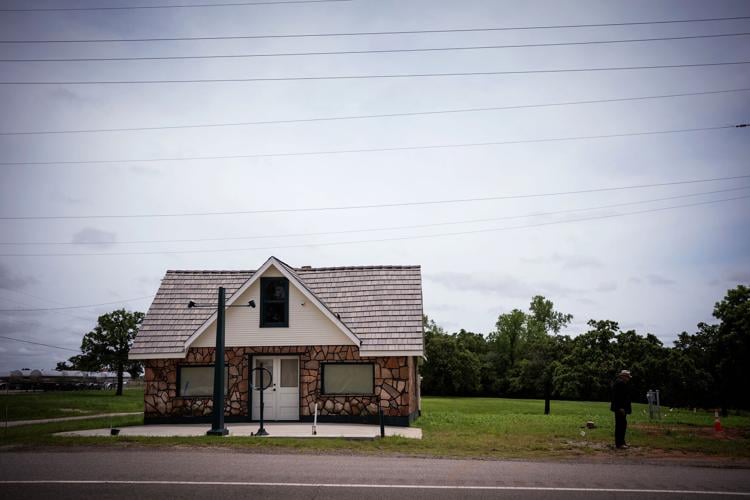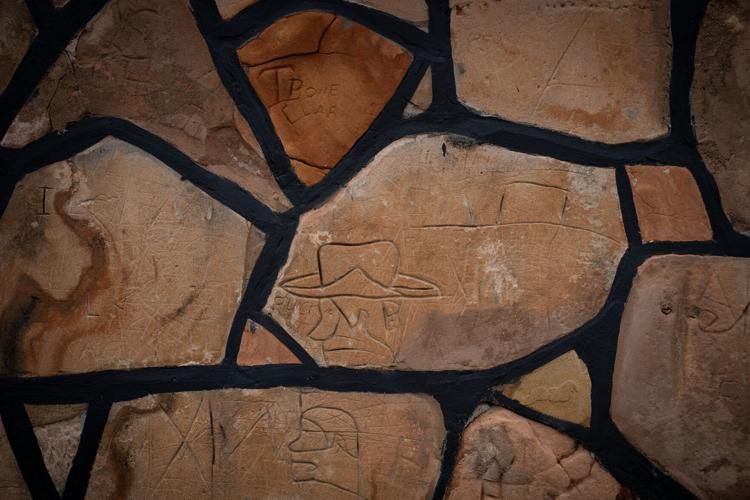
LUTHER, Oklahoma — It is, at first glance, an unassuming building that stands along Route 66 in this central Oklahoma town, a bungalow with a gabled roof and sandstone walls etched with the names of the many visitors who stopped here over the past century.
Look through the Rev. Allen Threatt III’s eyes, though, and something else comes into focus.
We first meet the 86-year-old family patriarch at his church, 10 miles west in Acadia. It’s Father’s Day, and the Sunday service includes gift bags filled with cookies for the fathers. The pastor stands tall at the pulpit and reads from the Gospel of Matthew.

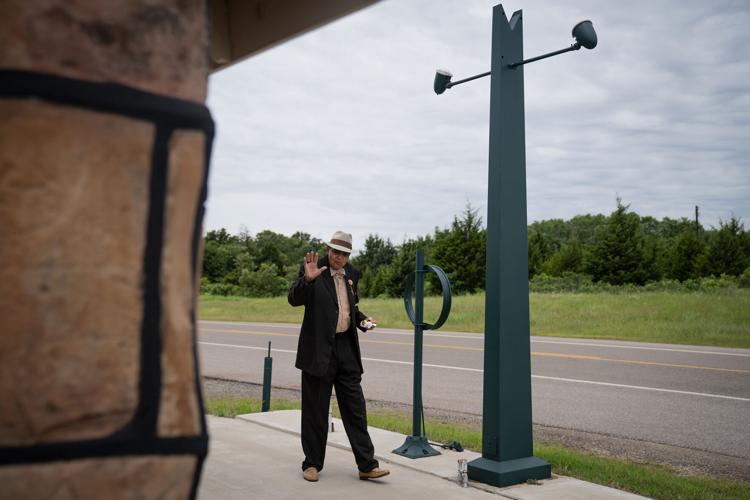
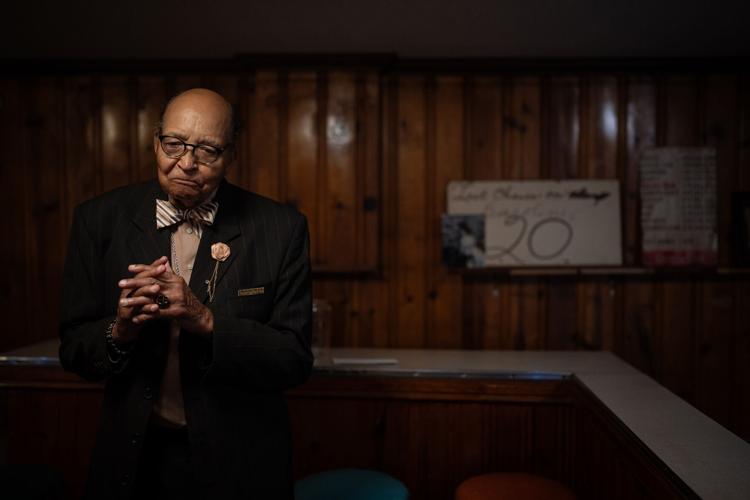
The Rev. Allen Threatt III stands June 15 at the Threatt Filling Station on Route 66 near Luther, Okla.
Later, at his grandfather’s service station in Luther, he describes what others cannot see.
He can see rows of cars parked along the famed highway and people streaming toward his grandfather’s service station to buy a hot dog and a beer before walking across the street to catch a Negro Baseball League game.
People are also reading…
He can see his grandfather standing just outside the front door, neatly dressed in overalls, chomping a cigar and greeting everyone who pulls off Route 66 for gas or food or to spend the night, because they heard they could take refuge at the Threatt Filling Station.
“This right here is part of history — Black history,” Threatt says, sitting on a bar stool inside the station. “This was their rescue place where they could stop and relax … here you could stay all night if you wanted to.”
Route 66 is called America’s Main Street, a moniker that fuels nostalgics who like to talk about simpler times and good days gone by. Of course, that wasn’t always true for everyone.

The Threatt Filling Station was built in 1915 and run by the Threatt family as a safe haven for Black travelers on Route 66, near Luther, Okla.
Forty-four of the 89 counties that touched the route were thought to comprise sundown towns — that is, places where Black people were explicitly or implicitly told to leave before sunset, said Candacy Taylor, an author and photographer who wrote about the highway in her book “Overground Railroad: The Green Book and the Roots of Black Travel in America.”
For Black travelers along Route 66, that put a vital importance on knowing where to find places listed in the Green Book, or places — like the Threatt Filling Station — between long, perilous stretches of their journeys.
“The consequences were deadly if you didn’t have a good plan,” Taylor said.

Allen Threatt Sr. came from Alabama to Oklahoma around the turn of the 20th century. He sharecropped for a white farmer who eventually turned the land over to Threatt, about 150 acres in total.
Threatt built a service station on the property about 1915. After a fire destroyed it, he rebuilt it in 1933, using sandstone quarried from his farm. He eventually expanded its offerings into something that resembles the convenience stores and dive bars of today.

Carvings are seen June 15 in the stones on the exterior of the Threatt Filling Station.
Along the west wall, shelves and cabinets that now hold T-shirts and other souvenirs once held canned goods, bread and produce for sale. A narrow bar separated the shelves from a pool table at the center of the pine floor, opposite two booths.
Outside, there used to be a pit, maybe 10 feet deep, filled with rattlesnakes. People would toss coins in the pit, like a fountain at a shopping mall. Neither the Rev. Threatt nor his cousin Edward Threatt could remember how the coins were collected.
In the field behind the station, the Threatts set up tables with benches under lights strung between trees. A wooden platform served as the dance floor. A jukebox supplied the music. The crowds that came danced the jitterbug with such excitement on Saturday night that by Sunday morning, the Rev. Threatt remembered, he and a cousin would find the platform littered with quarters and nickels that fell out of the dancers’ pockets.
Family stories tell of the filling station being visited by Joe Louis and Pearl Bailey, of bank robber George “Baby Face” Nelson hiding in a barn on the property — he’s rumored to have told Threatt Sr.: When I leave here, don’t pay any attention to the direction I go.

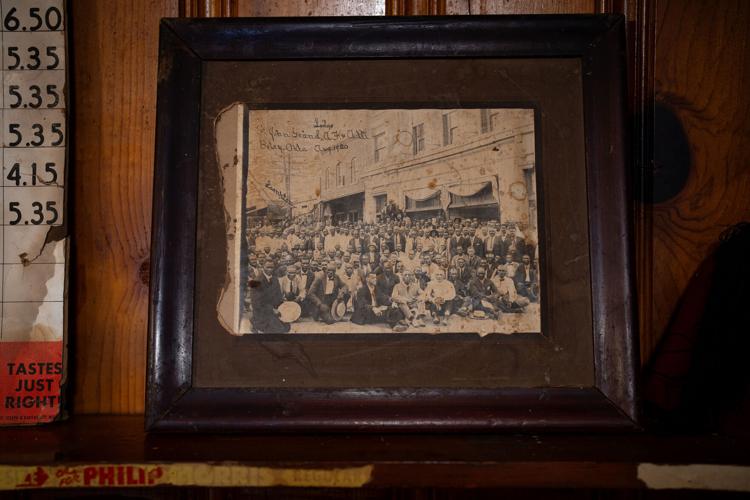
A 1920 photograph of Boley, Okla., a prominent historic all-Black town, is displayed in the Threatt Filling Station.
Threatt Sr. died in December 1950. His son, Ulysses Grant Threatt, took over the filling station until his death six years later. Ulysses Threatt’s wife, Elizabeth Hilton Threatt, kept it running until she closed it in the mid-1970s. A schoolteacher, Elizabeth Threatt was one of five students to integrate the University of Central Oklahoma. The library in Luther is named in her honor. She died in 2009 at age 98.
The station was added to the National Register of Historic Places in 1995. Twenty years later, Edward Threatt, whose father once ran a bar and restaurant next to the station, led his family’s efforts to restore the building, aided by grants from the National Trust for Historic Preservation and other organizations.
“It’s been a labor to get all of this put back together again,” he says. “A lot of time (and) a lot of money just to get to where we are.”

The Rev. Allen Threatt III is seen June 15 in the Threatt Filling Station on Route 66 near Luther, Okla.
Much of the interior is original: The pine floors and walls, the bar stools and the counter. The cash register, also original, was returned after it was loaned to the Smithsonian Institution.
The plan is to turn the station into an interpretive center, where people can learn about the family’s story and the stories of Black travelers during Jim Crow. Edward Threatt wants to reopen his father’s restaurant and bar and call it Brown Bomber Bar and Grill. He can see an RV park on the property, perhaps near the pond farther west of the station, which they could stock with fish.
“We don’t want you to come here, buy a shirt, take pictures and leave,” he says. “We want this to be a destination.”
Two months later, the station once again drew a crowd, as the Threatt family celebrated the installation of a 14-feet-tall monument to the building’s significance on Route 66.
Main Street of America: Route 66 attractions state by state
Main Street of America: Route 66 attractions state by state

For anyone who thrives on nostalgia, driving the 2,448 miles of Route 66 is a must. The iconic highway has inspired road trips, songs, and animated movie characters since construction on the “Main Street of America” was approved in 1926, back when gas cost less than a quarter a gallon. In “The Grapes of Wrath,” John Steinbeck dubbed Route 66 the "Mother Road;" a place where migrants came together as a community. Nat King Cole recorded “(Get Your Kicks On) Route 66” in 1946—and more than a half-century later, Tow Mater from the 2006 animated film “Cars” was inspired by a rusty tow truck in Galena, Kansas.
After the Great Depression, families looking for a better life could make their way west, driving their way across eight states starting in Chicago and ending in Los Angeles. Mom-and-pop shops, service stations, and motels popped up along the route. Travelers can still visit the Old Riverton Store in Riverton, Kansas, grab a root beer at Delgadillo's Snow Cap Drive-In in Seligman, Arizona, or spend the night at the Blue Swallow Motel in Tucumcari, New Mexico.
U.S. Highway 66 was realigned several times until 1985 when it was decommissioned and replaced with interstates. Modern roadways may have made sections of Route 66 irrelevant, but about 80% of the winding road still exists. Many of the historic sites along the route have been restored; and Congress voted in 2018 to designate the roadway a National Historic Trail.
Stacker compiled a list of 50 attractions—state by state—to see along the drive, drawing on information from historic sites, news stories, Roadside America, and the National Park Service. Keep reading to discover where travelers can get their kicks on Route 66.
You might also like: Most likely destination for travelers from every state
Grant Park (Chicago)

Many choose to begin a Route 66 journey at Buckingham Fountain in Grant Park—Chicago's oldest—before heading west. To find the original “Historic 66 Begin” sign, travelers can head to the southern side of Adams Street and look west toward Wabash Avenue. The “End Historic Route 66” sign can be found at the intersection of Jackson and Michigan avenues.
Mural City (Pontiac, Illinois)

There are 23 murals in Pontiac, including the Route 66 shield on the back of the Illinois Route 66 Hall of Fame and Museum. Roadtrippers can grab a mural guide at the museum or follow the red painted footprints for a walking tour.
Lauterbach Giant (Springfield, Illinois)

The Lauterbach Giant is a giant fiberglass statue towering over the parking lot of Lauterbach Auto Service in Springfield. The “muffler man” has been around since 1978. He used to hold a tire but now clutches an American flag. In 2006, his head had to be replaced when a tornado took it off.
Chain of Rocks Bridge (Madison, Illinois)

The Chain of Rocks Bridge, constructed in 1929, sits 60 feet above the Mississippi River and links Madison with St. Louis. The mile-long historic structure is popular with motorists and cyclists. The bridge got its name from a 17-mile series of rocky rapids called the Chain of Rocks that made the river difficult to navigate, which is why the Corps of Engineers built a dam to cover them in the 1960s. The bridge cost $2.5 million to erect, which was twice the original estimate at the time.
World's Largest Catsup Bottle (Collinsville, Illinois)

Drivers can find the World's Largest Catsup Bottle a little south of downtown Collinsville. The 170-foot-tall historic water tower was completed in 1949 for the Brooks Foods plant, which is no longer open. If it didn't have water in it, it could hold 640,000 bottles worth of catsup (or ketchup, as the tomato-based condiment is commonly called today).
Henry's Rabbit Ranch (Staunton, Illinois)

Drivers will have to get out of their car to fully enjoy the fuzzy friends at Henry's Rabbit Ranch, though appointments are necessary to get a complete tour. Visitors can also get a glimpse of VW Rabbits and pick up some Route 66 gifts and memorabilia.
Old Log Cabin (Pontiac, Illinois)

Drivers can get their day started at the Old Log Cabin restaurant in Pontiac with some freshly made eggs and hashbrowns. This quaint spot originally opened in 1926 as a roadside lunchroom and gas station. The owners now serve customers from 5 a.m. to 8 p.m. every day but Sunday. Locals love the cheeseburgers, homemade coconut cream, and rhubarb pie.
(Former) World's Largest Rocking Chair (Cuba, Missouri)

The World's Largest Rocking Chair (its actual name) may have only been created to break the Guinness World Record for the largest rocking chair. Nevertheless, the Fanning Outpost decided it made a great roadside attraction. The 42-foot-tall steel rocker had to be able to move back and forth to break the world record in 2008, but it has since been secured in place. The rocker was the largest in the world until 2015, when a 56.5-foot-tall chair was built in Casey, Illinois.
66 Drive-In Theatre (Carthage, Missouri)

Most of the drive-in theaters in the U.S. have vanished since their heyday of the 1950s. The 66 Drive-In Theatre is one of only around 325 drive-ins remaining in the U.S. The theater is open from early April through mid-September each year.
Route 66 State Park (Eureka, Missouri)

The Route 66 State Park visitor center is located at the former Bridgehead Inn, built in 1935, and offers plenty on the iconic highway's history. The park also offers nature trails and picnic sites where road-weary travelers can stretch their legs or have a bite.
Meramec Caverns (Stanton, Missouri)

Motorists passing through Stanton can stop in for a guided tour of the Meramec Caverns, a multi-level, natural underground wonder that has been a tourist attraction since 1933. Some say the cave was a hideout for Jesse James and his crew. To get the full experience, visitors should be prepared to walk a well-lit 1.25 miles for about 1 hour, 20 minutes.
Wagon Wheel Motel (Cuba, Missouri)

The Wagon Wheel Motel has been around since 1935, making it the oldest continuously running motel on Route 66. The historic inn still beckons weary drivers with original flashing neon lights from the ‘40s. The original wood doors, windows, and floors from the 1930s have been updated.
Devil's Elbow, Missouri

Devil's Elbow is situated in the Ozark Mountains and the Mark Twain National Forest, making it one of the more scenic stretches of Old Route 66. Be sure to check out the classic diners, bars, and grills in the area for a big taste of nostalgic Americana.
Cars on the Route (Galena, Kansas)

Only about 13 miles of Route 66 wind through Kansas, but Cars on the Route—the old Kan-O-Tex service station—is worth a stop. The station now has a “Cars” theme and is home to the mining boom truck that inspired the character Tow Mater in the animated film. It was first restored by Betty Courtney, Melba Rigg, Renee Charles, and Judy Courtney, which is why the gas station was dubbed “Four Women on the Route” for several years.
Galena Mining & Historical Museum (Galena, Kansas)

The Galena Mining & Historical Museum—which sits inside the old Missouri-Kansas-Texas train depot—educates passersby on the history of this mining town. Visitors can also learn about how Pixar animators based the fictional town of Radiator Springs—from the movie “Cars”—on this small Kansas town.
Brush Creek Bridge (Cherokee County, Kansas)

The historic Brush Creek Bridge, also known as Rainbow Bridge, was constructed in 1923. Iowa bridge designer James Barney Marsh created the Rainbow Arch design and patented the construction elements in 1912. Route 66 motorists used the 130-foot bridge to cross Route 66 until the interstate was built in the 1960s.
Williams' Store (Riverton, Kansas)

In 1925, Leo Williams built a small community store and deli that he ran with his wife until the Eisler family purchased the business about 50 years later. Today, Williams' Store offers groceries, sandwiches, and Route 66 souvenirs.
Baxter Springs Independent Oil and Gas Service Station (Baxter, Kansas)

Baxter Springs is one of only three towns Route 66 drivers pass through while in Kansas. The town's Independent Oil and Gas Service Station is one of the locations worth a drive-by. What's interesting about the gas station is that it looks more like someone's home than a place to fill up. After the Great Depression, some oil companies redesigned their buildings to have more of a domestic feel that might make their customers feel more comfortable.
Milk Bottle Grocery (Oklahoma City, Oklahoma)

The historic Milk Bottle Grocery was built in 1930 and is hard to miss: The 350-square-foot building has a giant milk bottle perched on top of it. Since its creation, many dairy companies have paid to advertise their names across the side of the sculpture. The landmark is a popular spot for Route 66 motorists to snap photos and has been home to a variety of businesses including a cleaners, realty office, Vietnamese sandwich shop, and landscape architect.
Blue Whale (Catoosa, Oklahoma)

The Blue Whale is exactly what it sounds like. Zoologist Hugh S. Davis originally built the sea mammal replica as a place where his grandchildren could play and swim. The whale took two years to create and was completed in 1972. Davis's daughter still owns the whale, but swimming is no longer allowed. There are some picnic tables nearby for motorists to take a driving break for lunch.
Lucille's Service Station and Roadhouse (Hydro, Oklahoma)

Built in 1929, Lucille's Service Station is no longer offering gas, but the building has been restored to its original condition. The vintage pumps are still on site and a historical marker tells visitors about how the station began. Included in that history is a bit about the station's namesake, Lucille Hamons, who ran the business for more than 50 years.
Allen's Conoco Fillin' Station (Commerce, Oklahoma)

Built around 1930, this service station—also known as Hole in the Wall Conoco Station—offered a place for Route 66 travelers to fill up. It did start out selling Conoco gas but switched to Phillips 66 in 1938. Word on the street is that Bonnie and Clyde may have even fueled up here. Allen's Conoco Fillin' Station may have originally been a gas station, but the tiny green and red structure—built out from the side of a building—is now a souvenir shop.
Totem Pole Park (Foyil, OK)

Artist Ed Galloway created his Totem Pole Park—located about 3.5 miles off Route 66—as a place to show off folk art made of stone and concrete. Many of the pieces depict birds and Native American images. The largest totem pole in the park is 60 feet tall. The original construction lasted from 1937 to 1961 and was restored from 1988 to 1998.
Cadillac Ranch (Amarillo, Tesas)

In 1974, a group of San Francisco artists decided to bury 10 Cadillacs made between 1949 and 1964 nose-first into a Texas field. Millionaire Stanley Marsh 3, who died in 2014, funded the art installation. Graffiti is encouraged, so road trippers can stop by and leave their own mark on the cars before heading further west. The site is off Exit 66 of Interstate 40.
VW Slug Bug Ranch (Conway, Texas)

If Cadillac Ranch is too crowded, motorists can drive a few miles from Amarillo to the lesser known VW Slug Bug Ranch in Conway, Texas. The scene is similar to Cadillac Ranch, except the cars are Volkswagen beetles instead. To find the art installation, motorists can plug "Conway Inn & Restaurant" into GPS.
Midpoint Cafe (Adrian, Texas)

Adrian, Texas, marks the official midpoint of Route 66. There's even a white line on the road and a sign noting the distance between Chicago and Los Angeles—both are 1,139 miles away. Hungry motorists can stop in for a burger at Midpoint Cafe, which served as inspiration for Flo's V8 Cafe in the animated movie "Cars."
Tower Station and U-Drop Inn Cafe (Shamrock, Texas)

Constructed in 1936, the Tower Station and U-Drop Inn Cafe on historic Route 66 includes a retail store, the Tower Conoco Station, and the U-Drop Inn Cafe. The latter got its name from a local boy who won a naming contest. The structure is now a visitor center, chamber of commerce office, and community center.
Leaning Tower of Texas (Groom, Texas)

Truck-stop owner Ralph Britten created the Leaning Tower of Texas to drum up business. The structure slants at an 80-degree angle with the ground and was quite the sight for unaware tourists who thought it was falling. Motorists regularly popped into the nearby truck stop to alert Britten, who would calm their fears and invite them in for a quick bite. While the tower is still in position, Britten's truck stop has since burned down.
Big Texan Steak Ranch (Amarillo, Tesas)

Travelers should bring their appetites when they visit the Big Texan Steak Ranch in Amarillo, Texas. The restaurant, which opened in 1960, is home to the 72-ounce steak. Diners can eat for free if they finish their 4.5-pound steak—and the sides—in one hour. Tired motorists can sleep off their meals at the nearby Big Texan Motel.
Blue Swallow Motel (Tucumcari, New Mexico)

The historic Blue Swallow Motel was built in 1939 and is still around today, making it the oldest motel still operating on New Mexico's part of Route 66. The neon lights beckon guests off the road, where they can stay in vintage-style rooms that are fully restored. Some even have detached garages.
Tee Pee Curios (Tucumcari, New Mexico)

After spending a night in the Blue Swallow, travelers can stop by Tee Pee Curios, a 1940s-era gas station-turned-gift shop. The store offers jewelry, pottery, and any number of Route 66 souvenirs. Guests enter the shop through a concrete wigwam built around the front door. A Route 66 shield is painted on the side of the building.
Clines Corners Retail Center (Clines Corners, New Mexico)

This New Mexico travel center has been serving Route 66 travelers since it first opened in 1934. Drivers can park their RVs overnight, or stop in the cafe for breakfast, a burger, or a burrito.
66 Diner (Albuquerque, New Mexico)

To get the full ‘50s dining experience, avid tourists flock to the 66 Diner in Albuquerque. The spot used to be a gas station but was converted into a diner in 1987. Guests can view one of the largest PEZ collections in America while sipping on a milkshake or malt.
El Rancho Hotel (Gallup, New Mexico)

The historic El Rancho Hotel, built in 1936, bills itself as a favorite of movie stars who filmed Westerns in the area in the '30s and ‘40s. John Wayne, Katherine Hepburn, and Humphrey Bogart all stayed there. Route 66 travelers can book a room named after one of the stars.
Blue Hole (Santa Rosa, New Mexico)

This natural sinkhole with sapphire-colored water was a fish hatchery in the 1930s. The Blue Hole became a recreation area in the 1970s and is now a popular spot for swimmers and scuba divers. The water is 81 feet deep and about 60 degrees, fed by a network of artesian springs connected to the Pecos River.
Hackberry General Store (Hackberry, Arizona)

The Hackberry General Store has been around for about 80 years, but it's easy to miss. Visitors should keep an eye out for two vintage gas pumps (which don't work anymore) out front. The owners have adopted some interesting decor: the walls and ceiling are covered with old license plates, patches, and money donated from around the world. Travelers should check out the re-creation of an old ‘50s diner before picking up some Route 66 souvenirs.
Winslow Corner (Winslow, Arizona)

Travelers who want to take it easy should make sure to stop by the corner where Old Highway 66 meets North Kinsley Avenue in Winslow, Arizona. The 1972 Eagles song “Take it Easy” inspired an installation called “Standin' On the Corner” Park,” a statue of a man with a guitar standing on the corner near a red flatbed truck. The town of Winslow didn't create the park until three decades after the song was written, partially because Interstate 40 bypassed the town and cut down on tourist traffic.
Angel and Vilma's Original Route 66 Gift Shop (Seligman, Arizona)

Angel Delgadillo, now in his 90s, turned his barbershop into a Route 66 gift shop in 1987 after he helped establish the Historic Route 66 Association of Arizona. Delgadillo—known as the “Guardian of Route 66”—still cuts hair on occasion, though he's been semi-retired since the '70s.
Delgadillo's Snow Cap Drive-In (Seligman, Arizona)

Motorists can stop in for a root beer float or a burger at Delgadillo's Snow Cap Drive-In. Visitors should take a close look at the walls and ceiling, which are covered with patches, money, and other paraphernalia donated from visitors around the world. Juan Delgadillo opened the shop in 1953, and his son still runs the business.
The town of Oatman (Oatman, Arizona)

Visitors to Oatman, a former mining town, can get a glimpse of bighorn sheep or mingle with burros (small donkeys) that roam the city streets. Clark Gable and Carole Lombard got married in nearby Kingman and may have honeymooned in the Oatman Hotel, which remains open as a museum and restaurant.
Wigwam Village Motel #6 (Holbrook, Arizona)

Tired motorists can sleep off a long day on the road at the historic Wigwam Village Motel #6 (there are five previous versions across the U.S.). Chester E. Lewis, charmed by wigwam villages he'd seen in Kentucky, opened the motel in 1950. There are classic cars on display out front, but the rooms have been renovated to include more modern amenities like air conditioning and cable TV. The Lewis family still owns and operates the business today.
Grand Canyon National Park

Access to Grand Canyon National Park isn't right off Route 66, but seeing one of the Seven Wonders of the Natural World is worth a detour. From Williams, Arizona, drive 60 miles north to get to the South Rim.
Meteor Crater (Meteor City, Arizona)

Sometime between 5,000 and 50,000 years ago, a meteor crashed into northern Arizona and formed a massive crater that's been turned into a popular tourist attraction. The site is only minutes from Interstate 40 and the old Route 66. If it's too hot, visitors can pop into the Meteor Crater Visitor Center on the crater's rim to view the crater from a comfortably air-conditioned room.
Elmer Long's Bottle Tree Ranch (Oro Grande, California)

A popular spot for an Instagram photoshoot, Elmer Long created his now-famous Bottle Tree Ranch out of bottles he collected as a kid. Years after he retired, he started hanging the empty glass bottles onto metal pipes that scatter rainbows of light when the sun shines through them. Visitors can try to spot the column topped by a rake—it's Long's favorite.
Emma Jean's Holland Burger Cafe (Victorville, California)

Opened in 1947, Emma Jean's Holland Burger Cafe has been serving Route 66 visitors for more than 70 years. It also made a cameo in “Kill Bill Vol. 2.” Hungry motorists can get eggs and pancakes for breakfast or chow down on a burger—and ice cream sundaes—for lunch.
Rt. 66 Museum (Victorville, California)

Motorists can stop by the California Route 66 Museum to learn some history and take some photos in the ‘50s diner or VW Love Bus. There's a Model T on the grounds and an old outhouse. Visitors can make a pit-stop in the library and gift shop to get some Route 66 memorabilia before heading back to the road.
Original McDonald's (San Bernardino, California)

The first McDonald's opened in 1948 close to Route 66 (the exact location is 1398 N. East St. at West 14th Street in San Bernadino). In 1954, businessman Ray Kroc met the McDonald brothers in California while selling the brothers milkshake mixing machines. The rest is franchising history.
Cucamonaco Service Station (Rancho Cucamonga, California)

The canary yellow Cucamonga Service Station was built in 1915 and remained a gas station until the ‘60s. It fell into disrepair in the ‘70s but has since been restored and turned into a museum.
Roy's Motel & Cafe (Amboy, California)

Roy's opened in 1938 and is located in Amboy, which some call a ghost town. The sign is a particularly popular photo spot for Route 66 road-trippers. While some hope the cafe is fully restored in the future, visitors can still pop in and thumb through old newspapers or buy a souvenir and some snacks.
Santa Monica Pier (Santa Monica, California)

In 1926, the original end to the route was at Seventh and Broadway in downtown Los Angeles. That spot wasn't a very scenic end for drivers after a long trip. So in 2009, the Route 66 Alliance and the Santa Monica Pier Restoration Corporation decided to erect an “End of the Trail” sign on the pier. To get there, motorists drive toward the pier and then walk out about 200 feet. The end sign is just past the Bubba Gump shrimp franchise and just before the Playland arcade.