PHOENIX — Calling it an illegal intrusion on their authority, Republican legislative leaders are moving to block or delay a court order requiring them to fix the system of funding public schools.
A judge previously ruled that system unconstitutionally leaves some students in buildings needing major repairs and without the equipment necessary to learn.
Attorneys for Senate President Warren Petersen and House Speaker Steve Montenegro are telling the state Court of Appeals that the directive by Maricopa County Superior Court Judge Dewain Fox is flawed.
They argue that the judge exceeded his authority because it is solely up to the Legislature to determine education policy. They're saying lawmakers — not the courts — set the standards that students must meet and then decide what minimum facilities are needed and, by extension, how much to spend.
People are also reading…
But attorneys representing school districts and education groups said nothing in the court order interferes with legislative prerogative.
They pointed out it was the Legislature itself that directed what was originally known as the School Facilities Board to craft the standards. That came after a 1994 Arizona Supreme Court ruling that voided the school finance system in place at the time.

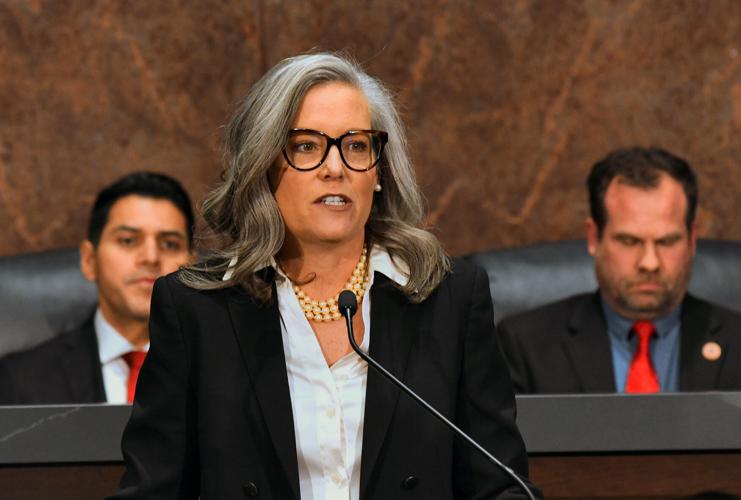
House Speaker Steve Montenegro, left, and Senate President Warren Petersen look on as Gov. Katie Hobbs speaks in 2025. Montenegro and Petersen are going to court seeking to block or delay a judge's order to fix the state's school funding system.
In turn, that led to the creation of "minimum adequacy guidelines.''
But it was shown at trial, lawyers for the schools said, that lawmakers have not provided the money for all school districts to meet the standards that they ordered created. They said that violates the constitutional requirement for the Legislature to maintain and fund a "general and uniform public school system.''
Judge set deadline
Fox, in his 114-page decision released in August, said many schools lack the resources to ensure students have what they need to learn, including equipment and well-kept buildings.
He cited a laundry list of unmet needs, including, in some cases, buildings that are unsafe because of cracks and other deficiencies.
Also missing, the judge said, was the money to fund a requirement in the state standards for certain academic equipment, such as computers for students. Fox said the state has also failed to provide the money for other legally required improvements, including keeping students safe from shooters invading schools.
The judge did not direct how to fix all that, however.
Instead, he gave lawmakers and the governor until early November to come up with — and fund — a system that ensures schools have what they need to meet those "minimum adequacy guidelines."
Part of that is because Fox conceded he doesn't have the authority to order a specific resolution, or to direct lawmakers to allocate a specific amount of money for a problem that both sides agree could cost billions to correct.
If the November deadline is not met, the judge could bar the state from maintaining an education funding system that does not meet the requirements for adequate facilities and other capital needs. And that means if the state does not come up with a constitutionally acceptable plan, Fox could simply block the state treasurer from distributing any funds at all to any schools — something that would effectively shut down the K-12 system.
Legislative leaders: 'Money is finite'
It is that deadline that the GOP legislative leaders want the Court of Appeals to delay, giving them time to argue that Fox's order to fix the problems should be voided.
All that starts with the costs. "Compliance with its edicts could require outlays totaling possibly in the billions,'' they said in their appellate court filings. "These funds do not materialize out of ether. They must either be extracted from the wallets of Arizona citizens and businesses or transferred away from other agencies and departments that provide vital health, safety, and social services.''
On top of that, they said it's unclear exactly how much cash it would take to comply with what Fox said is the constitutional standard and avoid a court order shutting down the school finance system.
For example, they told the appellate judges that the districts that sued said "building renewal'' — money for major renovations, repairs and certain upgrades to academic buildings — has been "underfunded'' by $3.8 billion.
Yet the entire state budget in the 2025 school year was about $16.2 billion, with nearly half of that already dedicated to K-12 education.
"At the risk of stating the obvious: money is finite,'' the lawyers for the GOP leaders told the appellate judges. "The state cannot print more currency. Every additional dollar allocated to school capital funding must be either obtained from Arizonans' bank accounts in the form of tax increases or siphoned from other components of the budget.''
Schools: The system is broken, must be fixed
Attorneys for educators, however, said that doesn't paint an accurate picture.
They acknowledged the $3.8 billion figure of cumulative shortfalls. But they said that does not necessarily represent the cost of bringing the education system right now into compliance.
They also said there's nothing in Fox's order that requires all the money to be found in the first year.
But ultimately, their case revolves around the argument that, as Fox found, the system is broken, it affects the ability of students to learn, and it must be fixed.
For example, the judge in his ruling mentioned leaks in the roof of the Elfrida Elementary School.
"The leaks disrupt the learning environment because students stop what they are doing to position trash cans to collect the dripping water,'' Fox wrote.
And in Chino Valley, the judge said, classroom temperatures "can reach into the 90s, which impacts student learning.''
All of that, the lawyers for the schools said, is a reason for the appellate court to refuse to delay Fox's order and deadline.
"The superior court's ruling documented a massive number of problems that existed for many years and continue to exist today,'' they said.

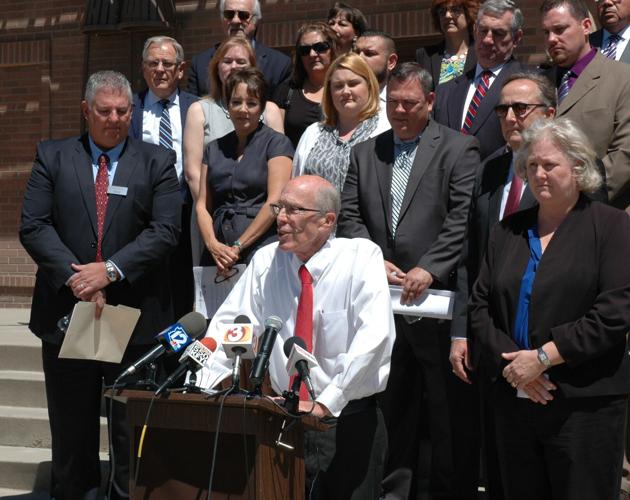
Attorneys for school boards and their clients in 2017 on the steps of a Glendale school when they filed the lawsuit seeking a declaration that the funding system for capital needs was inadequate.
In seeking a delay, however, attorneys for the GOP leaders said they haven't flatly refused to fix problems. Instead, they said questions of the timing and prioritization of the funds that are made available are beyond the reach of the courts.
"Nonsense,'' responded the lawyers for the schools.
"Children get one shot at elementary school,'' the attorneys for schools wrote. "A child in Chino Valley who spent her education in 90-degree classrooms while the district waited more than a decade for an HVAC replacement does not benefit from a remedy that may arrive after she is done with school."
Ditto, they said, of children in schools with leaking roofs, excessive carbon dioxide buildup, mold and inadequate air conditioning. "These are Arizona children, not widgets,'' they said.
The lawyers for GOP lawmakers, in seeking to void Fox's orders, have another argument.
What's missing, they are telling the Court of Appeals, is any evidence that students are not getting an adequate education.
"Representatives of the very school districts that the trial court deemed ostensibly underfunded — including Crane, Tolleson Elementary, Blue Ridge, Wickenburg, Mohawk, Laveen, and Somerton — all testified that they provide their students with an education outcome that meets the state's minimum academic standards,'' the lawyers argued.
"They offered no examples of students at their schools whose educational experience did not meet those standards,'' they continued. "These admissions and omissions, which the trial court ignored, extinguished the plaintiffs' claims.''
But the attorneys for the schools said such a direct link between deficiencies and outcomes is not necessary for a finding of inadequate funding and an order to fix the problems.
"For example, a teacher in a sweltering, noisy, moldy classroom with excessive CO2 and a leaking roof can technically 'teach' a lesson aligned with academic standards,'' they said. "But it would be impossible to show that a certain deficiency caused specific students to fail a test.''
They said that's why state law and regulations define minimum acceptable guidelines of the quality and quantity of facilities students need to achieve high academic standards.
They also pointed out that the state's own School Facilities Board — the one created by lawmakers after they lost the 1994 ruling — itself links those guidelines directly to student performance. In fact, the expert witness called by the GOP lawmakers in the case conceded at trial that "your leaking roof I would expect to be tied to student performance, because students don't do well when the roof is leaking.''
The appellate court has not set a date to hear arguments about delaying Fox's order.
Governor's role
Democratic Gov. Katie Hobbs, for her part, has been pretty much silent on the dispute.
Her last comment came after the August ruling when she said she was aware of it but had not seen the order setting the deadline. Instead, she provided a general comment about how she has "worked diligently" with lawmakers to address underfunding in facilities.
But the judge, in that ruling, said the governor is not blameless.
He pointed out that in planning for the 2024-25 school year, the School Facilities District — the successor to the School Facilities Board which is responsible for funding construction and repairs — estimated it needed more than $587 million to meet all identified needs of all the schools. Yet the Department of Administration, which is under the governor's purview, requested less than $222 million.
There was no response to repeated requests to the governor's press aide for comments about the case, her funding plans and her own role in the problem.
Howard Fischer is a veteran journalist who has been reporting since 1970 and covering state politics and the Legislature since 1982. Follow him on X, formerly known as Twitter, Bluesky, and Threads at @azcapmedia or email azcapmedia@gmail.com.