

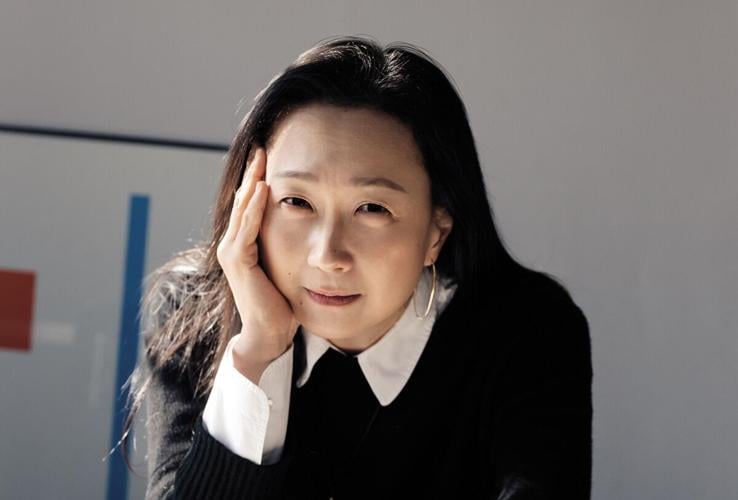
For critically-acclaimed author Min Jin Lee, the in-depth research she did for her latest novel “American Hagwon” – out Sept. 29 – included extensive visits across three continents to ensure that her fictional family’s lives rang true. In an effort to secure strong futures for their children, the Kohs move from Seoul, to Sydney, to Orange County, California. With each move, the importance of education and hagwons – for-profit cram schools – is explored. “I traveled to Australia four times,” the former attorney said in a phone interview from her New York home. “The reason why Australia is in the book is because it is a place that a lot of South Koreans send their children to learn English if they can't afford the U.S. Middle- class Korean people who want to give their kids a better shot for their future know that native fluency of English is really important.”
“American Hagwon” is a followup to Lee’s sweeping 2017 bestseller “Pachinko.” She is active on social media, including Instagram (https://www.instagram.com/lee_minjin/), X (https://x.com/minjinlee11), Bluesky (https://bsky.app/profile/minjinlee.bsky.social) and Facebook (https://www.facebook.com/minjinleebooks). For more information about her novel, check out her publisher’s website (https://www.hachettebookgroup.com/titles/min-jin-lee/american-hagwon/9781538752036/).
People are also reading…
Q: Do the teachers’ own accents determine who will be hired to work at hagwons?
A: You could argue that there's a hierarchy system of hagwon teachers depending upon which accent you have, and they will be paid a different rate. I interviewed a lot of hagwon teachers and one said, “I have an American accent and it's actually worth more than a British accent.” You would think the opposite maybe, but it’s not. Koreans want their kids to sound like a Midwestern American when you speak English versus sounding British. Not everyone can afford to sound the way you and I do, so they will send their children to [countries closer to Korea like] Australia, or New Zealand, or the Philippines to learn to speak English [without a Korean accent].
Q: Was education a reason your parents chose to immigrate to the U.S.?
A: No. We came here because my father is a war refugee from North Korea. When the Vietnam War ended in 1975, he felt that because there's only a ceasefire between North and South Korea and the war hadn’t technically ended, that the next war could again take place in South Korea.
Q: How did growing up in New York affect you as a writer?
A: It allowed me to really see my experience as being central. I think that I never felt like this statistical anomaly, because New York is made up of statistical anomalies and minorities and immigrants. The first time I really experienced a sense of otherness was really when I went to college.
Q: In an interview we did about 10 years ago, you mentioned that your dream vacation would be to rent a house in Tuscany and invite all your friends and family. Have you done that yet?
A: No, but I don’t think it’s my dream anymore. I love the idea of seeing the people that I care about and being with them. That part hasn’t changed. But the idea of something lavish doesn’t appeal to me in any way anymore. I would really like to be quiet and just sit at home.
Q: What has changed in New York that you enjoy?
A: Walking in New York has gotten better and better. The food in New York is outrageously good and the Korean food has become 10 times better than what it used to be 10 years ago. Los Angeles Korean food used to be so much better than here, but now we’re really holding our own at all price points. You can get something really high end, but also something really delicious for under $20.
Q: When you’re traveling, how do you handle staying healthy and eating well?
A: Actually, this is going to sound funny, but I carry food with me. If I'm gone for a couple of days, I'll bring a bag or two of Hero Bagels with me. Each bagel has [between 17 and] 19 grams of protein. If you toast it, it almost tastes like a Lender's bagel, which is what I grew up with as a kid. It's kind of embarrassing that I live in the bagel capital of the planet and I end up eating this processed stuff, but when I travel, it's very useful because I don't really get time to go anywhere to eat. It's really, really rare and especially when I'm on a [book] tour every day, I'm mostly just in a train station or airport. I carry KIND bars. Sometimes I’ll take Season skinless and boneless sardines with me. I’ll also carry hot sauce. And I don’t take sponsorships! These are just things I like.
(Jae-Ha Kim is a New York Times bestselling author and journalist. You can reach her at www.jaehakim.com, follow her on Instagram and X @goawaywithjae, or read more from her on Substack (jaehakim.substack.com).)
©2026 Jae-Ha Kim. Distributed by Tribune Content Agency, LLC.


