
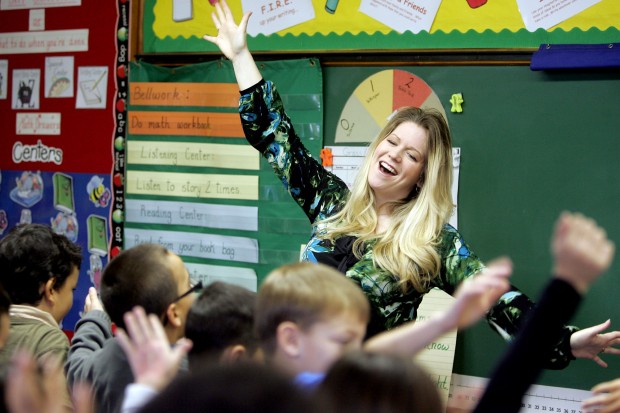
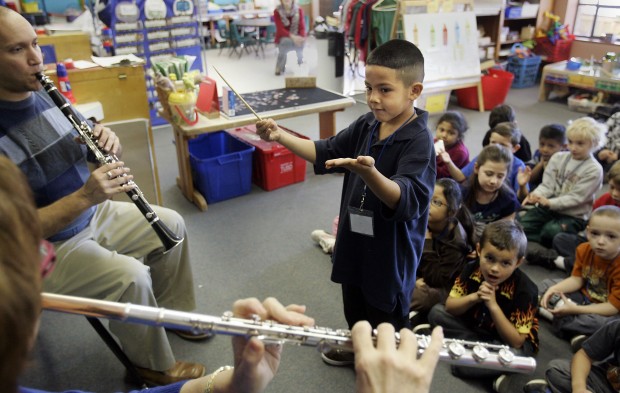
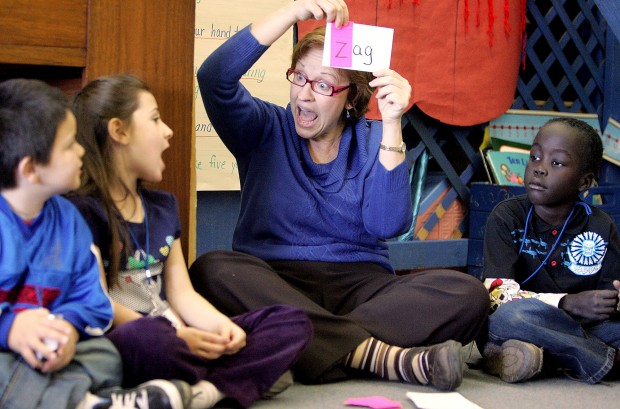
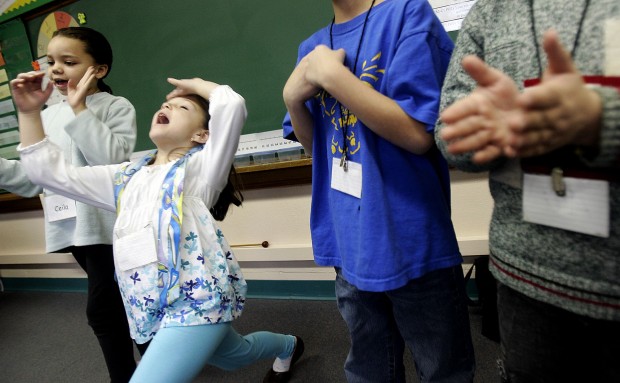
Eighteen smiling children sit cross legged on the floor, hanging on to every word opera singer Juan Aguirre sings.
"All right ladies and gentlemen, boys and girls! My name is Opie the Opera singer," sings Aguirre, his deep voice resonating through the Peter Howell Elementary School first-grade classroom. "Today we are going to play the friend game."
And so the science lesson begins. Peter Howell Elementary is one of 19 schools in Tucson that use the Opening Minds Through the Arts program to teach traditional subjects in nontraditional ways. The Tucson-based program has gained national recognition and has quantifiable proof that children learn.
This opera lesson tackles photosynthesis.
With a quick costume change, OMA artist Gregg Reynolds is transformed into Billy Bob, and the children's teacher, Janice Byrd, becomes Priscilla the Plant. Competing against each other for Opie's friendship, Billy Bob and Priscilla are questioned by Opie.
People are also reading…
"Priscilla the Plant, do you like to eat?" sings Opie.
"I love to eat! I don't need anybody else to feed me. I only need the sun. I stretch out my leaves and I catch that sunlight then I use photosynthesis to turn the sunlight into food for myself," explained Priscilla.
"Photo-senselessness?" asks Opie, puzzled.
"No! Photosynthesis," laughs Priscilla.
The children are in giggles as well. Priscilla turns to them, asking, "Can you say photosynthesis?"
"Photosynthesis!" all 18 children eagerly reply.
And that's all it took. They were hooked on learning.
"This is a different way of teaching the arts," explains OMA director, Joan Ashcraft. "OMA uses fine arts within the curriculum as a tool to help understand concepts better."
Created in 2000, OMA is a research-based program that correlates its curriculum with the neurological development of children, kindergarten through eighth grade. The concept has proven to be such a successful one that OMA is bringing it to schools across the state.
In the program, different fine-arts techniques are used for students' academic development.
Kindergarteners use instrumental music to develop auditory acuity; first-graders use opera to develop language acquisition; second-graders use dance to develop kinesthetic awareness; third-graders play the recorder to learn composition; fourth-graders play the violin to develop abstract reasoning; fifth- and sixth-graders compose, direct and stage original works to learn how to research, create and perform. By middle school, their learning becomes an integration of all previous experiences.
"The children go to middle school with such a heightened understanding of connections in the world," explains Ashcraft. "The teachers tell us that they have to redesign their classroom lessons because the children are challenging them and they have to elevate their work because the children are thinking more creatively."
When fine arts are infused with traditional lessons, teamwork and creativity are often byproducts.
"What OMA really does is make students work together and use creativity," says John Snavely, art integration specialist for OMA. "It teaches kids to be successful in whatever they do, while understanding and cooperating with each other."
Snavely puts a heavy emphasis on teamwork. His job is to facilitate the collaboration between principals, directors, artists and teachers as they coordinate schedules and curriculum.
"Fine arts can stand all by itself, but when you take it and purposefully use it as a tool to help academic achievement, it really cements the concepts," says Howell principal and pianist Mary Ann Jackson.
Dance artist Wendy Joy Koltnow helps Michelle Schickling's second-grade class learn about patterns and themes in visual art in a kinesthetic way.
"What pattern do we see in this painting?" asks Koltnow as she holds up Georges Seurat's "A Sunday Afternoon on the Island of La Grande Jatte."
"Dots!" the students reply as they got into proper formation to start the dance portion of the lesson.
With Koltnow as their guide, the students jumped up and down, emulating the dot pattern with their bodies.
"When they are thinking about the patterns and acting it out with their bodies they are making a connection," says Schickling.
Students jump at the opportunity to learn with this hands-on method.
"We don't just write boring reports all of the time," says fifth-grader Joanna Davison.
When learning literature, the fifth-grade students are not boxed into book reports. They dig deeper into the story and bring it to life.
"We try not to teach them by saying, 'This means that, kids,' and having them regurgitate it," says Aguirre. "We use it in context and keep using it in different forms and by the way they respond we can tell if they have an understanding of it."
Whether acting, singing, dancing or drawing is used to reinforce lessons, the connections students draw are incomparable to textbook-style learning.
Independent research firm WestEd Inc. has determined that students in the OMA program have higher AIMS and Stanford 9 test scores, regardless of ethnicity and socioeconomic backgrounds.
All that, and the students love it.
"I especially like the singing and the art," says fifth-grader Sacha Hyder.
"Art helps you visualize what you are learning about and how to get used to it and like it and not think it's boring."
And they are learning.
"I really like science because I am a scientist! My favorite thing that I like to do is discover more things," excitedly explains kindergartner Genesis Phelps.
"My favorite part about OMA is how we all get to learn about music. Maybe everyone in the world should go to this school. … This is a better school for everyone."
Alexa Miller is a University of Arizona student who apprenticed at the Star.