
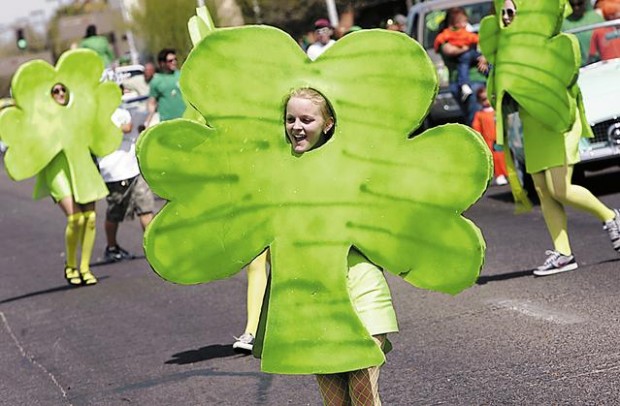
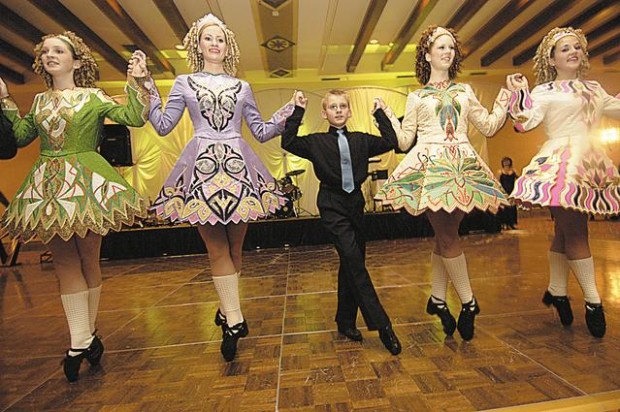
Monday is St. Patrick's Day, a day, it is joked, when everyone — regardless of culture or heritage — wants to be Irish.
That's easy to understand. The Irish always seem to have a verve for life that is contagious.
Take a look at the annual St. Paddy's Day celebrations in cities such as Boston or New York City, where the Irish have played important roles in local history. The parades are huge, with public figures vying for the honor of being invited to march alongside the Murphys, O'Briens and O'Rourkes, while bands play and confetti rains down.
Tucson's Irish community — said to boast about 400 Irish-born members — celebrates with no less enthusiasm. It's a day to honor Ireland's patron saint and toast the Emerald Isle, Irish pride and culture.
But Tucson's celebration has something New York and Boston may have overlooked: strong ties to the Southwest and Mexico.
People are also reading…
How did that happen?
Come along and we'll tell you tales of how the Irish came to the Old Pueblo and how some came to be celebrated as heroes in Mexico.
The Irish o' the Old Pueblo
Robin McArdle-Landers' family proudly proclaims its Irish pride — through the family lore it passes to younger generations, its cultural activities and commitments to Tucson's Irish community and, above all, through its actions.
For nigh on 40 years the family has come together — relatives gathering from out of town — to alert Tucson of the coming of St. Patrick's Day by painting a giant shamrock in the intersection of Pennington Street and Stone Avenue, Downtown.
It all started in 1970, less than a year after the family had moved to the Old Pueblo from Boston.
McArdle-Landers' late mother, Anne Leahy McArdle, started the tradition.
"My mother handed my brother, Andrew, a can of green paint and a paintbrush and told him go and 'make our mark.' "
He painted a little shamrock at Pennington and Stone, she said, but the one they paint now is much larger.
McArdle-Landers remembers those days when the staunch Irish Catholic family traded the Atlantic sea air for Southern Arizona's dry high desert and 100-plus summer temperatures.
You'd think there'd have been major culture shock, but in McArdle-Landers' memory, it was a smooth transition.
"We lived near "A" Mountain, and I went to school at the cathedral (St. Augustine's Catholic School)," she said, recalling the days when the whole downtown area was the McArdle family's home territory. Predominantly, their neighbors were of Mexican descent with a heritage and culture one might expect to be far removed from the Irish-American McArdle clan.
"I never felt a disconnect," she said. "We (the Irish and the Mexicans) share common values: religion and a deep love of family and music."
"The two cultures share many similarities," agrees Andrew Brown, who for four years has served as president of the St. Patrick's Day Parade and Festival Committee.
"The Irish and Hispanic cultures share a strong belief of Catholicism, a strong sense of family and a reputation of being hardworking people," he said in his message written for the 2008 event's program. Besides that, "both . . . are known for their love of a good celebration. Whether that celebration is a birthday, graduation, Cinco de Mayo, Christmas or St. Patrick's Day, there will be tons of good food, plenty of libations and hours of singing and dancing."
Which is why the theme of this year's St. Patrick's Day Parade and day-long festival today at Armory Park Downtown is "St. Patrick in the Old Pueblo."
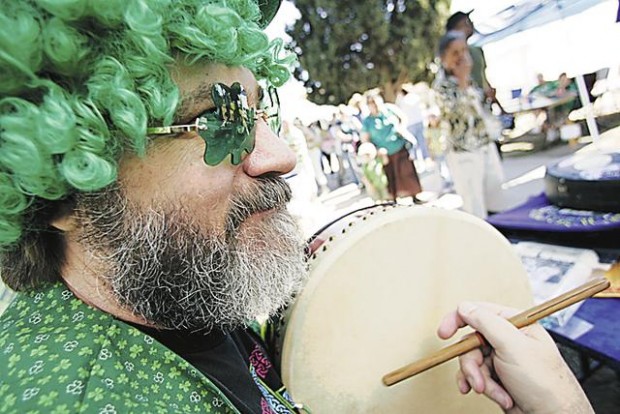
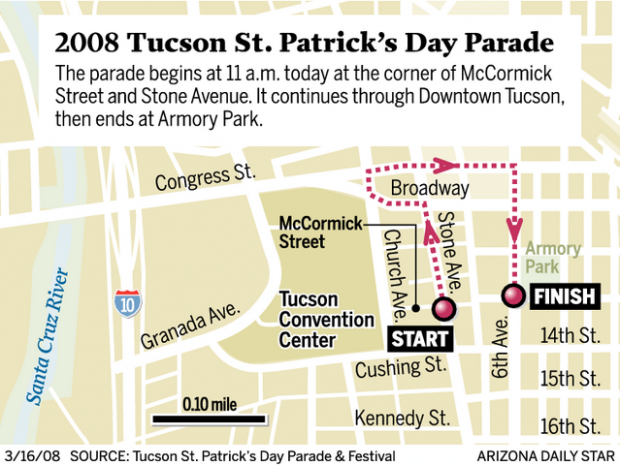
Celebrants will begin gathering at 10 a.m., while the parade, with Pima County Supervisor Ray Carroll as grand marshal, starts at 11 a.m. There will be food booths offering Irish and Mexican food, games for children, arts and crafts and lots of Irish music and dance.
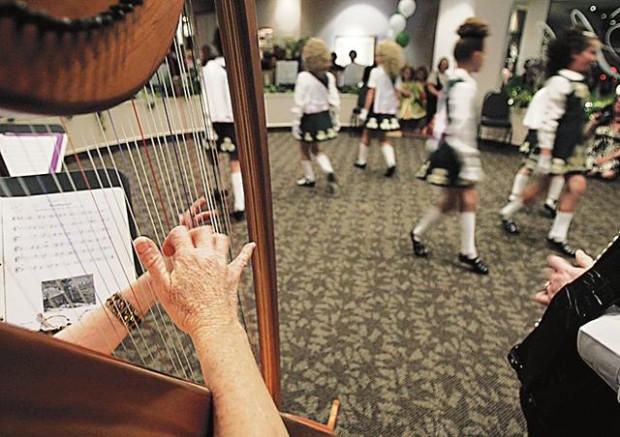
Entertainment will include Mariachi Tesoro de Tucson; performances by Tir Conaill Academy of Irish Dance; Mark Luther, Tucson's Irish troubadour; Cheat the Hangman, the three Mansager Brothers who sing Irish ditties; and the Maguire Academy of Irish Dance.
Hugo O'Conor founded Old Pueblo in 1775
Ireland and Southern Arizona may be miles apart — 5,022 miles "as the crow flies" between Dublin and Tucson, to be exact — but in terms of culture, spirit and history, they're as close as corned beef and cabbage. Or beans and tortillas.
Southern Arizona's and Tucson's Irish ties date to Aug. 20, 1775, when Hugo O'Conor, who served in the Spanish Army, signed the proclamation establishing the Presidio of San Augustín del Tucson.
He was the first Irishman to come to the Old Pueblo; others followed in the mid-1800s, thanks to two tragedies — famine and war.
In 1845, the Potato Famine sent more than a million Irish fleeing their home country, many coming to the United States.
Meanwhile, the U.S. was heading for war with Mexico, and in the spring of 1846, fighting finally broke out. So, as Irishmen arrived on the East Coast, they were recruited by the U.S. Army for the Mexican War.
They had to eat and they couldn't get work, explains Bill O'Brien, organizer of Los San Patricios de Arizona (literally, The St. Patricks) and the catalyst for the establishment of the Irish Cultural Center in Phoenix.
"There was a lot of discrimination against the Irish," he said. "Signs reading 'Workers Wanted — Irish Need Not Apply' went up. They had no choice but to join the Army."
A further incentive: They also were offered U.S. citizenship if they joined the Army.
Many of the Irish recruits ended up along the Mexican border in Texas. Others, said Jim Turner, community outreach historian with the Arizona Historical Society, were with Gen. Stephen Watts Kearny's Army of the West as it followed the Gila River across Arizona in November 1846. It's also highly probable that there were Irish with the Mormon Battalion — composed of many immigrants — when it reached Tucson about a month later, he said.
Many of these immigrants settled in Tucson and other parts of Arizona when they mustered out of the military. There were Germans, Swiss, Jewish, Spanish, Italian, English and, of course, the Irish.
Tucson was quite cosmopolitan, Turner said, and it became even more so in 1849 when gold was discovered in California. Thousands of immigrants rushed west, hoping to strike it rich. The disillusioned left California, many coming back through what was to later become the Arizona Territory.
Community leaders in early Tucson were predominantly Mexican, but the newcomers carved out their roles in the town, by now officially nearing 100 years old.
The Irish worked as miners, cowboys, merchants and freight haulers, Turner said. Many became mechanics, boilermakers, brakemen and engineers on the railroad. Eventually they, too, became community leaders, serving in civic, county and state government.
Los San Patricios honored in Mexico
Mexico long has celebrated Los San Patricios, heroes of the war that nation fought against the United States from 1846 to 1848. Ireland, too, commemorates their valor.
But in the United States, little has been written about the 200 or so Irish immigrants serving in the U.S. Army who opted to fight for the Mexicans as the St. Patrick's Battalion, Los San Patricios.
It all came to an end at the battle of Churubusco in August 1847 when the San Patricios were defeated. The numbers vary in reports, but at least 100 escaped and roughly 85 were captured.
Of those, five were pardoned, and about 15 — including San Patricios leader John Riley — who had deserted before the war officially started, were flogged and branded on the face with a "D." (American troops were so angry that Riley was not to be hanged, that he was flogged an extra nine times and branded on both cheeks.) The rest were hanged as traitors.
There were lots of reasons for the desertions: harsh — even cruel — punishment for slight infractions, the unpopularity of the war, widespread prejudice against foreign-born soldiers (especially Irish) and Catholics. And, of course, financial incentives Mexico offered such as higher pay and a chance to receive land after the war.
But for Riley, the issues likely were more personal. He was born in County Galway and had witnessed the oppression of the Irish: land-ownership declared illegal for Irish, a denial of the right to vote or practice their religion or be educated.
Then, as a trooper in the U.S. Army stationed along the Texas border with Mexico, he saw American soldiers cross the border and set the village of El Fronton — the church, homes, farmers' fields and the customs house — ablaze.
It was all too familiar.
When all was said and done, Los San Patricios were dismissed as traitors, their story never really told.
But Ireland remembers them as heroes — a ceremony is held every September in Riley's hometown of Clifden — and Mexico never forgot.
In 1959, a commemorative plaque was installed in the Plaza de San Jacinto in the San Angel suburb of Mexico City honoring the Irish soldiers who gave their lives for Mexico, and at the annual memorial ceremony, an official reads off the names of 50 Irishmen:
"Patrick Dalton, Dennis Conahan, Kerr Delaney, Hugh McClellan . . . ," the official intones. And after each name, the crowd responds, "Murió por Mexico" — he died for Mexico.
Irish community appreciates Tucson
Don't look for corned beef and cabbage on restaurant menus in Ireland, says Cathy Harris. That's an American thing.
Harris is known as "English Cathy" in the e-mail world because she was born in England. But, she hastens to explain, her mother was born in Ireland, so Cathy holds Irish citizenship.
The Irish do like a meal similar to corned beef and cabbage, she said. Except the meat is Irish bacon, nothing like what Americans call bacon.
"American bacon is really, really fatty," she said. "You cook it and you get a pan full of grease. Irish bacon is meaty."
Tim Prendiville, who grew up on a farm in County Kerry, Ireland, agrees.
He remembers how his family would slaughter a pig, butchering it into large chunks that were covered with a brine to preserve the meat. To serve it, his mother would boil a chunk, adding vegetables — "turnips, potatoes and whatever else" — to the pot.
Irish immigrants in the U.S., unable to find the bacon they were accustomed to, made do — substituting corned beef.
Harris is part of the Maguire Academy of Irish Dance and The Celtic Academy, a nonprofit organization that teaches about Irish dance, music and culture. "We're going to be teaching Irish history, too," she said.
Chris McGrory, originally from County Donegal, and his wife, Rosemary Browne, are directors of the Tir Conaill Academy of Irish Dance of Tucson and Phoenix. He is an accomplished dancer, composer, choreographer and teacher. He came to Tucson in 2003 to play his accordion in the Feile Rince Tucson, an Irish dance competition held each May. He returned the following year and decided to settle here.
He has said the degree of interest in Irish culture in Tucson surprised him, and he is pleased with the enthusiasm and support of his Tir Conaill dancers.
Prendiville, a former Catholic priest, feels it's important to keep Irish traditions, culture and history alive, which is why he teaches classes at Pima Community College. His classes emphasize the Celtic people and their spirituality.
"The Celts were great lovers of nature (and in their culture you find) the natural and supernatural all entwined," he said. "They see the spirit of God in all of nature."
Writing in the 2008 St. Patrick's Day Parade and Festival program, he explains that "the ultimate goal of Irish Celtic spirituality is to help us live happier, healthier, more fulfilled lives where all things are held in sacred balance."
If the Emerald Isle interests you . . .
You don't have to be Irish-born or even boast ancestors who hailed from the Emerald Isle to appreciate Irish history and heritage. There are at least 14 organizations in town that promote Irish culture and values.
They range from the Emerald Isle Society — that sponsors a gala ball every March to raise money to benefit the Tucson Alliance for Autism and the Tucson/Ulster Project — to the St. Patrick's Day Parade and Festival Committee.
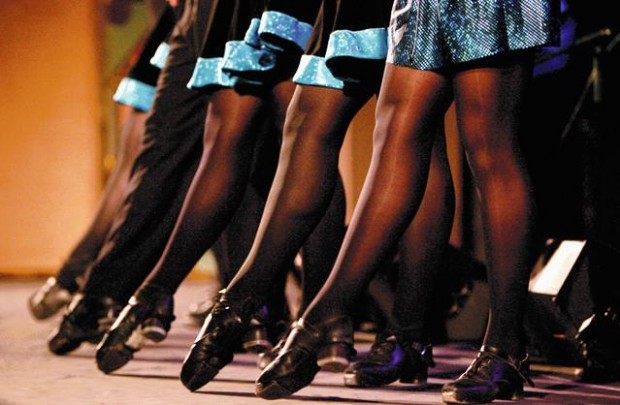
Of course, music and dance play a huge part of promoting Irish and Celtic culture. In Tucson, step dancing — sprinkled with Irish traditions and culture — is taught at two schools: the Maguire Academy of Irish Dance and the Tir Conaill Academy of Irish Dance.
Scots are Celts, too, and in Tucson, The Seven Pipers Scottish Society teaches, performs and entertains with Scottish country and highland dancing, bagpipe and singing. Its performing groups are the Ceilidh Band and the Pipe and Drum Band.
The Society for Creative Anachronism offers anyone interested in arts and skills required by pre-17th-century life in Europe a chance to research and recreate those topics.
The Tucson/Roscommon Sister Cities promotes cultural and economic exchange with the Old Pueblo's Irish sister city, Roscommon, and the Tucson/Ulster Project brings teenagers from Northern Ireland — Catholic and Protestant — to Tucson to live with host families and spend amiable time together.
Interesting facts, legends of a proud people
Irish lore
Four-leaf clovers are good luck — double that luck if you find one on St. Patrick's Day. But four-leaf clovers are not shamrocks.
A shamrock — a "seamróg" in Irish Gaelic — is a young clover with three leaflets on one stalk. St. Patrick, born in Scotland in the year 387, used a shamrock to teach the ancient Irish the religious concept of the Trinity.
Now the shamrock is the symbol of Ireland and the trademarked emblem of the Republic of Ireland.
Legends
Ireland has no snakes, and, according to legend, that's because Patrick (later to become a saint) charmed the snakes into the sea where they drowned. It is said that he stood on a cliff and used his wooden staff to rid the isle of the serpents.
Before Christianity came to Ireland, serpent symbols were common, a part of pagan beliefs, and some say that the story of Patrick ridding Ireland of snakes really is about his ending the pagan religions.
Music
Looking for traditional Irish music? Check out these artists:
The Chieftains, Kevin Burke, Altan, Cherish the Ladies, The Clancy Brothers, The Dubliners, Clannad and Mary Black.
But the Irish have given the music world other types of music, too. The Dropkick Murphys and Flogging Molly are known for their Celtic punk, while The Pogues play Irish rock, and Sinéad O'Connor is a folk rock star. And you can't forget U2 and Bono.
Thanks to Public Broadcasting, Americans now are familiar with Celtic Woman (pictured above), a group slated to appear in concert at 7:30 p.m. May 12 at Centennial Hall on the University of Arizona campus. For more information, contact UApresents, 621-3341.
And blessing
May God grant you always
A sunbeam to warm you,
A moonbeam to charm you,
A sheltering angel so nothing can harm you.
— Courtesy of Cathy Harris
irish in tucson
• John W. Sweeney was 20 when he arrived from St. Louis, Mo., in 1856 and opened a blacksmith business. A successful businessman, he dissolved his business interests to run for — and win — a seat in the Territorial Legislature in 1877.
• Maj. John Gregory Bourke, awarded the Medal of Honor for gallantry in action during the Civil War while still in his teens, served as an aide to Brig. Gen. George Crook in Arizona. He was at Camp Lowell and Fort Lowell. His book, "On the Border with Crook," written in 1891, still is read.
• Phillip T. "Irish" Garigan was a railroad man who began as the car-shop foreman in Tucson in 1911. He was known for promoting good times for the Tucson "rails," as they were known, and their families, arranging parties and picnics.
• Lt. Howard B. Cushing was killed chasing marauding Apaches in 1871 and was buried at Fort Lowell. Bourke spoke of him in his "On the Border" book:
"He was about five feet seven in height, spare, sinewy, active as a cat ... (with) gray or blue-gray eyes, which looked you through when he spoke and gave a slight hint of the determination, coolness, and energy which had made him famous all over the southwestern border. There is an alley named after him in Tucson (today's Cushing Street in Downtown) and, when last I saw it, a tumble-down, worm-eaten board to mark his grave. And that was all to show where the great American nation had deposited the remains of one of its bravest."
The Cushing Street Restaurant and Bar, 198 W. Cushing St., Downtown, boasts a collection of historical photos, including several of the street's namesake. Stop by while you're Downtown for the St. Patrick's Day festivities and drink a toast to the late lieutenant.
• Pinckney Randolph Tully, a merchant and co-owner of Tully, Ochoa & Co. in Tucson, served as treasurer of Tucson and the territorial government, a councilman, a member of the Tucson Board of Health and was twice the city's mayor. Tully Elementary Magnet School was named in his honor.
• Lew Murphy holds the distinction of being a Republican who served four terms — 16 years, from 1971 to 1987 — as mayor of Tucson. When he died in January 2006, hundreds gathered to celebrate the life of an Irishman known for his energy, his humor and his penchant for wearing guayaberas — or Mexican wedding shirts.
• Nellie Cashman, born in Cork, Ireland, was best known for her community service and her years as a business owner in Tombstone, but she also was in Tucson for two years. She left her mark here in 1879 by opening the Delmonico Restaurant, the first to be owned by a woman in Tucson.
Includes information compiled by Vinnie Ryan Nanna and Vinnie Hennessy, proud wearers of the green.