

She has a last name, not that anybody uses it.
Bonnie Henry is simply Bonnie to the untold thousands who devoured her history and humor columns in these pages over the last 25 1/2 years.
Like Lute Olson, perhaps the only Tucsonan during the same period whose popularity eclipsed her own, Bonnie's first name is enough to evoke instant recognition.
Over the years, her column became a conversation with someone you knew, someone you trusted, someone you liked.
We'll all find new friends - heck, you can collect three before breakfast on Facebook - but will any of them end up telling us so much about ourselves, our neighbors and the hot, sprawling place we call home?
Not likely, says Bernard "Bunny" Fontana, a writer and historian who moved to the Old Pueblo from Alaska in 1955.
People are also reading…
"Tucson, in spite of everything, manages to remain a small town, and Bonnie Henry's column is a reminder of that all the time."
Fontana says he was always impressed by her ability to write so well about "the sort of things that were the glue keeping the community together."
Her spot-on descriptions of long-bulldozed lunch counters, skating rinks, dance halls and even entire neighborhoods - Another Tucson, she called it - were a welcome, comforting start to many a morning, he said.
Although she didn't set out to become the Star's historian in residence, she certainly had a knack for it.
Digging into Tucson's past became a sort of calling. The Tucson native who grew up on the south side and graduated from Pueblo High School found herself poring over yellowed clippings or hunched over the microfilm machine for hours at a time, regularly uncovering nuggets like this 1951 headline about Howard Hughes deciding to bring his guided-missile plant to Tucson:
"Manna from heaven."
Bonnie knew her way around the morgue, as newspapers once called their archives, but her ability to pry information from human sources was legendary.
The personal connection she formed and sustained with thousands of Southern Arizonans, most of whom she never met, was obvious as word spread of her retirement.
One source she'd worked with over the years called the paper, worried that Bonnie wouldn't be around to write his obituary.
And when folklorist "Big" Jim Griffith hears the news, he touches on one reason why she'll be missed:
"She's managed to dig out so much of what Tucson used to be, and so much of the real Tucson.
"I guess the other Tucsons are real, too," adds Griffith, the larger-than-life founder of Tucson Meet Yourself. "But I prefer the Tucson in her columns. Over and over again, she's written about people who, by being who and what they are, gave Tucson its flavor."
"It feels weird not to have a notebook," says Bonnie, sitting down with a reporter who was also hired by the Star in 1984 - same month, in fact.
Response to her work has ranged from the ridiculous to the sublime, she tells me, and so has her subject matter.
The ridiculous was apparent in a 2001 piece about getting lost in a Tucson subdivision. You know, the kind that has one main street that "keeps spilling out into smaller streets that snake and twist and turn every which way."
"Not only do all the streets look alike, they all have names like 'Calle Con Vacas Contentas.'
"Or is that Calle Sin Vacas Contentas?"
"No matter," she wrote. "All these streets eventually wind up with the same name: 'No Outlet.' "
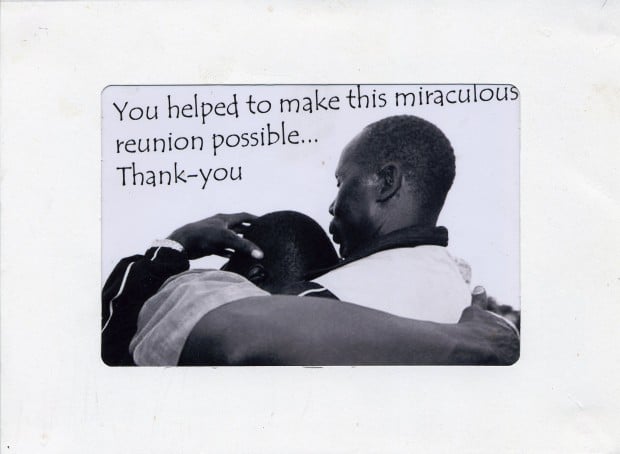
The sublime includes the tale of Tucsonan Chris Garang, a so-called Lost Boy who trusted Bonnie to tell about the horrors of his childhood in southern Sudan and his Herculean effort to reunite with the father he hadn't seen since war came suddenly to their village.
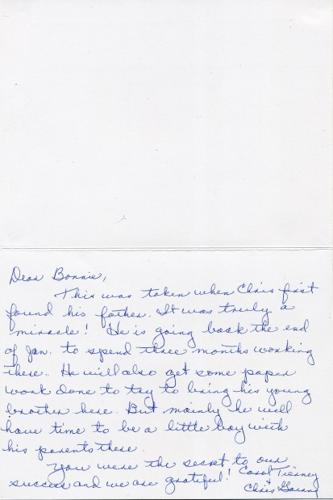
A picture of Garang embracing his father, who worried for years that his boy might indeed be lost, adorned a handmade card sent to Bonnie with the words, "You helped to make this miraculous reunion possible . . . thank you."
Says Bonnie: "That's far and away the most rewarding feedback I've received. It just doesn't get any better than that."
Garang sent the columnist his best wishes.
"Bonnie is a one of a kind and sincere person," he wrote in a Facebook message from Sudan, where he is currently volunteering. "I am honored to know her."
Bobbie Jo Buel, the Star's executive editor, recalls that some readers reacted less favorably.
"She couldn't seem to stop herself from commenting on the driving habits of snowbirds, and did they ever call to complain."
When she wasn't ruffling those particular feathers, Bonnie covered a "huge range of things," Buel says.
When the UA men's basketball team went to its first Final Four, in 1988, Greg Hansen wasn't the only Star columnist given a plane ticket to Kansas City. Sending Bonnie was a no-brainer.
Buel reels off a list of diverse subjects tackled by Bonnie, including education, fashion, home improvement and military history.
"She wrote our eight-day series for the 50th anniversary of D-Day and spent many hours reporting a long history column about segregation in Tucson."
Working on the segregation story was "intimidating for a Betty Crocker white woman like me," Bonnie says.
"I grew up here, but I wasn't aware that the lunch counters where I sat and ate were off-limits to blacks," she says. "I had no idea what black people in Tucson went through, or the Chinese or the Mexican Americans in the barrios.
"I considered it a privilege that I was not only able to learn about their experience but share it with other people."
Coming out for a crosstown freeway
Bonnie doesn't miss a beat when asked which column drew the biggest response.
It was her 2003 piece headlined "Build a freeway already."
"Freeway, freeway, freeway," she began.
"So there. I've said it: the 'F' word. In triplicate.
"Let others talk trolley or bandy about the idea of more buses. What we really need in Tucson is a crosstown freeway. Maybe two.
"God, but it feels good to come out of the closet."
The letters and calls poured in, and what surprised Bonnie the most was that most readers agreed with her.
When she tells you a story, like the one about sharing a bed with fellow reporter J.C. Martin while covering the pope's visit to Phoenix in 1987, it's like she's telling it for the first time.
"There were six of us crammed into one hotel room, and I always tell people that J.C.'s the only person at the Star I ever slept with," she says, letting loose one of those cackles that make your whole body smile.
Bonnie, who is 64, likes people and she loves Tucson, a place she writes about in an accessible, plain-spoken style, says Tom Beal, a veteran reporter and former high-profile columnist himself.
"I can't tell you how many times I would be out and about, speaking to this group or that, and the first question would be, 'What's Bonnie Henry like?' "
The easy answer, of course, is that the Bonnie Henry we know is the same Bonnie Henry you know. To read her is to know her.
Method in her manner
As for reporting technique, hers was hardly secret - how could it be with a voice that carries halfway across the newsroom?
It was a sort of mentoring by immersion. Because we could always hear her end of the conversation - when we tease her about it, she reminds us that many of her sources were hard of hearing - we knew how hard she worked to get the story. Patient and persistent in equal measure, she listened and laughed and asked question after question after question.
You'd think she was talking to an old friend.
Bonnie's unfailingly familiar manner was matched with rigorous fact-checking and corroboration, says features editor Maria Parham, who was here the day Bonnie hobbled into the newsroom for the first time, having just injured her foot.
"She always said that she had to check and double-check the name of every car or airplane or branch of service mentioned by a source," says Parham, who marvels at Bonnie's accuracy over the years.
True to form, Bonnie downplays any notion that she produced error-free copy.
"I've had my share of corrections," she says.
But it figures that when we went looking for Bonnie's biggest screw-up, eager to expose her as a human being, the effort was fruitless.
An electronic search of archives dating to late 1990 shows that she wrote an avalanche of stories, and errors were few and far between.
How typical that after one mistake, she turned the ensuing gotcha! from readers into one of her best columns.
"Never say never.
"Once upon a time I wrote that Buddy Holly never played this burg.
"Wrong, wrong, wrong. That was the word from readers who took the time to tell me differently."
Bonnie goes on to tell the story of the night in 1957 when Buddy Holly played a show for 3,000 screaming "hepsters" at the Catalina High School gym.
Also on the bill? Fats Domino, Chuck Berry, LaVern Baker and a 16-year-old Paul Anka.
Bonnie's recounting of the concert, quoting people who were there, is included in "Tucson Memories," the second of two books by Bonnie published by the Star. Like the first, "Another Tucson," it's a collection of her best columns.
She certainly had plenty to choose from.
Bonnie's productivity inspired amazement from her colleagues, some of whom had a tendency to coast for a few days after a big story.
Not Bonnie.
She'd bang out a detailed stunner about, say, the red-light district that flourished in downtown Tucson for decades. And then, before the ink was dry, she'd jump into the next story with the same level of energy and enthusiasm.
In 2007 she won the Don Schellie Award from the Arizona Press Club, the state's top honor for columnists. It was overdue.
Asked about her strong work ethic, she says:
"It came from my parents, my good old mom and dad, and I had some very good teachers who always pushed me to be my best. In school, the very worst thing that could happen to me was when I got an assignment back from a teacher with a note saying 'You can do better.' "
From the secretarial ranks
After earning a journalism degree from the UA, Bonnie went to work for Territorial Publishers, which put out a business daily and a community weekly.
In June of 1981, when Tom Walker was hired as executive editor, the Territorial had a staff of three full-time reporters and a "tall secretary named Bonnie Henry," he said via e-mail.
"She asked if she could do some stories for me. . . . So I gave her a couple of ideas, not expecting much of anything. She came back with stories that absolutely sparkled. "
That same day, Walker talked to owner E.D. Jewett, and, before she knew it, Bonnie had a new title.
Reporter.
Less than four years later, Bonnie was snatched away by the Star, assigned to Neighbors, a section that was dissolved a year later. Bonnie landed in the features section and immediately started writing a Sunday column.
It was early in 1987 when John Peck, the Star's features editor and soon to be the managing editor, asked her to write a second column each week.
"My kids were growing up and weren't as cute as they used to be, and so what was I going to write about?"
Happily for all concerned, Peck was also a Tucson native who shared her interest in the city's past. It was his idea to focus on Tucson's recent and not-so-recent history.
"She just was so damn good at getting people to talk to her," says Peck, who was here for the first seven years of Bonnie's career.
Right from the start, she had a knack for putting her sources at ease, Peck recalls, describing how she gently prodded them for details that would put readers at the scene of the battle, the dance, the proposal, the collision, the championship.
But Bonnie nearly met her match with the greatest generation, whose stories she sought for the Star's D-Day project.
These guys just didn't want to talk about themselves.
"All of them, every single one, said 'Don't make me out to be a hero.' They were so humble."
But they came to see the importance of getting their stories in print, Bonnie says, or maybe she just wore them down. "Many of them told me things they said they had never told anyone, not even their wives."
Among the more talkative vets was a fellow she met here in the newsroom. Hans Fischer was picking up review copies of books destined for the Cochise County Library. The aging volunteer with the thick accent recognized Bonnie and complimented her on the D-Day series.
Thanking him, she asked if he was at Normandy.
"Yeah, I was bombing it," said the proud pilot with the German Luftwaffe.
Sure enough, his story checked out, and another column was born. It prompted a group of vets in Green Valley to arrange a meeting so they could all talk shop, the animosity long gone.
Efforts to create a memorial in Tucson for those who served in World War II have never gained much traction. But, as the Star's Debbie Kornmiller says, "She's done a memorial of sorts in our news pages."
All this talk about Bonnie the historian prompted this thought from Bunny Fontana, who is 79 years old.
"When you've lived as long as I have, you don't think of it as history," he said of her columns. "It's just life as we lived it."
Contact the Star's M. Scot Skinner at skinner@azstarnet.com or 573-4119.


