

A local historian likes to imagine that angels carried Mission San Xavier del Bac — a beautiful white apparition itself — through the sky and plopped it in the Sonoran Desert.
If so, we now know there was one extra angel to help them: a "new" one just discovered in the 211-year-old church.
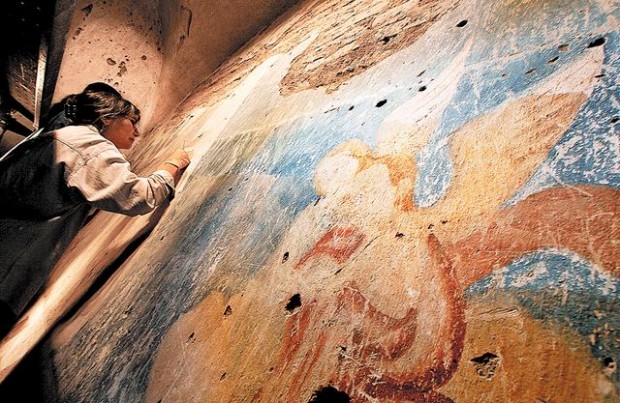
Restorationists Tim Lewis and Matilde Rubio uncovered the painted angel this month on the north wall of the mission's tall, narrow baptistry, which is under the west tower.
The angel, draped in a red cloak, had been hidden for years — perhaps a century or more.
It was covered with dirt and a thin coating of plaster that was likely applied by well-intentioned construction workers.
"It's always exciting to see something that has been there for a couple of hundred years and no one in the recent century has noted it. Then all of a sudden, there it is," said Bernard L. "Bunny" Fontana, an ethnohistorian who lives near the mission and has made a lifelong study of its art.
People are also reading…
He's working on a book about the mission's art with photographer Edward McCain. Its title is "A Gift of Angels."
Fontana has always talked about the mission's 182 angels. Now he's altering that to 183.
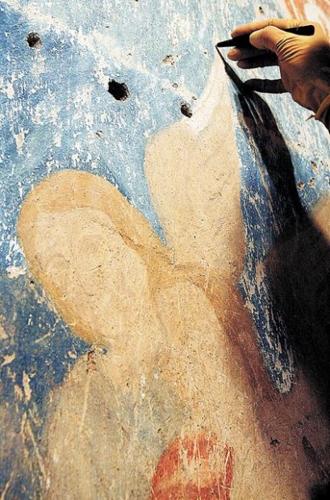
The angel is part of a wall painting of John the Baptist baptizing Christ. Prior to the restoration, the entire design looked like a rough sketch, not quite complete or colored in. John the Baptist appeared ghostly. Christ's face was barely discernible. The top part was hidden under a hard coating. And the faded, dusty mural appeared to have one angel in it.
But when Lewis and Rubio began the painstakingly detailed process of cleaning the painting, a second angel emerged. The two angels are floating on a cloud beneath a blue sky.
The cleaning process also revealed colors — red and blue cloaks on the angels, flesh color and red lips on John the Baptist, a peaceful expression on Christ's face and a greenish-brown object that looks like a seashell, used for the baptism. A tail of what appears to be a dove also emerged.
Since restoration work is so slow-moving, it will be at least another week or two before the angel and other details on the painting are completely visible.
"We never expected it," said Lewis, who grew up on the Tohono O'odham Reservation where the mission is located and continues to live there with Rubio, his wife.
"When we got up high and looked at it from that angle, looking down, it was clear," he said. "We'd always been looking at it straight. But they are two separate angels, each with one wing showing."
No one knows who did the baptistry artwork, but Fontana believes it dates to 1797, when the mission was completed. Fontana guesses that the artists weren't local and probably hailed from Querétaro, Mexico, near Mexico City, which was like a headquarters for the Franciscans, who took over the administration of San Xavier from the Jesuits in 1768.
Lewis and Rubio have been working on the mission's interior restoration on and off since 1992 and have spent many long hours studying the painting inside the baptistry. Their conservation work there won't be complete for another two to three years, they say.
The baptistry — at one time the area where baptisms were performed — sits behind a wooden door that is covered with a locked metal grille, and it isn't open to the public. It is just west of the church's front entrance.
Fontana isn't sure how long the baptistry has been locked up. For years it was open and the walls have plenty of graffiti to prove it.
"I hope they don't open it up again," Rubio said, "or the public might scratch it up again."
When the restoration work isn't going on, the wooden door behind the locked grille is typically open, which will allow the public to have a peek, said the Rev. Stephen Barnufsky, pastor at San Xavier.
The restoration process is time-consuming. Washing the painting with water or other regular cleaners would erase it. So Lewis and Rubio use special tools — a rotary drill to remove the hard coating that had covered part of the artwork, and medical scalpels and fiberglass erasers to take off the dirt. They then use ethyl silicates to coat the painting as a reinforcement. The chemicals must cure for about six months.
Rubio and Lewis fill in holes and cracks like a dentist filling cavities, as they did with the ocher-and-Venetian-red squares that border the baptistry.
"What is important about the church is not only that it's beautiful, but that it's 200 years old," Rubio said.
Fontana is the archivist for the non-profit group that is paying for the restoration, the Patronato San Xavier. In that role he has taken photographs of nearly every square inch of the church, and said he made a kind of game out of carefully counting the angels and documenting them on 35 mm slides.
"If you stand in front of the altar and just stare, the angels start to pop out at you," said Vern Lamplot, the Patronato's executive director. "It's very neat. I think that's the way somebody somewhere intended it to be."
In his book, Fontana writes about a popular shrine in Italy dedicated to Our Lady of Loretto. The story is that the building at Loretto was originally the house where Christ grew up and, to preserve it, angels descended and moved it to Italy.
Fontana imagines that the same could hold true for the Mission San Xavier del Bac.
"How else do you explain something as crazy as a church out there in the desert?" asked Fontana. "The only sensible thing is the angels were taking it someplace and decided to put it down."
The church's count of angels is remarkably high, he noted. Even more so now.
"It's aflutter," he said. "It's a fun place."
DID YOU KNOW
Completed in 1797, Mission San Xavier del Bac is considered one of the finest examples of Spanish Colonial architecture in the United States.
The quality of San Xavier's art belies its once remote location in a chain of 18th-century mission churches on the northwest frontier of New Spain. The artists were no amateurs, and they used the finest pigments from Europe and Mexico.
In 1995, Paul Schwartzbaum, chief conservator with the Guggenheim, told the Arizona Daily Star he considered San Xavier an art treasure for the entire nation because it is unique for its sculptured and painted art.