

Freaks need church, too.
So decided Larry Munguia in the late 1990s when he was climbing back from alcohol and cocaine addictions that got so bad his wife kicked him out of the house and wouldn't allow him to see their two children.
Munguia had grown up Catholic. But he fell away from the church around the time he was working as a bouncer and bartender at some of Tucson's tougher watering holes.
He began burning his candle at both ends — partying, drinking and taking drugs while trying to keep a job and be a father.
It didn't work.
He ended up unemployed and desperate.
On a whim, he went to a Christian Promise Keepers convention in California, and says he was awakened to the power of faith. When he got back to Tucson, he began studies that eventually led him to be ordained as a Baptist preacher.
People are also reading…
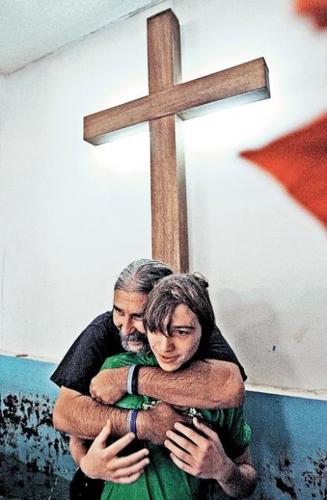
On Easter 2004, he led his first service as pastor of The SOBER Project, a church for addicts.
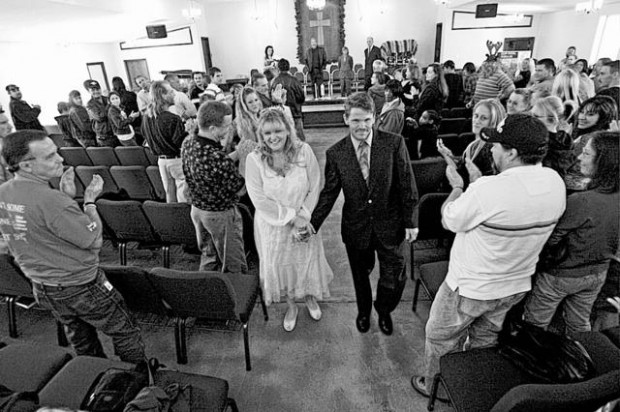
In less than four years, Munguia's Sunday worship service has grown from 60 people to more than 250. That's no small feat; most churches in the United States have 100 or fewer congregants on Sundays.
And religious leaders across the country are spending energy and brainpower trying to attract the 20- and 30-something demographic that packs into Munguia's services, Bible studies and God-themed 12-step meetings.
"I came here broke, busted, disgusted. I smelled like mustard, couldn't be trusted," said 25-year-old Justin Cheek, addressing a packed room of rapt faces at one of the 12-step meetings. The church holds the meetings seven days per week at locations around the city.
Roughly one in 10 Americans struggles with some form of substance abuse. But one quarter of Americans are estimated to be affected by addiction, whether their own or that of a relative or friend, according to CODAC Behavioral Health Services.
The holidays are especially tough.
Cheek, who moved to Tucson from New Orleans in November, is living in a men's shelter. He says his family doesn't speak to him. He's kicking a heroin addiction and believes he's newly created.
Starting fresh is a concept Munguia, 50, embraces at The SOBER Project. Aside from its obvious meaning, SOBER is an acronym for service, obedience, bonding, education and relationships.
"We're always trying to fix the body when it's the spirit that needs just a little bit of help," Munguia hollered into a microphone attached to a headset during a recent service.
The church belongs to the Southern Baptist Convention and is an example of the denomination's rapid expansion through "planting" new churches in the Tucson area over the past five years. But it's not an example of a typical Southern Baptist church.
Most SOBER Project worshippers have run afoul of the law — the youth director, for example, is a reformed burglar. Lots of them have lost children to the state. Many don't have homes, cars, families or friends. Worshippers swap stories about making mistakes and making amends. The church's job ministry and hepatitis C support group are nearly as popular as Sunday services.
There's no dress code. Munguia, who always wears a T-shirt, jeans and a ponytail, tells worshippers to dress down.
He wants anyone and everyone to feel comfortable. That's why he tells congregants to show their piercings and tattoos, and it's also why he doesn't pass a collection plate but instead puts an offering box at the back of the sanctuary. He does urge congregants with jobs to tithe 10 percent of their earnings.
Within 10 feet of every church door is a can for congregants to use as an ashtray. There's a designated parking area for motorcycles, since so many of the congregants are bikers.
The SOBER Project now meets at Calvary Baptist Church in Midtown, but Munguia expects the church will get its own building because it keeps growing.
He evangelizes in halfway houses and on city buses.
"We talk about the freedom of forgiveness. When you have no guilt or shame, it changes your outlook on life," Munguia said.
"We can accomplish and achieve. God loves to use us, the fringe population, the misfits, the ones who aren't supposed to accomplish anything," to restore lives and show his power, he added.
Munguia tells worshippers not to shy away from their status as outsiders. Church T-shirts say "Freak Show" on the front.
"We're pretty much used to being considered freaks of society anyway, so there's almost a comfort about it because you are already set apart," said Elaynia Cline, 30, a recovering crystal methamphetamine addict and a SOBER church parishioner the past two years.
"To embrace the word 'freak' rather than shun it creates a very comfortable place for a lot of people," she said.
Cline has three children, but none of them live with her — one consequence of her addiction, she said. Her first marriage failed. Her addiction left her jobless, homeless and broke. She went into rehabilitation in 2005 and says she has been committed to sobriety ever since. Though she says she briefly relapsed once, she never stopped going to church.
"The amount of support and love is so unconditional you don't have to hide," said Cline, now a job coach for adults with disabilities. "There's a different level of understanding. And Larry speaks in a way that is so easy to understand. If the brain is still foggy from the drugs, the message is still clear."
The SOBER church is at times loud, boisterous, even raucous. Parishioners are jokingly reminded that there's no pot allowed at the church potluck. The church has guidelines but no rules — Munguia knows his congregants don't have a good history with rules.
When Munguia recently told them about a passage in Exodus, in which Moses absconds after killing an Egyptian whom he saw beating a slave, worshippers responded with a loud chorus of "Oh yeah." This group knows what absconding means, Munguia said.
"Tucson has such needs when it comes to people who have been addicted to drugs and alcohol," said Cline.
Congregant Erika Stoddard, 24, was addicted to crystal meth for seven years, has spent time in jail and is on probation. She also has a 7-year-old son.
She's not one for getting up in the morning, but now she never misses the 9 a.m. Sunday services. "I've seen people I used to sell drugs to, and now they are in church with me and it's the warmest feeling ever," said Stoddard, who now works at a restaurant. "I'm glad to see they are not in the lifestyle."
Munguia supports his congregants through troubles with the law, though he stops short of going to court hearings — there would be too many of them.
"Sometimes deliverance comes in the form of the SWAT team," lay associate pastor Mark Vavra told worshippers during The SOBER Project's Tuesday night 12-step meeting.
"Hallelujah!" shouted a voice from the back of the room.
Vavra, 51, is a Vietnam veteran who says he's been sober from an alcohol and cocaine addiction for five years.
He says there's a tremendous need to help people stay clean and out of trouble post-incarceration. One in every 31 adults in the U.S. is in prison, jail or living on probation or parole.
"Prison re-entry is a real big thing," Vavra said. "Unless we get them connected so they are not alone, it's real hard to keep them away from what they know."
The 12-step meetings are based on principles in the Bible The SOBER Project uses: The New Living Translation Life Recovery Bible. The steps begin with admitting powerlessness and end with a spiritual awakening and making amends.
Attendees receive crosses colored according to how long they've been sober. They begin with red, which means they've been sober at least 28 seconds.
Stacy Rolfer, a 45-year-old employee at a coin-operated laundry, received a black cross with a sparkling rhinestone, signifying she's been sober for a year. Rolfer was so addicted to crack cocaine that five years ago she permanently lost custody of her two children. She has not seen or heard from them since.
Hope is a common theme for the congregants.
And it's particularly important during the holidays, when many, like Rolfer, are missing their children and other family members.
Munguia says there's reason to give them hope. Sober for 10 years, he says, "I got my wife, my kids and my home back. I have a whole new career. I see these people who have had nothing: Now they own businesses, they are managers, they get married, they get their kids back."
More inside
There are also many ways to stay sober during the holidays that aren't based on faith. Page A5
"I've seen people I used to sell drugs to, and now they are in church with me and it's the warmest feeling ever."
Erika Stoddard, 24, SOBER Project parishioner and former crystal meth addict