


My friends love to tell this story: A group of us is driving to a remote Ontario cabin. At the Canadian border, our cars face inspection by customs officials. We pull up next to four burly, plaid-wearing, Copenhagen-chewing guys, the rear of their bruiser of an SUV jammed with fishing gear and assorted outdoorsman equipment.
I pop the trunk of my sedan, and what's perched on top of the luggage? Popover pans.
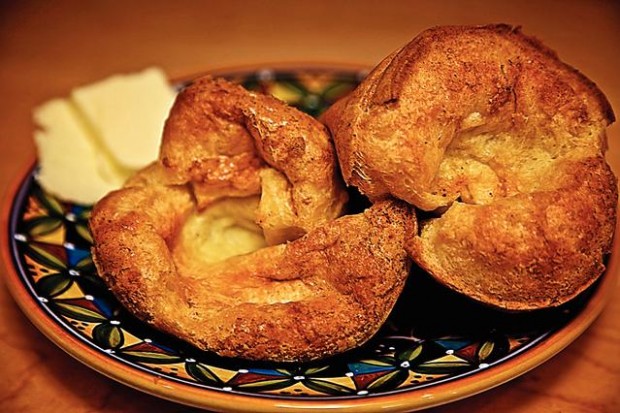
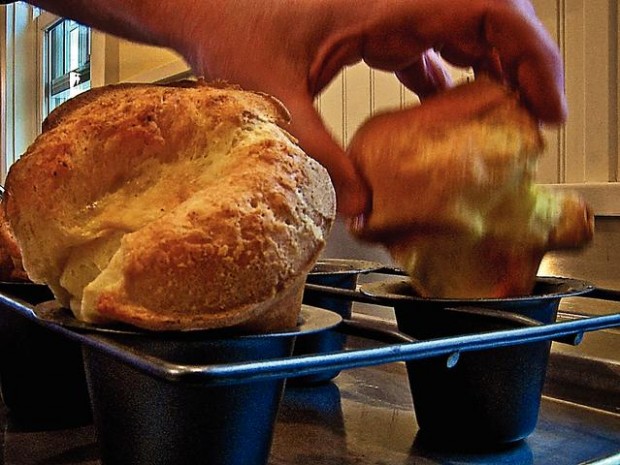
Well, why not? It has been my experience that nothing elicits astonishment and gratitude at the table faster than the appearance of hot-from-the-oven popovers. Great taste aside, I love how popovers give the distinct impression that you made a major fuss, when in reality you pretty much threw together a glorified pancake batter, poured it into a funny-looking pan and then let a superhot oven work its magic.
The search is on
People are also reading…
After relying upon the same recipe for what seems like forever, I recently got to wondering if a better popover formula exists. Out came the cookbooks, and over the course of a few weeks, I rather obsessively test-drove nearly a dozen formulas from a pantheon of culinary headliners, including Martha Stewart, Marion Cunningham, Shirley Corrihor, Mark Bittman, Maida Heatter and Alton Brown, as well as Cook's Illustrated, Gourmet and Bon Appetit magazines. Then I remade my tried-and-true recipe, lifted from a batter-splattered Dayton's Oak Grill flier that dates to at least the early 1990s.
The results ran the gamut, as my Facebook friends will attest, since I chronicled my popover project online. Some were flat-out failures. (Starting with a cold oven proved to be a major misstep; what was "The Fanny Farmer Cookbook" thinking?) Others relied on too many futzy steps (straining the batter doesn't really pay off) or excessive gadgetry (I know I should own a pizza stone, but I don't, and I'm not in the mood to drop $42 at Williams-Sonoma).
Or they had ingredients I don't always have on hand. (When is the last time you had a high-protein bread flour lurking in your pantry?) The few promising versions — including my old reliable from the Oak Grill — didn't quite achieve the puffed-up, golden-brown outer shell and richly tender interior that I was seeking.
That's when I started cobbling together components from various recipes and, dozens of eggs later, I think I've arrived at a foolproof solution. Variation No. 17 — with its rested, room-temperature batter, extra egg white, ultrawet texture, use of clarified butter and dual oven temperatures — produced a tender popover that soared to towering heights and boasts both a gently crispy crust and a mostly dry but still eggy interior. Eureka.
Go ahead — give it a shot. You'll discover how the benefits of popover-making far exceed any challenges. Before you know it, you'll have a batter-spattered recipe all your own, and you'll be packing popover pans on weekend road trips.
Popover variations
• Fold 1 tablespoon freshly chopped summer savory or marjoram and 3 tablespoons finely grated Parmesan cheese into batter when adding butter (from "American Home Cooking" by Cheryl and Bill Jamison).
• Fold 1/4 cup crumbled blue cheese at room temperature into batter when adding butter (from "Come One, Come All: Easy Entertaining With Seasonal Menus" by Lee Svitak Dean).
• Mash 2 garlic cloves with a pinch of salt into a paste and whisk into batter when adding flour. Pour batter into popover cups in thirds, alternating with a sprinkle of finely grated Parmesan cheese after the first and second pours (from "The Gourmet Cookbook," edited by Ruth Reichl).
• Fold 2 tablespoons freshly chopped chives into batter when adding butter ("The New Basics Cookbook" by Julee Rosso and Sheila Lukins).
• Bake popovers in a mini-popover pan. Remove from oven, remove popovers from pan, brush hot popovers with melted butter, then roll popovers in a mixture of 1 teaspoon cinnamon and 3/4 cup sugar (from the New York Times Magazine).
• In a medium bowl, using an electric mixer on medium speed, beat 1/4 cup ( 1/2 stick) unsalted butter at room temperature until butter is light and fluffy. Add 1 teaspoon honey and beat until well-combined. Transfer to a bowl and serve with warm popovers (from "The Marshall Field's Cookbook" by Steve Siegelman).
• In a medium bowl, using an electric mixer on medium speed, beat 1/2 cup unsalted butter (1 stick) until light and fluffy. Add 3 tablespoons good-quality strawberry preserves and beat until well-combined. Transfer to a bowl and serve with warm popovers (from "The Neiman Marcus Cookbook" by Kevin Garvin).
Tips for popovers
• Cover up. Blanketing the popover pan with aluminum foil during preheating will prevent the clarified butter from splattering.
• Skip the cooking spray. Nonstick cooking sprays are convenient, but they also can negatively affect flavor and texture (ditto vegetable oil). Use clarified butter.
• Keep it shut. Popovers are steam-driven, and allowing the oven's heat to escape may cause deflation, especially early in the baking process.
• Fill them up. If you run out of batter, fill any remaining cups with water.
• Invest wisely. Custard cups and muffin tins are OK, but they don't give the distinctive hot-air-balloon shape that comes from a popover pan's deep, narrow cups. Expect to pay $20 for a decent six-cup, nonstick popover pan.
• Take a break. Resting the batter for a half-hour after mixing allows the flour's glutens to relax a bit. Just don't make it any further in advance, and forget about freezing it; this is a fresh batter.