

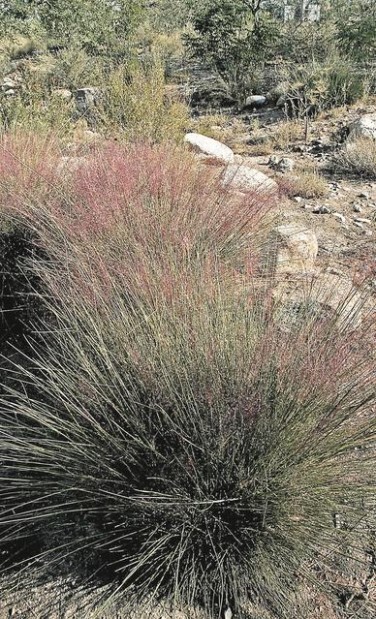
Ornamental grasses are becoming more and more popular in desert landscapes. Their fine-textured foliage and flower plumes provide an attractive contrast with the bold forms of aloes, agaves and cacti.
Ornamental grasses are well-adapted to sun and heat and are surprisingly drought-tolerant. Most established grasses require watering only every week or two during the hot weather and only once or twice monthly during cool weather.
Among the best of the ornamental grasses for the desert Southwest are the muhly grasses. More than nine species of Muhlenbergia offer a wide selection for landscape use with a variety of leaf shades, flower colors and clump sizes. Here are some of the best:
Pink muhly (Muhlenbergia capillaris) forms a dense mound of fine, dark green leaves with a height and spread of up to 3 feet. One of the showiest varieties is Regal Mist, which produces tall, light rose-colored flower plumes September through November. Although evergreen in warmer microclimates in the Tucson area, the grass will freeze back in colder winter locations. Pruning off the brown leaves in the winter will allow new grass to quickly emerge in early spring.
People are also reading…
Deergrass (Muhlenbergia rigens) is a large, symmetrically rounded, bunch grass that grows 4 feet tall with equal spread. It has a dense crown of dark green leaves that dry to a light gray in winter. Spikes of pencil-thin, straw-colored seed heads, 5 to 15 inches long, add interest from July to October. Deergrass naturally occurs in Arizona along desert washes. It is drought-tolerant, but its appearance is improved with some supplemental watering during dry periods.
Bamboo muhly (Muhlenbergia dumosa), is a large clumping grass native to Southern Arizona and northern Mexico. It grows to a height of 4 to 6 feet, and has larger than normal stems, and small, rather inconspicuous leaves, providing a bamboolike appearance. Wispy, branching seed heads about 1 foot long are produced in the upper half of the clump. Seed heads are produced from January to May. Although drought-tolerant once established, bamboo muhly will grow larger and look more attractive with periodic watering.
Most ornamental grasses freeze back in the winter, but even those in protected locations should be pruned back in the winter to rejuvenate the clump and promote new spring growth. The easiest way to cut down the grass clump is with a hedge shears, either manual or electric. Cut as low as possible. In March, apply one-half cup of a high nitrogen fertilizer, such as ammonium sulfate, around the outer edge of the clump and water it in.
An excellent publication, "Desert Grasses," is published by the Arizona Native Plant Society. It contains detailed information and color photos of 30 species of desert-adapted grasses. For more information, go online to aznps.org or write to Arizona Native Plant Society, P.O. Box 41206, Sun Station, Tucson, AZ 85717.
» Demonstrations
"Butterfly & Bird Gardening" will be the topic of this week's gardening demonstrations. Presentations will be 1 p.m. Wednesday at the Wilmot Library, 530 N. Wilmot Road; and 1 p.m. Friday at the Oro Valley Public Library, 1305 W. Naranja Drive.