

Q: We inherited about three-dozen mustache cups from our mother, who collected them for many years. There seems to be little interest online. Are the cups too specialized? We took some to an appraisal event, but the expert there talked about barbershop shaving mugs, which left us really confused.
A: First, we need to clue readers to what a mustache cup is. Imagine a coffee or teacup with a bridge of the same material spanning the lip, east-west. That's where a Victorian gentleman's mustache rested as he drank his coffee or tea. Sort of a mustache cozy, if you will.
Mustache cups mattered back when facial hair was standard for many men. Dates span the Victorian era to about World War I. Once the clean-shaven look came into vogue, mustache cups became a curiosity.
Today, the cups are popular collectibles. Are they too specialized? Nah. Mustache cup collecting, like many collecting interests, is cyclical. But there are always core collectors.
People are also reading…
They were made in every fashion that cups were made. Some are pottery, others are fine china with lots of gold. In the days when silver plate cups and saucers were a novelty, they were made as mustache cups as well.
Barbershop shaving mugs are totally different. First off, they lack the bridge.
During the same period when mustache cups were made, men commonly kept personal shaving mugs at their neighborhood barbershop. That way they'd always be on hand for their daily shave.
A traditional short mug with a handle, shaving mugs usually sported the customer's name in gold along with a personalized decoration on the front. If the customer fancied trains or was a conductor, his mug showed his name and a hand-painted train or streetcar on the front.
It's those decorations that make shaving mugs fascinating collectibles. While a mustache cup collector might hunt for examples by differing makers or in varied materials, mug collectors look for occupations.
I'm wondering if what you took for appraisal were shaving mugs instead of mustache cups. That would explain the appraiser's comments.
See if your library has "The Shaving Mug and Barber Bottle Book" by Keith Estep (Schiffer, $69.95) and any of Jim and Susan Harran's volumes of "Collectible Cups and Saucers."
Q: A family member was in the import-export business in New Orleans around 1901-05. He got these two chairs from mainland China. I've not found anything like them. Any info?
A: Along with the query, our reader included two images of elaborately carved Oriental chairs with carved arms and low backs.
One he describes as a sea turtle chair. Photo quality is mediocre and carving is hard to determine, but one can see that the chair is ornate and floridly carved with what could be some sort of sea creature. The other chair features birds on entwined boughs plus a seat incised with floral designs.
We've covered dragon-theme Chinese chairs before. Smart collectors will recall that the heavily carved seats were popular especially from the late 19th through early 20th centuries when Westerners snapped them up as exotic looking Orientalia. Versions are still made today.
Made for export, the busily carved chairs are not traditional Chinese antiques. They are decorative items. The dragon, a symbol of the emperor, was the most common theme for carvings.
As decorative pieces, the chairs are ranked by aesthetics, condition and quality of carving. Over the top is good.
A visit to www.liveauctioneers.com found a "tiger dog" chair very like the reader's that sold at auction last year for $775.
AUCTION ACTION
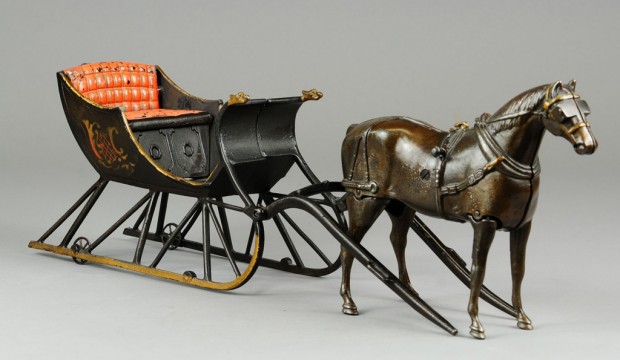
Known for selling fine antique toys including cast iron, Bertoia Auctions in New Jersey made $86,250 earlier this year for a rare and pristine Ives cutter sleigh pulled by a walking horse with articulated legs. The 22-inch-long toy is remarkable for details including running boards with figural ends, padded seating and a movable hitch. The one-owner sale realized over $2 million.
COLLECTOR QUIZ
Q: When did Mattel release the first Harry Potter action figures?
a. June 2000
b. September 2001
c. August 2000
d. October 2001
e. September 2000
A: The answer is d. They came with a casting stone for use with the Electronic Powercasting Playset. Figures with crests on the uniforms are worth more today.
Source: "The Unofficial Guide to Harry Potter Collectibles" by Kathy Wells (Schiffer, $14.99).
Danielle Arnet welcomes questions from readers. Send email to smartcollector@comcast.net or write Danielle Arnet, c/o Tribune Media Services, 435 N. Michigan Ave., Suite 1400, Chicago 60611. Please include an address.