

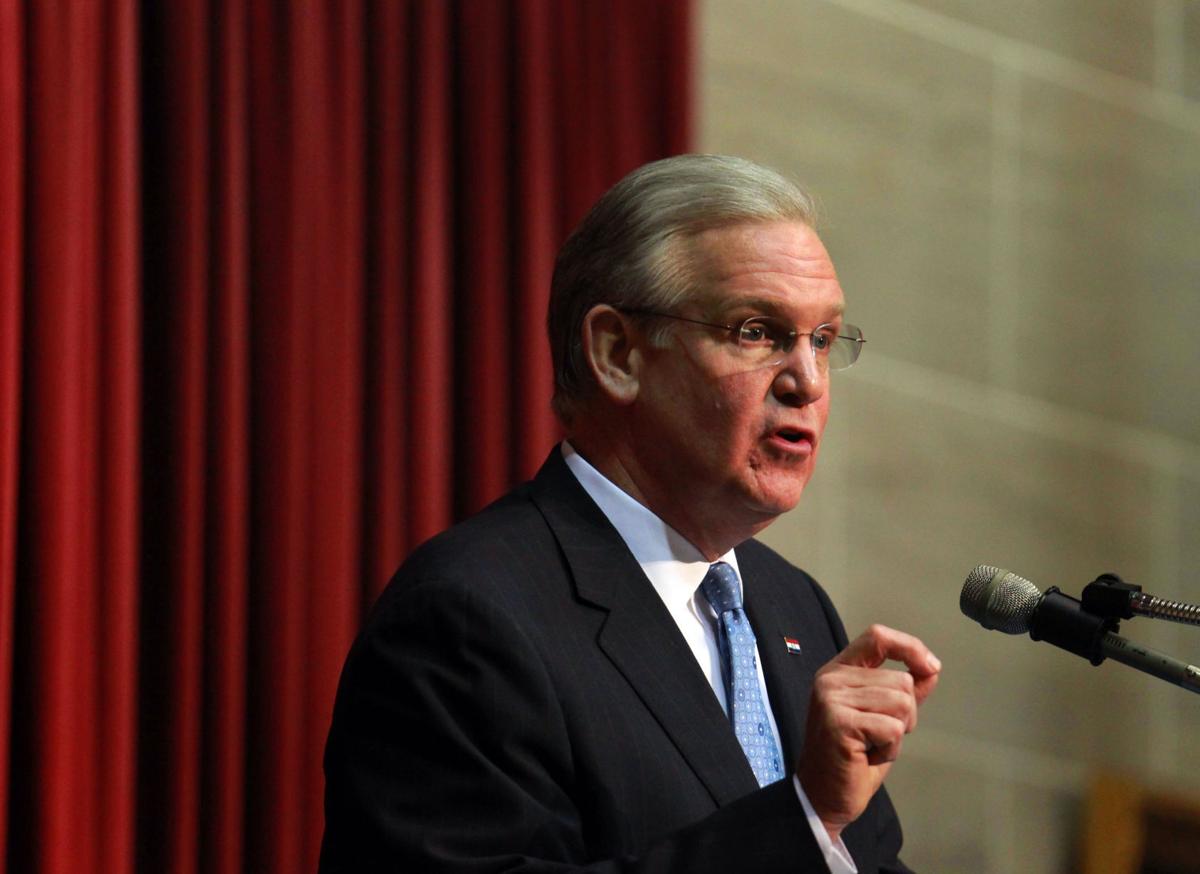
JEFFERSON CITY • Gov. Jay Nixon, who said in January that “I don’t do bill reviews at halftime,” broke with that policy today by offering harsh criticism of a tax proposal that is nearing a final vote in the Missouri Senate.
In its major provisions, the bill would cut state income tax rates for individuals and corporations by 0.75 percent over the next five years. Over the same time frame, it would raise the state sales tax by one-half cent.
Nixon, a Democrat, said the Republican legislative proposal would shift taxes “away from corporations and the affluent onto those who can least afford the added costs.”
Under the bill, “a single mother’s school supplies would cost more, while a corporate executive’s country club membership would cost less,” said his letter to senators. “This shift would hit seniors and veterans living on fixed incomes especially hard.
People are also reading…
"Making a veteran with aches and pains pay more for an aspirin so that an S-corporation can get a tax cut does not reflect our priorities," Nixon said.
The governor urged the Senate to reject the bill, which a fiscal note projects would reduce state revenue by $477 million to $670 million a year when fully implemented.
The bill is sponsored by Sen. Will Kraus, R-Kansas City. His office had no immediate response to the governor's letter.
The Senate gave preliminary approval to the bill last week. It awaits clearance from the Governmental Accountability and Fiscal Oversight Committee. After passing that hurdle, the bill will be up for a final Senate vote, probably later this week. If passed, it would move to the House.
Supporters cite recent tax cuts in Kansas as the catalyst for the bill. Kansas eliminated income taxes for thousands of small businesses and lowered individual income tax rates, spurring fears that some Missouri companies on the western border would move across the state line.
Under Kraus’ bill:
The top personal income tax rate in Missouri would gradually drop to 5.25 percent from 6 percent.
The personal exemption would nearly double for individuals with adjusted gross income of less than $20,000.
Businesses that report company income on owners’ personal tax returns would get a phased-in, 50 percent deduction.
The corporate tax rate would gradually fall to 5.5 percent from 6.25 percent.
The state sales tax would be increased by ½ percent over the five-year period.
Missouri would attempt to tax online sales that now escape state sales taxes.
During the floor debate, Kraus said: “I believe we’re going to create an economic engine in our state and more money’s going to come in because of what we’re doing.”
Opponents disagreed, saying the bill could cost the state treasury as much as $700 million. They said the state needs the money for schools, roads and other services. Some wanted to wait and see the results of Kansas’ experiment before changing Missouri’s tax policy.
Nixon said Missouri’s tax burden currently ranks 44th nationally as a percentage of personal income.
“Putting an additional financial burden on each and every Missourian would threaten the progress we have made and hamper our economic recovery,” he said.
An analysis by the Associated Press estimated that under the bill, the typical household would save little. The bill could produce bigger savings for the wealthy, especially those who run their own businesses, the AP reported.
(The bill is SB26.)
Virginia Young is the Jefferson City bureau chief of the Post-Dispatch. Follow her on twitter at @virginiayoung.


