

CAEN, France — The memories are 64 years old but retold with the clarity of yesterday: a young boy lowered by rope into a deep, dark cave, watching the sky above shrink to a small and distant patch of blue.
That hole was home for a month for Gerard Mangnan, his family and dozens of others. And it likely saved their lives. While they huddled underground, Allied and Nazi troops above were waging one of the toughest battles of the D-Day invasion.
Now, generations later, the story of how caves and quarries became bomb shelters during the 1944 battle for the Normandy city of Caen is being brought alive by an amateur archaeologist, his photographer colleague, and the memories of survivors like Mangnan.
Most remarkably, the cave enthusiasts — Laurent Dujardin and Damien Butaeye — have rediscovered quarries that had lain largely undisturbed since the war, mysterious and eerie worlds frozen in time.
People are also reading…
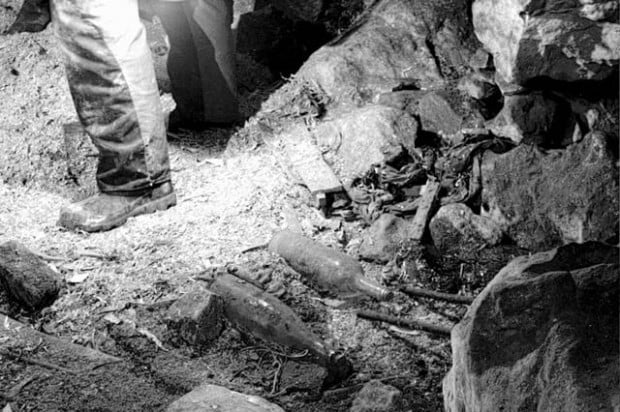
A shoe. A rusty bike. A child's coloring book. Jewelry. Cough remedy bottles. A box of Ridgways Finest Darjeeling Tea ("Grown at the altitude of 3,000 feet," says the still visible lettering).
Souvenir hunters with metal detectors have long picked over Normandy's battlegrounds, but underground, in these virtual time capsules, "You have the feeling that people were still there 24 hours beforehand and, most important, it has never been manipulated, picked up, moved," historian Stephane Simonnet, of Caen's war museum, said in an interview with The Associated Press.
Butaeye and Dujardin guided AP journalists through one cave where several hundred people sheltered. It sent shivers down the spine, and not just because of the cold and damp. In a site so well preserved, it was easy to imagine the hacking coughs of people packed together, children wailing, and old men groaning, the stink and discomfort, everyone wondering whether the relentless Allied bombing would bring down the caverns and bury them alive.
"They lived with the cold, with fear," said 55-year-old Dujardin. "Some were sick. There were a lot of respiratory diseases. So conditions were very difficult. There was the lack of food, the stress. Those who went outside to get food risked getting hurt or killed."
Attack lasted two months
Caen, straddling the River Orne and garrisoned by German troops, was a key objective for the Allies' attack on Adolf Hitler's heavily defended Western front.
At dawn on D-Day, June 6, 1944, the bombing and shelling began, lasting more than two months. Allied planes sometimes dropped leaflets before a raid, warning: "The vital objective near which you find yourself will be continuously attacked. … Leave now! You don't have a minute to lose."
British troops liberated one bank of the Orne on July 9; Canadians liberated the other on July 19. German forces counterattacked but were finally beaten back, and lobbed their last shells on the city center on Aug. 10, said Simonnet.
In all, he said, 10,000 tons of Allied bombs fell. Three-quarters of the city was destroyed. Distinguished by big red crosses painted on sheets hung on their roofs, churches were largely spared but otherwise "virtually nothing was left," he said. Some 2,000 of Caen's inhabitants were killed.
But for many others, Caen's quarries proved a lifeline. The city and its surroundings are riddled with caves from which Caen's famous limestone was extracted for centuries, ferried up the Orne to build such faraway monuments as the Tower of London and Cologne Cathedral.
20,000 hid in quarries
Roughly one-third of Caen's 60,000 inhabitants took refuge in about a dozen quarries, the biggest sheltering 8,000-10,000 people, said Simonnet. Some stayed a few days, others longer. Some emerged at day and sheltered at night. Mangnan, then 7, stayed underground for weeks without coming up.
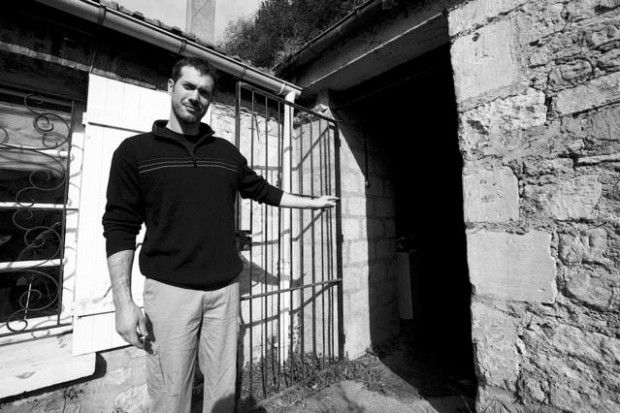
The cave that the AP toured burrowed dozens of yards into a hill. Its entrance, behind a house, was barely shoulder-wide — a narrow, slippery crack in the rock that led down to larger caverns.
There, refugees slept on mattresses, straw or piles of wood shavings. Families marked out their space by piling stones into little walls. They are still visible.
Here lay a rusty fork and spoon, there, an ink bottle still screwed shut with ink inside.
One quarry-shelter had an abattoir, said Dujardin. Soup kitchens served stew, made with animals killed or injured in the bombings.
"There were soup kitchens outside, a clinic," he said.
Mangnan said 50 people huddled in his cave. A pot served as a common toilet. A woman in labor was hauled to the surface to give birth in a nunnery.
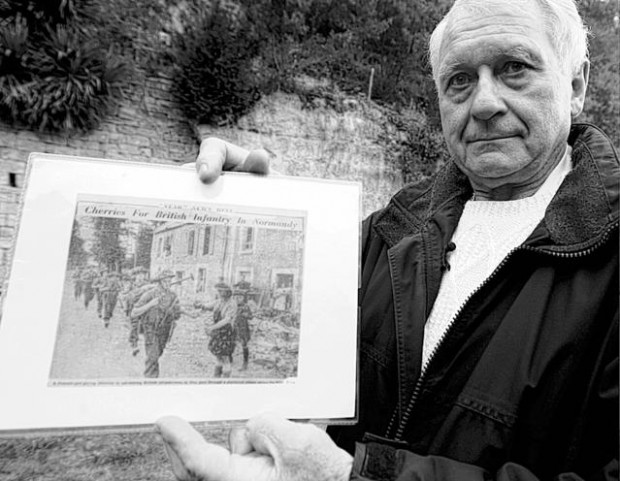
Canadian troops once visited their cave. "They brought us chewing gum, biscuits in square tins and tobacco in round tins for the men," said Mangnan, now 71.
His elder brother Roger, then 18, was killed falling down the entrance hole on June 23, 1944, he said. Venturing outside, the Roger had stolen some machine gun ammunition from the Germans. They chased him back, shooting. He leaped for the rope, but let go as he slid down.
Finally, in July, they deemed it safe to climb out. Mangnan described the long scramble upward by ladder as "the fright of my life." "My mother said, 'Don't look around, climb, climb, climb,' " he recalled.
They emerged to scenes of devastation, of hedgerows torn up and walls caved in.
In the postwar rebuilding of buildings and lives, the weeks underground tended to be forgotten, pushed into Caen's collective subconscious, Simonnet said. Survivors preferred not to relive their wretched experiences, and historians concentrated on the battles and the soldiers who fought them.
"People spoke about the landings and the liberators but we haven't spoken until now of this daily life, living a little like hidden rats, in the humidity and dark, with death, pestilence and lice," he said. There were births, deaths, underground hospitals, kitchens, a real subterranean life that had been a bit underestimated until now."
On the Net
Slideshow on Caen museum site:



 Nancy Guthrie's Tucson neighbors: Life with streamers 'unbearable'


