

I’m a folklorist, not an historian. My kind typically uses the past to help understand the present, rather than treating the past as subject matter in its own right. So I find myself turning Black History Month into Black Heritage Month for the purposes of this blog.
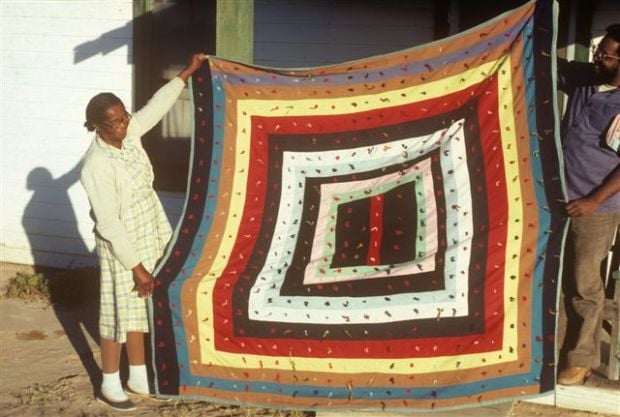
And for now, I want to share with you our region’s exciting African-American quilting traditions as I encountered them in the early 1980s, when I did the fieldwork that produced these photos. These are truly field photos. We would be directed to a quilter, get into conversation with her, and ask her to show us her work and let us photograph it.
We had no special equipment for displaying the quilts — we either held them up or hung them over a handy fence. The “we” was myself and Worth Long, an African-American folklorist who acted as my mentor for a couple of weeks.
Here is what we found out, looking at the design of quilt tops. (We didn’t worry about the distinction between knotted and quilted coverings; it was the pieced designs we were interested in.)
People are also reading…
These quilts had brighter, more contrasty colors than the majority of quilts made by European-descended quilters. Strict symmetry and precise repetition of design elements seemed less important than a kind of variation upon a theme.
For instance, in Mrs. Muldrew’s quilt (below) she uses strong colors for her strips, and contrasting colors for most of the knots. But not all the time, as some of the knots are of the same color as the strips behind them, apparently randomly. This brings a sense of improvisation and playfulness to the entire design.
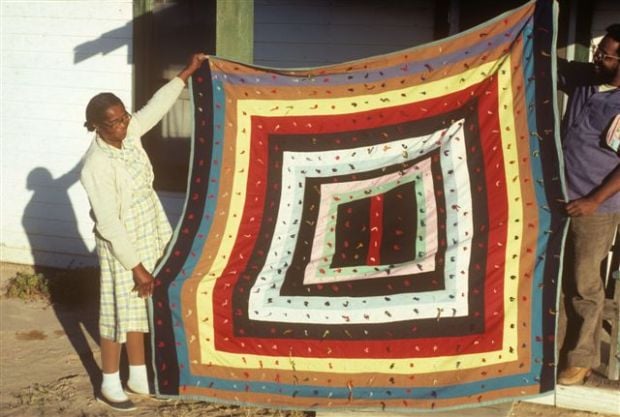
Mrs. Ella May Muldrow and Worth Long holding Mrs. Muldrow's strip quilt ouside her home in Randolph, Arizona. Photo by Jim Griffith, Special to the Arizona Daily Star
Similarly, in Mrs. Woods’ “bow tie” quilt (below), the selection of the materials for the bow ties seems almost random, rather than calculated.
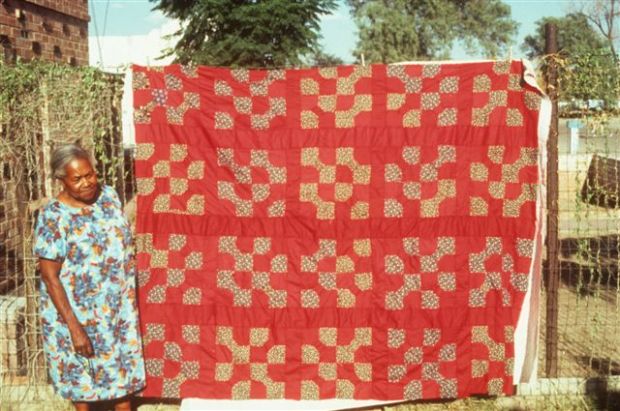
Mrs. Ruby Woods with the "bow tie" quilt top she has just pieced. Tucson, AZ. Photo by Jim Griffith, Special to the Arizona Daily Star
Once one realizes that these women are not playing by the European-derived rulebook, one can find oneself excited by the improvisational nature of the designs. That, and the preference many of the women show for organizing their patterns into strips, reminiscent of some West African woven cloth, suggest that these quilts are organized according to a set of rules that have their origins in West Africa, rather than in Europe.
Now it’s time to let the quilts speak for themselves. As you look at these pictures, see if you don’t agree that, while the game (quilt making) may seem familiar, it’s being played according to a very different rulebook. And this rulebook has at least some of its origins in West Africa. That some women are still following that rulebook strikes me as a kind of miracle. And that’s another way in which an African heritage has enriched the fabric of our national life.
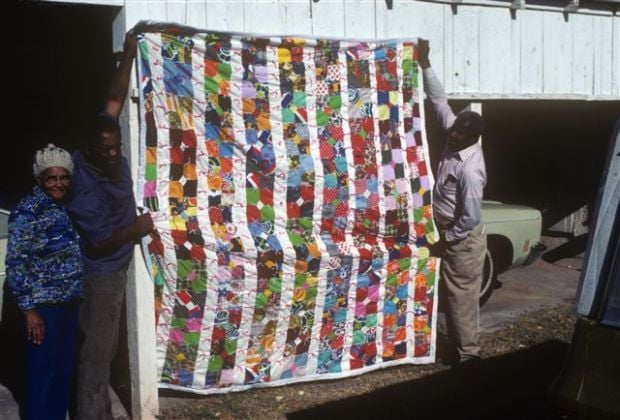
Another take on the "bow tie" pattern. Reverend and Mrs. Cartwright and Worth Long outside the Cartwrights home in Florence, Arizona. This time the bow ties are organized in strips, rather than squares. Photo by Jim Griffith, Special to the Arizona Daily Star
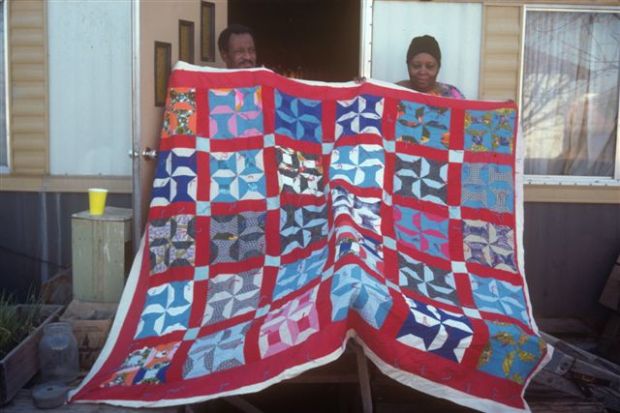
Reverend and Mrs. Hilaseo Howard with Mrs. Howard's "hourglass" quilt at their home in Eloy, Arizona. Photo by Jim Griffith, Special to the Arizona Daily Star
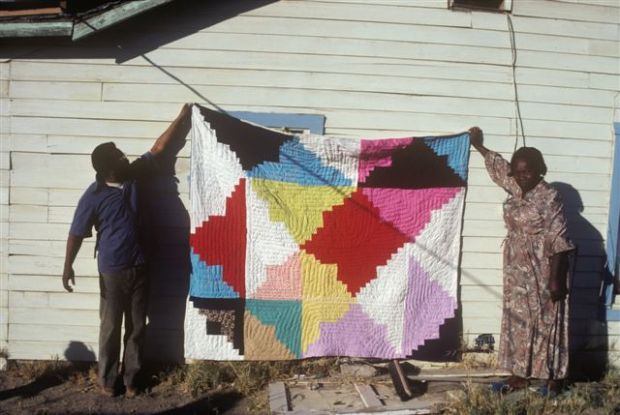
Worth Long and Mrs. Lenore Mathis with Mrs. Mathis' "Light shade" quilt, Randolph, Arizona. This is the most startling quilt I have photogaphed, and I couldn't bear to leave it out. Photo by Jim Griffith, Special to the Arizona Daily Star


