

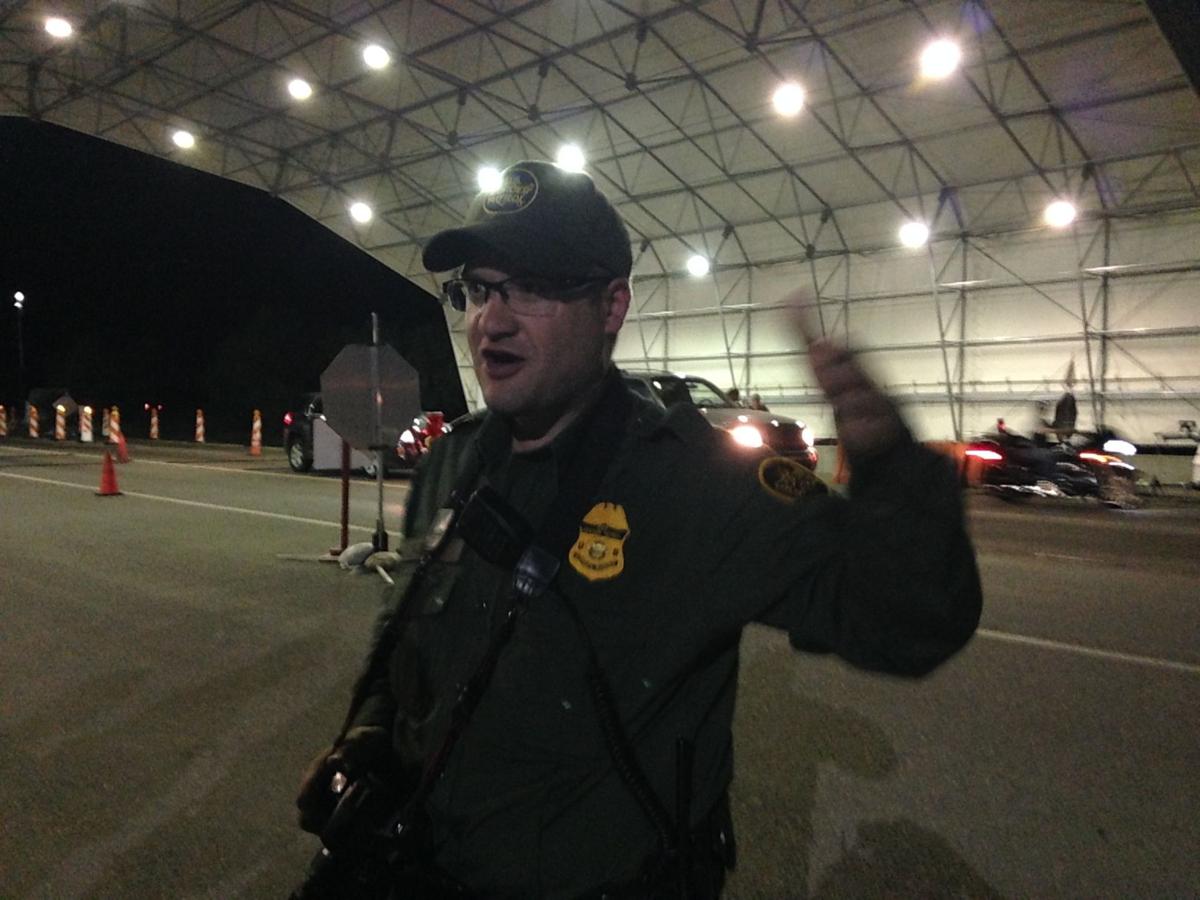
The Nogales Station Border Patrol Ambassador classes started last week, unfortunately I wasn’t able to attend the initial session because I was in New Mexico visiting the detention center in Artesia. During the first class, attendees learned about the agency’s history and immigration law. They were given a six-page handout on nationality and immigration law (which they were nice enough to share with me this week).
For Thursday’s class we got to tour the Nogales station and learn more about area checkpoints, a point of contention with many in the community.
The station on 1500 W. La Quinta Rd. is the largest in the country. When the Tucson sector was apprehending hundreds of thousands of people in a year, the Nogales station was where a lot of them were coming through. About 1,000 people were caught every night -- and they have the pictures to prove it.
People are also reading…
Photographs line the hallway from where agents get their daily assignments to the armory area where they check out equipment for their shift. The pictures show agents crawling out of tunnels, apprehending a group of more than 100 crossers in the desert, and canine teams next to the drugs they helped detect.
Leslie Lawson, who became the fifth female Border Patrol station chief in 2011, stopped by to welcome the group of 14 participants, including myself. She’s a native of Vermont, born and raised along the border, she said, only five miles from Quebec. Her 20 years in the Border Patrol have taken her to the Caribbean, Mexico, Washington, D.C., and now Nogales.
She described the ambassador academy as “peeling back the curtains of the theater.”
Next, we got to hold the M-4 rifle agents are assigned, look through night vision goggles and feel the weight of a bullet proof vest. With all the equipment, weapons and uniform, agents can end up carrying about 100 pounds, said Richard Funke, one of two agents leading the academy.
That’s a lot to carry, but surprisingly once agents graduate from the academy there is no active duty fitness requirement. You would think it would be in the agents’ best interest, especially if they end up hauling out of the desert one of the 75-pound marijuana backpacks they often seize.
Although I had previously toured the station back when I first joined the Star nearly two years ago, the citizens’ academy offered a more thorough visit. Not only did we stop by the radio room, where agents and two National Guard members monitored the feed from the infrared cameras, we also visited the detention area’s control room, where the holding cells are visible through large windows.
We went from the strong smell of coffee in the radio room to Lysol in the detention area. Cameras inside the control room showed some of the 16 border crossers held that night. Some slept on green mats, covered with blankets. One of them took a cup of water from a cooler, something Agent Raymond Bean, our other instructor, was quick to point out since there’s been criticism of the Border Patrol’s treatment of its detainees.
The thermostats on the wall were all set to the low to mid 70s, another thing that Bean addressed since advocates and immigrants often refer to the holding cells as “hieleras” or freezers.
But the main point of the class was to learn about the checkpoints, what agents can and cannot do, and why. A participant asked about vehicle profiling. Her husband, she said, used to drive an older model vehicle with tinted windows that was still registered out of Phoenix because they had just moved. The Border Patrol followed him all the time around the Elgin area.
We spent some time – I lost track of time – in a conference room learning about when probable cause is needed versus reasonable suspicion and mere suspicion. It turns out that agents only need “mere suspicion” that the person is not legally in the country to send the car to secondary inspection. I was under the impression they needed more to send someone to secondary.
They can also ask a series of questions as long as an agent keeps the line moving, Bean said. At checkpoints, before they even get to secondary, agents can ask about immigration status, make open-view observations, press down on a vehicle’s trunk (to get sense of load), tap exterior fuel tanks and request consent to search. If a canine unit is present an alert gives the agent probable cause to send a vehicle to secondary inspection. (There were plenty of questions regarding dogs and alerts, but Bean said that would be part of another class).
There are laws and court decisions that give the Border Patrol the authority to have checkpoints. Congress has given the agency authority to do line watch (the immediate border area) and access private lands within 25 miles of the border, “but not dwellings for the purpose of patrolling the border to prevent the illegal entry of aliens to the U.S.,” Bean’s presentation said.
At about 7:30 p.m. we got in our cars and drove about 30 minutes north to the I-19 checkpoint. I had also been to the checkpoint before, but had never been inside the trailers where agents fingerprint those arrested and weigh drugs seized.
There are also two small holding cells, one was basically a steel box while the other had steel mesh. When we got there an agent was leading a young man in handcuffs to one of the cells. He apparently had an outstanding warrant and the Department of Public Safety had been called to pick him up.
An SUV was sent to secondary inspection after the dog alerted. Another agent got inside a pick-up truck that carries an enclosed portable X-ray machine in the back and slowly drove it back and forth parallel to the SUV until he had a thorough image of the vehicle. Agents continued to search the SUV, the dog was called again, but at the end the driver was free to go.
Since 9/11 agents carry PRDs, personal radioactive devices, around their waists that alert them of any radiation. When it vibrates, agents ask the driver to pull to secondary inspection to figure out where it’s coming from. So far, it has detected people who have gone through recent medical procedures. Once they figure that out, they are free to go.
For people who got through the checkpoint every day or even several times a day, waiting in that line can seem like a drag. “I know that waiting in line can feel like forever,” Bean said. But per car, he said, the agent is taking between 15 and 20 seconds. Thursday night seemed to be quiet, with not too much traffic, and class was dismissed at a little past 9 p.m. as the nearly full moon rose behind the Santa Rita Mountains.
Contact Star reporter Perla Trevizo at 520-573-4213 or ptrevizo@azstarnet.com. On Twitter: Perla_Trevizo.


