


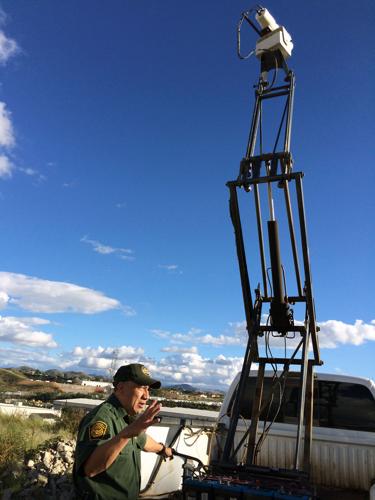
This was the last week of the Nogales Station Border Patrol community ambassadors program and since we had missed a class when heavy rains were projected due to Hurricane Odile last month, the instructors had to cram a lot into it -- but it was all very interesting.
We started the evening by learning more about the mobile surveillance cameras agents use out in the field. Border Patrol veteran Henry Lopez showed us the truck he drives that has a camera mounted on its bed. It has long-range thermal imaging sensor systems and is mostly used at night. Basically with this camera, he said, agents don’t always have to trek miles to see what activated a sensor. Many times, Lopez can just drive close to the area and use the camera to see if it was cattle or people.
Depending on the terrain, he can see as far out as five miles. For Nogales, being surrounded by mountains and hills filled with thick brush, it’s often less. Still, Lopez said it comes in very handy.
People are also reading…
“There’s a lot of thick cactus and cholla in the terrain, I’ve walked the terrain,” he said. “I try to make it as safe as I can for the agents.”
Agent Raymond Bean, one of our instructors also showed us the Recon 3, a thermal imaging camera that he said costs more than his house. Price is around $100,000 he said. It’s amazing how clear you can see through the lens and how far.
From learning about the surveillance equipment the agents use out in the field we went inside a warehouse to learn about traffic stops. This was supposed to be part of that September class we missed, so it was cut short, which is a shame because there is so much to this topic.
It turns out the warehouse where Agent Ryan Gilbert did his presentation and demonstration was the same warehouse where the Border Patrol processed and detained about 5,000 unaccompanied minors this summer, many of them who had crossed through Texas.
Since agents in Texas where overwhelmed by the large numbers and lack of space, many were brought to Arizona, where the Nogales station already had this huge warehouse that had at one point been used to process large numbers of Mexican men. Although it was now mostly empty, remnants of when the children and teens were held here was still visible, including signs with numbers and the words “incoming juveniles” and “incoming females.”
Gilbert focused on two things: officer safety and what an agent needs to have in order to stop a car. Border Patrol agents can’t stop cars for traffic violations. They can stop a car, for example, is they suspect the person is not legally in the country or for smuggling (people or drugs).
The agent, as any law enforcement officer, has to be able to articulate why they made that stop. But what a colleague and I found when we were investigating the impact of Arizona’s SB 1070 law, is that many law enforcement officers, not only Border Patrol agents, don’t often include in their reports enough information to paint a complete, full picture of why the stop was made.
For instance, Gilbert said, a car with tinted windows on its own is not enough to give an agent probable cause, but if the suspension is low, it has tinted windows, is driving on a road at a time that agents know is common for smuggling, the driver is nervous, etc., all of that put together may give the agent probable cause to stop the car.
In terms of safety, it was interesting to see everything an officer has to do and think of before they make a stop and during the stop. For instance, turning the wheels to the side in case a car hits the patrol car from behind. Or that the officer is trained to leave his fingerprints on the car he stops in case something happens to him and the car flees the scene.
I hope I don’t get stopped anytime soon, but if it happens, I’ll see what the officer does. It will be interesting to compare with what the agent taught us.
And finally, probably one of the most interesting parts of the class (maybe it’s just because I love dogs) was about service dogs.
A couple of facts I learned:
• The Border Patrol’s canine program started in 1987.
• One of two training sites is actually in my hometown of El Paso.
• Most of the Border Patrol dogs are bought in Europe, although they’ve recently started their own dog breeding program when a dog they bought was pregnant.
As with other things related to the checkpoint, dog alerts — and not only for Border Patrol, but in enforcement in general — have been contested. At the checkpoints, an agent can’t search inside a car unless the owner gives them permission or they have probable cause. A dog alert can give them that.
Agent Chris Dudding, a trainer and handler, said people often say, “Well I didn’t see a dog sit, or they didn’t bark.”
The dogs the Border Patrol uses are trained with specific odors: concealed humans, drugs (pot, meth, cocaine) and its derivatives.
A dog gives the handler an alert and sometimes an indication, here’s how they explained what each means:
• Alert: a change of body posture and increase respiration when the dog first encounters the odors he has been trained to detect.
• Indication: trained behavior that pinpoints to source. (Sit, down, point -- stare where they believe the odor is coming from.)
The alert is what they would use in court and indication is a plus, Dudding explained.
Dudding and Bill Akins, another trainer and handler, said handlers are trained to read their dog’s alert and that no two dogs have the same alert. And the bark you sometimes hear as you drive down the checkpoint, they said, is the dog letting out his/her frustration but has nothing to do with alerting.
The Nogales station has between 20 and 25 dogs. Dogs can do search and rescue, find human remains, track and trail, patrol (apprehend people by biting) or detection.
Here’s a list of three cases they cited as their basis for legal authority, including that the Supreme Court has determined that a dog sniff is not a search:
And to end the night, Ice (Dudding’s dog) and Laura (Akins' dog) did a little demonstration.


