

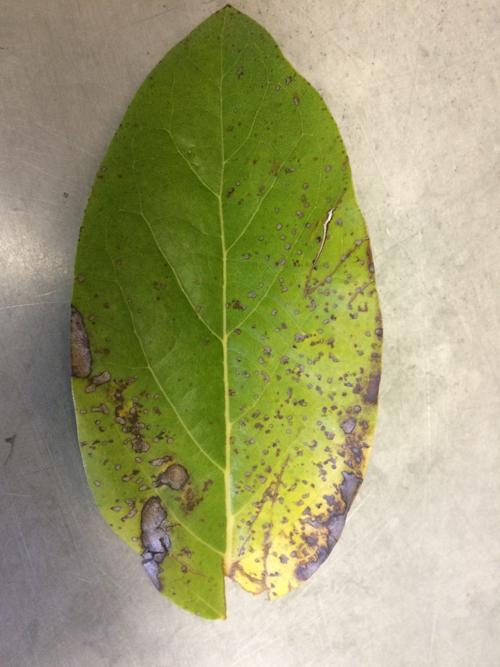
My avocado leaves are getting yellow, and brown spots are appearing as well. Is there something I can do to keep the plant healthy?
If it’s an avocado, it’s going to look horrid. They don’t do well here because it’s too hot and/or too cold. Our soil is also too salty and too alkaline.
There were no signs of feeding arthropods on the leaves so I suspect dust, salt or wind damage.
Keep it well irrigated and fertilized and be prepared to replace it with something better adapted to Arizona when it dies.
I know that is not want you want to hear but it’s the way these things grow here.
I was referred to you about my sick eucalyptus trees. I believe they have lerp psyllids. What can I do to keep my trees healthy?
People are also reading…
You are correct; the lerp psyllids (Glycaspis brimblecombei) are a common pest of eucalyptus trees in this region. Originally from Australia, these insects also occur in Florida, Hawaii, and Mexico on a variety of eucalyptus species.
Psyllids in general are about the size of aphids and have similar feeding habits in that they suck sap from plants with their piercing, sucking mouthparts.
The term lerp refers to a waxy circular cap they produce as a cover that serves as protection from the environment.
The good news is that they are a temporary pest problem and do little damage to the trees in our area.
One reason they are temporary is that monsoon rains reduce their populations by washing them off the trees.
There are also many predators of these insects including birds and a variety of insects like lady beetles, lacewings, and pirate bugs (arrrr!).
Keeping trees healthy is the best defense and this includes proper irrigation, fertilization, and pruning.
I live in Green Valley in a 16-year-old home I purchased two years ago. The home has a large century agave plant in the front yard. This last week I noticed a large stem that looks like an asparagus growing up from the center of the plant; I believe this is the bloom. Will this result in the plant dying? Can I stop this process by cutting the bloom down, as I do not want to lose the plant?
No, the process cannot be stopped or changed. So enjoy the beautiful blooms and plan your replacement strategy. Many agaves reproduce by putting out “pups” that can be transplanted.
Peter L. Warren is the Urban Horticulture Agent for Pima County Cooperative Extension and the University of Arizona. Questions may be emailed to plwarren@cals.arizona.edu
Peter L. Warren is the Urban Horticulture Agent for Pima County Cooperative Extension and the University of Arizona. Questions may be emailed to plwarren@cals.arizona.edu


