

This writer from San Francisco paints such a lovely picture of the area that it is no wonder the Arizona Weekly Star reprinted it.
From the Arizona Weekly Star, April 10, 1879:
A visitor describes San Xavier del Bac and Tumacacori
First reported by Ben C. Truman in the San Francisco Bulletin.
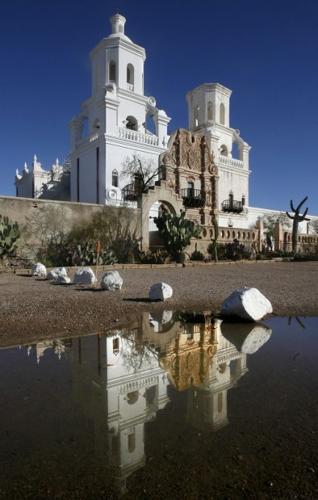
Few travelers through this section of Arizona have failed to vist and inspect the famous edifice, nine miles from Tucson, known as the Mission church of San Xavier; and no traveler who has written of Arizona, and who had gazed upon this venerable structure, has omitted giving a description of the sacred pile, a delightful paragraph in his book or correspondence.
Almost all who have wrriten thus, however, disagree regarding its age. Some say that the structure was commenced more than 200 years ago, while others declare that it is not over a century. As I stated in my last "Notes," I have seen a manuscript diary of marriages solmenized under its sacred roof 150 odd years ago.
From all I have learned concerning this architectural remant of Franciscan dominion in this part of America, I am entirely convinced that this temple in the wilderness was commenced and constructed more than two centuries ago, and it, or a former church on its site, may have been commenced over three centuries ago, for it is now 319 years since Coronado and his army camped on the Santa Cruz river, at or near the site of what is now Tucson.
This church is built in one fo the most charming and picturesque portions of the Santa Cruz valley, and, although its exterior is fantastically frescoed with the finger-marks of Time, and its massive towers are being ruthlessly touched by the hand of decay, is, even now, a magnificent monument to Christianity, and stands like an imposing milestone along the difficult pathway of faith.
The church proper occupies 8,050 square feet and is cruciform in style, or more particularly speaking, is shaped like a Latin cross. The highest point that can be reached is standing-room in the west tower, which is about 60 feet from the ground floower; adding ten or 15 feet more for a balance of height, would give the real height 75 feet, more or less. The edifice has two towers and a dome, the latter surmounted with a cross. The eastern tower is in a remarkable state of preservation, but the ravages of time have played sad havoc with the western tower, which however, has never approached a perfectly finnished state. The ascent to the bell tower is by a flight of steps cut into and worn into the masonry.
Omitting all extravagant detail I will proceed to state that the building is constructed of stone and brick and a character of cement which has no equal at the present day in this country. The interior is plastered, stuccoed and frescoed and is in many respects like the best of the Mission church buildings in California during the palmy days of Franciscan authority, except that none of the California edifices were so richly and elaborately finished, nor supplied with so artistically executed paintings and statuary; nor were any of the California churches possessed of such rare, costly and impressive altar and other appointments. The walls and ceilings still display unmistakable evidences of matchless mechanism and artistic manipulation of loud and subdued colors.
Vandalism and time have together performed a medly of irreverant work up on this noble landmark of Christianity and civilization. Either the one of the other, or both, have touched with unsanctified hands its outer and inner wall. Select Latin inscriptions have given way to rude hieroglyphics of the ignorant and irreligious "native here and to the manor born," or to the empty scrawls of the irreverent and uncultivated "looker-on in Venice."
Solid gold ornaments and latar appointments have gradually disappeared, until nothing of great value is left. Even the gilt, and veneering, and coloring are either besmearched or otherwise defaced. The 80-odd pieces of statuary, representing Jesus, the apostles, and many other celebrated characters of the great passion play of Christianity, are many of them mutilated and broken past reconstruction or renovation.
The large frescoe paintings of the "Last Supper," the "Pentecost," the "Nativity of Christ," and the "Anunciation," The "Visitation of the Virgin," etc., are almost past recognition, and it is only a matter of time when the walls upon which they are suspended will fall and crumble into ruin and dust.
I can conceive of no more delightful drive than that from Tucson to San Xaiver and below, even to Tubac and Calabasas. It is between six and seven miles from Tucson to the renowned church of San Xavier, for the most part through a wilderness of the largest mesquite trees in the world. They do not grow to such a height as those in Texas, but the branches shade two or three times as much ground.
It is not the venerable structure above that commands all the attention of the tourist — the tribe of ever friendly Indians known as the Papagos, with their civilized ways and Christian virtues, dividing with the edifice in which they worship the observations of all travelers. These Indians not only never have been and are not murderous, but they are unlike all other tribes, including the Pimas and Maricopas and the good Indians in northern Arizona — they will not steal.
They dress as much as possible, or as much as they can afford to, like men and women outside of Indiandom. The men and women all work although the women do the greater share. I think the Papagos are smaller in stature than any of the other tribes in Arizona. I have seen little women who did not seem over four feet or four feet and a half in height, packing great baskets of mesquite wood, containing sacks of fuel in some instances ten feet in height, which must have weighed, at the least calculation, 200, 300 and even 400 pounds.
Two miles below, the traveler comes to Punta del Agua, and ten miles further on Sahuarito — two pretty pieces of ranch property. Between these two ranches a smelting works will soon be completed for the concentrations of the San Xavier mines, situated a few miles west of the travel road. Eleven miles further is what is called Cauve crossing, and where the eccentric Santa Cruz river takes a subteranean course except during the rainy season, at which times it assumes the proportions of a young Mississippi. Fifteen miles beyond, in almost a directly northern course, is Tubac, with its savage and romantice history. Tubac is situated in the northeast corner of the Calabasas concentration of ranch lands. From Tubac, which will always remain a stage station and teamsters' camp, travel by stage and team branches off for the Arivaca and Oro Blanco mining districts on the east, and the Aztec, Tyndall and Toltec districts on the west. This road, from Tucson to Tubac, and below, is filled with teamsters, traders, travelers, and tramps. You cannot travel many miles at any time during the daytime that you do not meet parties going either in one direction or the other.
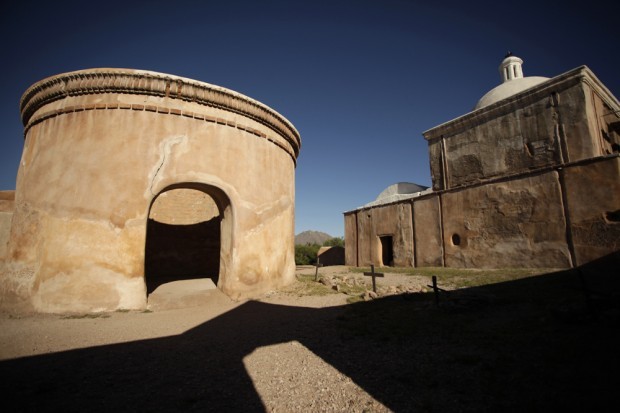
Next to the well preserved church of San Xavier del Bac, the ruins of the mission of St. Soseph, Tumacacori, (Morgue Lady's note: It was, indeed, spelled Soseph in the originial article, but it is likely the Mission San José de Tumacácori) command attention. These ruins are a little to the west of the regularly traveled road, between three and four miles from Tubac. The first mission erected, or established in this immediate locality was consecrated at Tubac in 1750, and was called the Santa Gertrudes mission. Shortly afterward this building was detroyed by Apaches. In 1751 a church was built upon the site now occupied by the ruins above named. This edifice shared the same fate as that of the Santa Gertrudes mission at or about the same time. In just 50 years afterward a new church was erected, and the ruins of Tumacacori constitute what is left of it; it having also been destroyed, or partially destroyed, by the Apaches 18 years after its consecreation.
While the above named church structure did not approach San Xavier in architectural beauty and grandeur, the outer and communicating buildings were more extensive and agricultural expectations greater.
At this late day, however, the ruin is not so completed but that the passer-by may see a good deal to reward him for the gratification of an inquisitorial turn of mind. The seeker after information will discover that the main building was at least 100 feet in length by 50 in width; that its shape describes a Greek cross; that it was substantially and elaborately constructed of sun-burnt and kiln-burnt brick, which were put together with a sort of cement and concrete; that it was well timbered and well roofed; that it was surmounted by two domes -- one over the chancel and one upon the eastern or southern corner; that there were pretentious residences for the padres and their master workmen and soliders, and abodes for their peons and neophytes; that there were orchards with oranges, lemons, limes, pears, figs and pomegranates, and gardens with flowers, vines, exotic plants, shade trees and possibly fountains. The dome above the chancel is still in a fair state of preservation, but the walls and the surroundings have crumbled or are crumbling into decay; its splendid timber and tile roof has been shivered by time and the elements, and its only covering now is the illimitable canopy of heaven with its imperishable constellations; the orchards with their umbrageous shade and fruit trees, through which sunlight and shadow used to chase each other and fatastically skirmish for mastery, and the gardens, with their hyperborean gifts, have all passed away; and the vast space between these consecrated walls dedicated to solemns offering in the sacred guise of chants, genuflexions and benedictions, is one vast pile of indistinguishable ruin.
The mountain scenery from this place is picturesque, sublime and enchanting. There is one point upon the road, though, say half way between San Xavier and Tumacacori, which presents a view at once grand and incomparable. You have left the Santa Catalina range and its detached continuations of castellated peaks sweeping northeasterly away to the far off horizon, and you gaze first upon the Picacho del Alamo Muerto, which rises majestically over your right shoulder, and then upon the Santa Rita mountains in the northeast, which left themselves like colossal ramparts before you. Further south you incline your vision again to the west, and the Sierra Del Paiarito and Atacosa mountains, like Titans, stand up along your path; again you turn to the east and a matchless panorama with Mount Wrightson in the foreground, and the Patagonians in the distance thrills the delighted senses. Each succeeding turn in this mosaic highway presents like the kaleidoscope a new and pleasant picture to the enraptured eye.
People are also reading…
As Tucson readers well know, the Mission San Xavier has been, and is still being restored. Dedicated artisans and generous donors have insured it will be a favorite destination for tourists and local residents for many years.


