

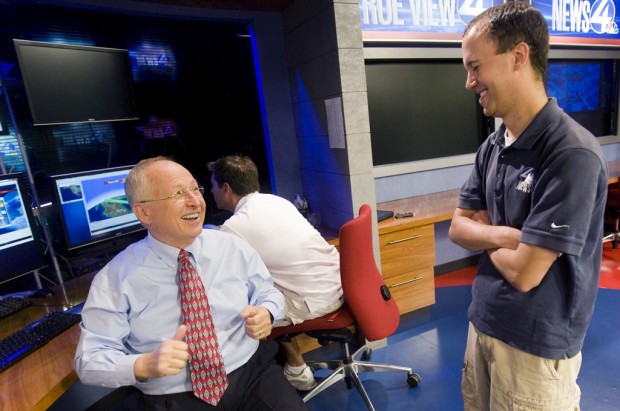
Plan A for KVOA chief meteorologist Jimmy Stewart, back when he was a little boy named Jim who banged baseballs off barns in Havana, Ill., was to play third base for the Chicago Cubs.
"My arm wasn't strong enough and I couldn't hit well enough, so that kind of went out the window," he says.
Plan B was to become a pharmacist. Jim enrolled at Drake University in Des Moines, Iowa.
"In my second year, my roommate worked at a radio station," he says. "I spent a lot of time at the station, and they eventually hired me."
This begat Plan C. Jim would drop out and climb the radio ranks toward the big time.
He made it - and then he was fired from a rock DJ gig in Washington, D.C., and learned in Iowa that he didn't want to be in management. Or live on the East Coast or in the Midwest. Or work in radio, really.
People are also reading…
Plan D was to stick with radio but head west. He posted an ad in industry rag Radio & Records seeking work in Seattle; Portland, Ore.; Phoenix; or Tucson. KCUB, then a country station, bit. Jim decided he would become Jimmy, telling the Star in 1982, "It's just one of those things that seemed to fit better with country music."
Plan E was thrust upon Jimmy, who transitioned to news at KNST. Ring! went the studio hotline, usually a sign of trouble.
But Jimmy was not in trouble. Fate was on the line. A KOLD executive called to say he liked Jimmy's style and asked if he knew anything about weather.
"No."
The exec asked if Jimmy was interested in weather.
"Not really."
"Let's talk," he recalls the executive saying.
Soon afterward, Tucson had its newest weatherman - someone local viewers would welcome into their homes for 30 years. His last visit before he retires will be Wednesday.
The underdog
Jimmy was not content to be a weatherman. He reasoned that if he were to stop this pingpong ball of a career, he'd need an edge. He would become Tucson TV's first meteorologist.
"When I worked my radio job in Ann Arbor, no matter how good I was, I was in the shadow of the Detroit stations," he says. "I could never really beat them. I said I was never gonna put myself in the position again where I was an underdog."
He saved up paychecks and quit his radio gig to channel his energy into becoming Tucson's first meteorologist newsman. For 18 months, he says, he did little but work, study and sleep, taking 18 to 20 units a semester, even as KOLD asked him to go from weekends to full time. The station kept a motel room on retainer, and Jimmy would slip into it for power naps or cram sessions before newscasts.
"It was worth it," he says - he secured his degree in 1986.
Broadcast news, though, was too volatile to indulge Jimmy's Plan E, F, G or whatever letter he was up to by then. In 1989, KOLD shook up the staff. Management did not renew his contract but let him work month-to-month.
He mused to the Star at the time that he knew he would be out of a job any day, and there were no open positions for weathermen - even a meteorologist. But, as jeering weather-obsessives let him know all too often, Jimmy's forecasts are sometimes wrong.
It turned out KGUN and KVOA had their sights set on him for some time. KVOA managed to land him, grooming him to take over for local institution Michael Goodrich in 1998.
Jimmy says former KVOA General Manager Jon Ruby, who died May 17, always told him that he never really wanted Jimmy - he just didn't want another station to have him.
And no other station ever did get him, despite offers from Cleveland, Dallas, El Paso and Phoenix.
"Had I not been in major markets in radio, I wouldn't have been happy until I made it major-market in TV," he says. "Major markets are not what they are cracked up to be. The pressure is greater and it's not as much fun. Also, they say it takes about six years to get a following as a meteorologist. I figured if I stayed in the same place, I'd earn quite a bit of money and get a great following, but not if I jumped around every two years."
"Really a funny guy"
KVOA's Martha Vazquez, who has worked with Jimmy at KOLD and at KVOA since 1984, says one of his strongest traits is his sense of humor.
"He's really a funny guy. A lot of that comes across. He's got a very dry sense of humor, kind of a different sense of humor. He'll say stuff that makes me think to myself, 'If people only heard that. ...' "
An example: Pausing as he cobbles together graphics for the night's broadcast on his iPad, Stewart chuckles as he recounts a 1993 newscast in which he became stranded in a monsoon flood and flagged down a police officer to hustle him down to the station. His pants were soaked.
"I just ended up taking them off and ended up doing news in my undershorts," he says, transported back to the moment though he's no doubt told the story dozens of times. "The news desk was hiding everything."
Minutes later, his replacement, Rob Guarino, jokes that whenever he does something wrong, Jimmy beats him with a stick. Jimmy smiles.
Jimmy glows with the excitement of an 11-year-old about to embark on summer vacation as he ticks off the plans for retirement. He is establishing a nonprofit corporation, Weather Bus Inc., through which he'll take a converted 2000 Blue Bird school bus from school to school for the next five years, three days a week, three weeks a month, teaching meteorology to kids in late elementary school.
"I'm not a Harley guy"
He'll take as many motorcycle trips as possible, using his small stable of Italian and Japanese bikes.
"I'm not a Harley guy," he says.
On one trip, he'll travel cross-country alongside one of his two sons, Steve, to his hometown of Havana, Ill. Stewart says they'll take it slow, pausing to check out towns if the weather makes travel dangerous.
He plans on playing a lot of golf and spending time with his wife, Elaine Jackson, at their second home in Bisbee.
"Most of my energy is going to the weather bus," he says, segueing into his passion for education. "I've spoken at hundreds of schools to thousands of kids over the years. I can't say I didn't get up some mornings and wish I hadn't scheduled them.
"But I never once walked out of the schools without a good feeling."
KVOA News Director Cathie Batbie-Loucks says Jimmy has treated her the same since her days as an entry-level producer in the late 1990s. She praises his work ethic.
"The guy you count on"
"Jimmy is always here. Any time there's any kind of weather happening off of his shift, he's easy to get ahold of. He immediately comes in. The monsoon is really important to him. He's always available to do whatever is needed. He's the guy you can count on, which is not always easy to find."
And now Jimmy won't be quite so easy to find. He will do his own thing, and he thinks his fame will pass like a fleeting monsoon storm.
"It lasts for about five years," he says before trailing off, as if wondering what it will be like in 2016 when fans stop bugging him for autographs at restaurants.
Not that he wants to stay a local celebrity. "I don't think I'll really miss that. There are so many people that know me. I don't know them."
He pauses for a half-second, saying diplomatically, "but they're really good people."
"Rain ... is great"
Jimmy is amused by how his time in the desert has warped his Midwestern view of weather.
"In Tucson, I think I'm like a lot of people. I look forward to a cloudy day. In other parts of the country, rain is bad weather, but I don't think rain is bad. I think it's great."
Asked if he sometimes wishes he'd decided to stick around a bit longer, Jimmy shakes his head. He tried to retire a year ago, he says, but management persuaded him to stay one more year.
Asked if he's wishing away these last few days, full of awkward goodbyes and on-air hullabaloo, he shakes his head again. He's relishing this final chapter.
"I'll still see all these people," he says as he glances around the studio, almost as if to convince himself. "I'll be affiliated with the station, at least to a certain degree."
What would he like viewers to remember about him?
"That I was always there. Informing them. Letting them know about the weather. Keeping them safe."
DID YOU KNOW
Stewart has been in the broadcast news business for 50 years, starting in radio in Ann Arbor, Mich., in 1961. He stayed in radio, bouncing around to Washington, D.C.; Des Moines, Iowa; Minneapolis; and Tucson, where he worked at KCUB and KNST before making the jump to TV, taking over as weekend weather anchor at KOLD in 1981. Stewart earned an atmospheric physics degree from the University of Arizona in 1986 and joined KVOA in 1990. His last day on the air will be Wednesday.
Contact reporter Phil Villarreal at 573-4130 or pvillarreal@azstarnet.com


 Historic bank vault now new Tucson speakeasy


