

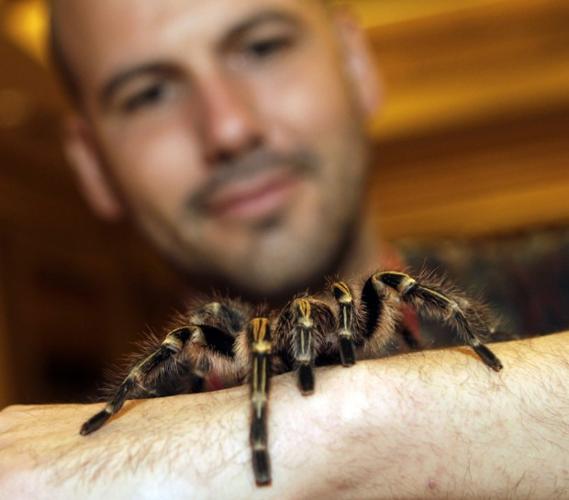
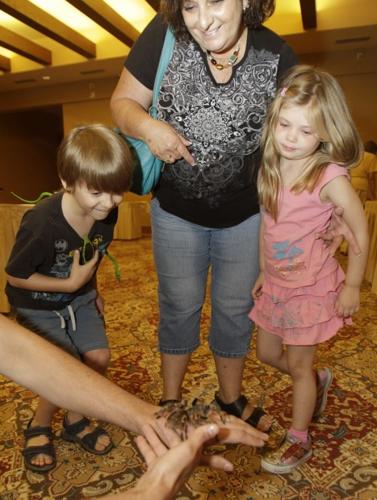
What has eight fuzzy legs, a docile demeanor and the ability to liquefy its food before eating?
If you are a member of the American Tarantula Society, the answer is: a pet.
About 100 arachnid enthusiasts of all ages - from infants to seniors - are in the Tucson area this weekend for the society's 13th annual conference. They are meeting at the Hilton Tucson El Conquistador Golf and Tennis Resort in Oro Valley, prime desert habitat for observing local species.
"Tarantulas are very easy to care for," said society treasurer Pat Mumford from Nebraska. So easy, in fact, that the Omaha resident has 40 adults and 70 juveniles. "It's a very addictive hobby."
His interest was spurred by his son's fascination with eight-legged creatures.
"As soon as he could crawl he put one in his mouth."
People are also reading…
Now his son is grown and pursuing other interests, but Mumford remains interested in tarantulas.
"A lot of people compare it to keeping fish," he said. "Some people handle them; some don't. I prefer to set them up and watch. Some are like pet rocks and others dig holes and bulldoze all day long. Some are arboreal and make intricate webs."
Dawn Dubose, of Everett, Wash., was setting up the children's craft table on the first day of the conference. She comes from a blended household. She and her youngest daughter are tarantula devotees; her husband and older daughter want nothing to do with the hairy little creepy-crawlies.
The family got its first tarantula when its original owner gave it away. Initially, Dubose was afraid of the tarantula, but as the family got acquainted with the new pet and vice versa, she warmed up to it. Now the family's living room is full of aquariums displaying a variety of species, and they've added several exotic scorpions to the mix.
"There are so many different kinds," she said, "and they all have their own personality."
About the society
The nonprofit American Tarantula Society was established in 1991 to educate people about tarantulas and other arachnids. Members range from college professors and professional arachnologists to children and senior citizens.
For more information about the American Tarantula Society, go to www.atshq.org
Did you know
• In the Sonoran Desert, tarantulas grow to a length of 3 to 4 inches.
• Male tarantulas live 10 to 12 years. Females can live twice as long.
• Tarantulas are very sensitive to vibrations in the ground that may indicate the presence of prey or danger.
• Tarantulas are nocturnal hunters. They feed primarily on insects like grasshoppers, beetles, other small spiders and arthropods, and will sometimes eat small lizards. They will attempt to overtake anything of the right size that moves in their range. Most tarantulas have weak venom.
• Most spiders have no teeth with which to chew their food, so they rely on their venom to liquefy their prey. They then use their sucking stomachs to draw in or suck up the meal.
SOURCE: www.desertmuseum.org
Contact reporter Kimberly Matas at kmatas@azstarnet.com or at 573-4191.


