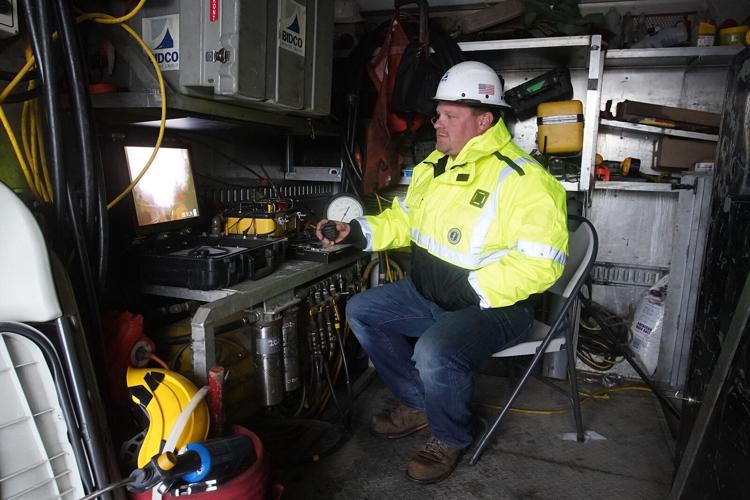
John Waters, wearing a hard hat and life jacket, sat in a cramped trailer Thursday morning, feet from the starboard side of the listing USS The Sullivans in Buffalo's Inner Harbor. He pointed to a small computer monitor next to a control board – his makeshift command center – that he would use to track the underwater movements of Thursday's lead diver, Robert "Turbo" Dorato.
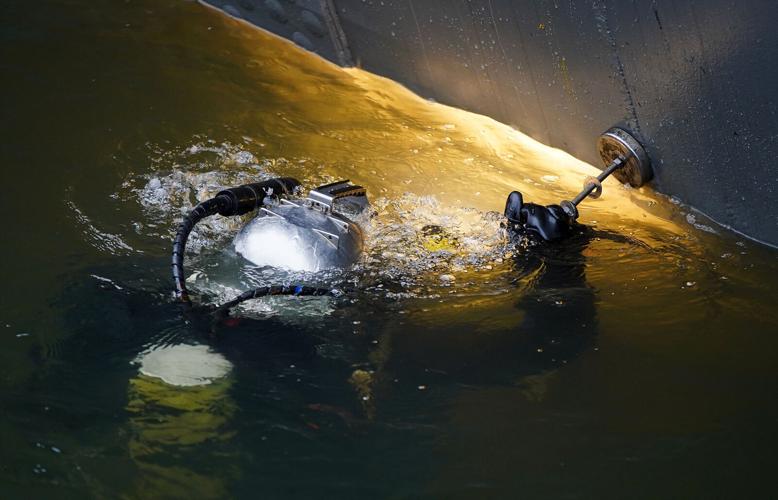
Divers inspect USS The Sullivans on Thursday, April 21, 2022.
Winding from the trailer was a 600-foot hose that supplies Dorato's suit with warm water – warm enough to make him sweat in a 38-degree river – and air that feeds his umbilical line.

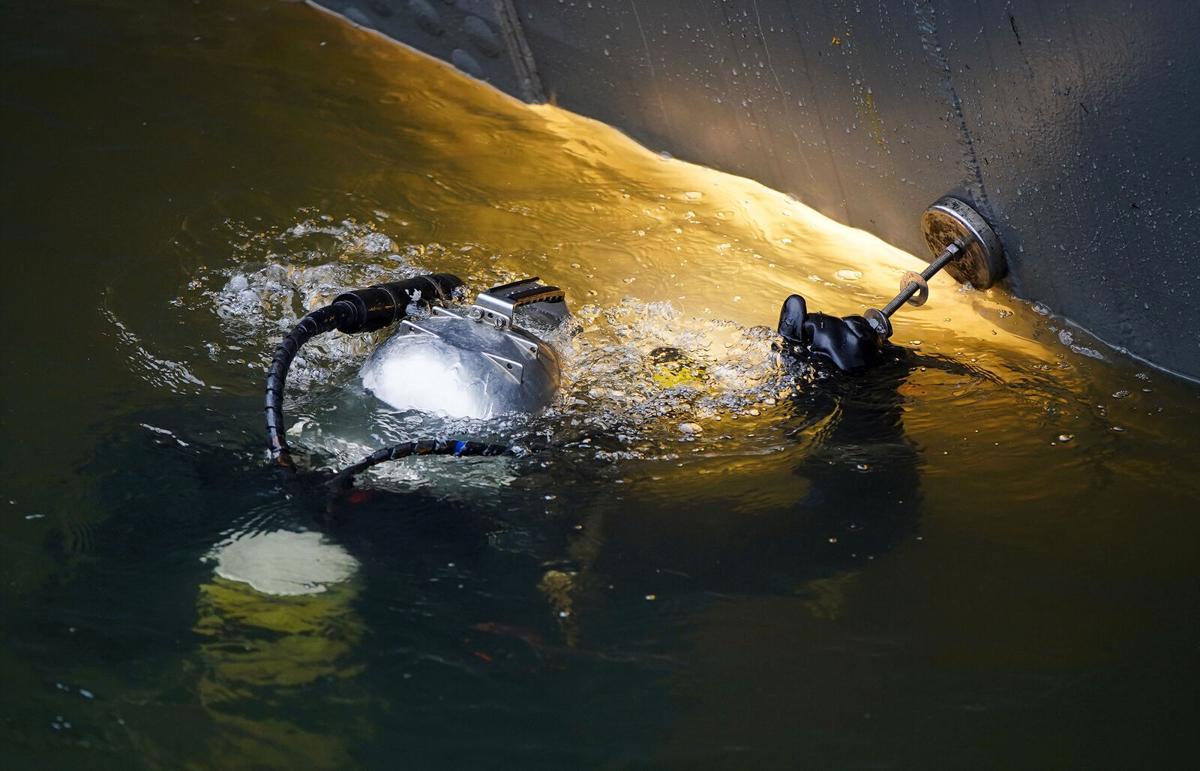
Commercial diver Robert "Turbo" Dorato examines the hull of the USS The Sullivans for holes on April 21, 2022.
Waters and Dorato are part of an eight-diver team from BIDCO Marine Group that is trying to decipher the mystery behind what is causing the 79-year-old Fletcher-Class destroyer to fill with water. There’s only one way to locate the breach or breaches: by putting divers in the water to see the damage for themselves. Once the magnitude of the problem is determined, the divers will play a role in stabilizing the ship and then either patch or plug the hole or holes in the hull.
People are also reading…
In the eight days since the ship began leaning and taking on water, both organizations overseeing the dive and the divers have faced many obstacles: battering winds, the precarious position of the ship and murky water that limits visibility.

BIDCO dive supervisor John Waters sits in his command station in a trailer next to the USS the Sullivans on April 21, 2022.
Naval Park and U.S. Coast Guard officials are focused on protecting the divers. Plans have been scrapped, "stand down" pauses put in effect and the restoration of the vessel prolonged at the first hint a diver might be in danger.
Mark C. Judd, BIDCO's president, has worked closely with the Buffalo sector of the Coast Guard each day to evaluate potential concerns. One has been prevalent this week: Could the mooring lines, taut like piano strings, snap and disconnect the ship from the pier?
"That's one of the reasons why anyone who's out there should have a hard hat on and be extremely cautious," said Buffalo Naval Park president and CEO Paul J. Marzello Sr. "If one of those lines snaps, they could snap a human body in half."
Also, when the diver is in the water, if the unstable ship slides from its position – it tilted 2 inches Wednesday night into Thursday – several dangerous scenarios come into play. Waters, the supervisor, must be alert.
"He's monitoring the water temperature and ensuring that all the conditions are right," Judd said. "He's monitoring the diver's communication back – 'Is he seeming stressed? Is he breathing heavily?' "
With guidance from Judd and Waters, BIDCO's team of eight divers has been prepared for anything. It is mostly the same crew that saved a man from drowning in the Niagara River in December. But the safety concerns are balanced by the pressure to fix an ailing National Historic Landmark whose bow hovered 6 inches above the water's basin on Thursday.
The weather

Diesel pumps worked throughout the night and have reached a point of "equilibrium," in that they are pumping out as much water as is leaking into the vessel, said Paul Marzello, president and CEO of the park.
Gusting winds approaching 40 mph along the waterfront Tuesday and Thursday halted BIDCO's attempts to put divers in the water. The primary fears were the wind's effect on ship stability, as well as seiches – standing waves that operate in a seesaw motion – in which divers could get caught.
"The wind is blowing the lake toward us, creating that seiche effect, or away from us, which lowers or raises the ship, and that's our real concern, what it's going to do to her when she's precariously fixed in this position," Marzello said Tuesday.
Water levels are monitored using ladder rungs on the pier; there are set depths and heights the water can reach that would cause an immediate stop.
If water is deemed safe but still unsettled, the divers are equipped with a buoyancy control vest in which air may be pumped in or out, depending on their desired direction of movement, Waters said.

Unlike the wind, the water temperature isn't an issue thanks to the divers' suits, through which warm water flows.
"In the water, you're warm like you're standing in the shower," said Judd, a former diver. "In fact your face plate fogs up."
"You're usually sweating," Waters added.
To see and to move
Before the water that caused the Sullivans to list could be pumped out, more than 7,500 gallons of contaminants that leaked from the compartments of the ship were removed. Even with the removal, the oil and debris – combined with a Great Lake's water close to shore – hinder the divers' vision and movement.

"I don't suspect there will be additional damage to the ship," said Lexia Littlejohn, commander of the Buffalo sector of the U.S. Coast Guard.
"They can see about one foot in front of them," Waters said. "When he's on that ship, there's a lot of hand feeling, and the zebra mussels are another issue with your hand placement."
These mussels, an invasive, freshwater species, cling to the hull of the ship, a slippery, unnatural surface on an otherwise smooth hull.
As divers maneuver along the hull, BIDCO deploys lines on which they can hold to maintain their balance. BIDCO divers on Thursday were able to patch five holes in the Sullivans' hull, according to a Naval Park release. It is unclear whether those holes were recent breaches or existing air vents submerged during the list.
Movement and vision challenges will intensify once divers can enter the hull of the ship. Compartments within the hull are dark and likely coated with oil, Marzello said. The Naval Park's recovery of the Sullivans' damage control manual and general arrangement drawings will be crucial to BIDCO and the Coast Guard's thorough plans ahead of each dive.
"Plan your dive and dive your plan, that's the motto," Judd said.

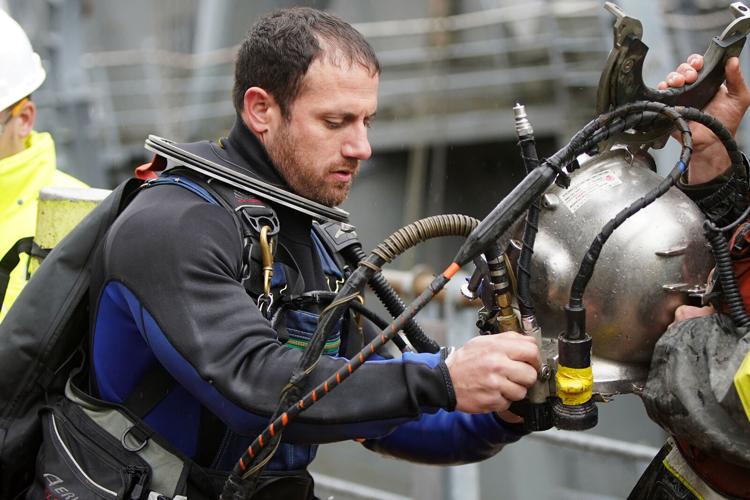
Commercial diver Robert "Turbo" Dorato gets his equipment ready before he dives on the USS The Sullivans at the Buffalo and Erie County Naval & Military Park in Buffalo, Thursday, April 21, 2022.
Mooring lines
The mooring lines present a twofold danger. Should the ropes stabilizing the ship break, the Sullivans could slide from its position and either trap a diver inside or pin a diver against the surface. In water 16 feet deep, the divers will be working with the hull over their heads.
"If the hull moved and the ship rolled ... " Judd said before trailing off. "It's very unlikely, but the ship is not stable, and complacency is a problem."
Above-water or "top side" trouble is possible, causing the Naval Park to be closed to the public, elaborate barriers blocking off the park and hardhat-only zones. The state of the mooring lines was so important that Wednesday morning's dive was canceled and support mooring lines were added as a precaution.
Mental perspective
Teamwork – particularly the relationship between Waters and the divers – is an integral, underappreciated part of the task. Fatigue, stress and productivity factor into how long a diver may stay in the water. Wednesday afternoon's dive lasted two and 1/2 hours, Waters estimated, during which about a quarter of the ship's hull was assessed and the surface below the ship was probed. If conditions allow, a diver could stay in the water for an entire eight-hour shift.

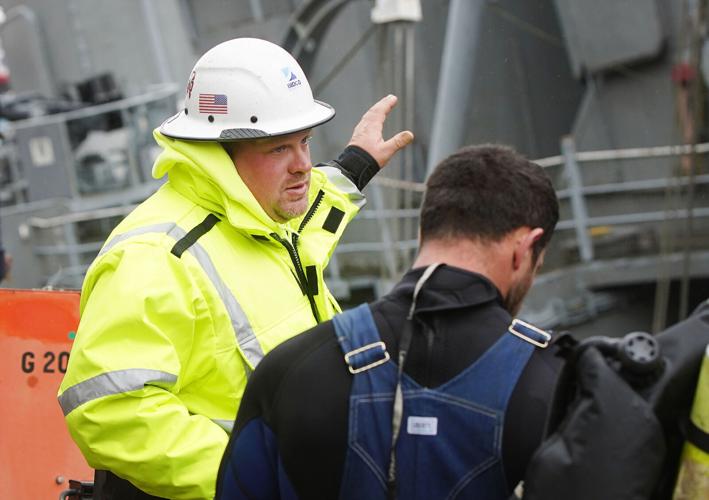
Dive supervisor John Waters talks with commercial diver Robert "Turbo" Dorato before he dives on the USS The Sullivans at the Buffalo and Erie County Naval & Military Park in Buffalo, Thursday, April 21, 2022.
That duration depends mostly on Waters' feel, Judd said, his ability to know a diver's personality.
"These guys are tough – nothing scares them, but things concern them," he said.
Additional safeguards are in place. A standby diver will be in full gear at the edge of the dock, prepared to enter in case of emergency. The Buffalo Fire Department has worked with BIDCO and the Coast Guard to determine a rescue plan for a diver. But Waters' role in the command station again looms large in crisis.
"You just try keep everybody calm enough to make the right decision and come out," Waters said.
Ben Tsujimoto can be reached at btsujimoto@buffnews.com, at (716) 849-6927 or on Twitter at @Tsuj10.