Newton described gravity as a force that acts instantaneously between bodies in fixed physical space. Einstein taught us that matter warps space, and this warping gives rise to gravity.
We now know that space can bend, stretch and even vibrate like a wave. In particular, a big gravitational disturbance — say, a pair of black holes colliding — creates ripples in gravity that propagate outward, so-called gravitational waves.
After decades of searching, these waves were finally discovered in 2015 by the U.S.-based Laser Interferometer Gravitational-Wave Observatory (LIGO), with the bombshell announcement coming early last year.
When black holes collide, they don’t just smash head-on. Instead, some chance event will bring two black holes into proximity, after which they fall under each other’s gravitational sway, orbiting around each other, just as the moon orbits the Earth.
People are also reading…
Over millions or billions of years, the orbit slowly gets tighter, as energy is carried away by the gravitational waves. Eventually the black holes merge with a bang, emitting an enormous burst of gravitational radiation.
After a long journey across the universe, the radiation wiggles Earth and its inhabitants, but only ever so slightly. The effect is far too small to be felt, but specialized equipment can detect waves from the strongest, nearest events.
To understand the content of such waves, physicists often convert them into sound. Theorists had predicted that colliding black holes would “chirp,” with the pitch and volume increasing as the black holes orbit faster and faster, before suddenly quieting down after merger.
This sounds rather like the chirp of a bird.
LIGO has now detected two black-hole chirps, confirming the theoretical prediction and bringing us a wealth of information about the black holes of nature.
As experimental sensitivity increases, we can look forward to many years of black-hole chirps. But can we expect anything else from colliding black holes?
Until last year, the answer was no: Every theoretical calculation had predicted a chirp. Imagine our surprise, then, when we discovered that a special kind of black hole doesn’t chirp at all — instead, it sings a song.
The black holes of our universe are characterized by two numbers: their mass and their rotation rate.
We recently developed new theoretical tools allowing us to crank up the rotation rate practically to the maximum allowed. When the black hole spins at nearly the speed of light, the physics nearby changes dramatically.
If a smaller black hole orbits in this region, the gravitational waves are dragged along with the rotation and have trouble escaping. As such, they are emitted with precisely the rotation frequency of the larger black hole, and they quiet down as merger approaches.
Rather than the typical chirp, this sounds like an ethereal song, as the black holes fade away humming a single note.
We are excited about this result because precise probes of black hole spin are hard to come by. Astrophysicists have little idea how fast the black holes of nature actually rotate. Hearing a song instead of a chirp would be a “smoking gun” signature of a rapidly rotating black hole.
The discovery of such a black hole would also be particularly exciting in light of connections to string theory and holography (the principle that information lives on boundaries), where rapidly spinning black holes have been used as theoretical tools.
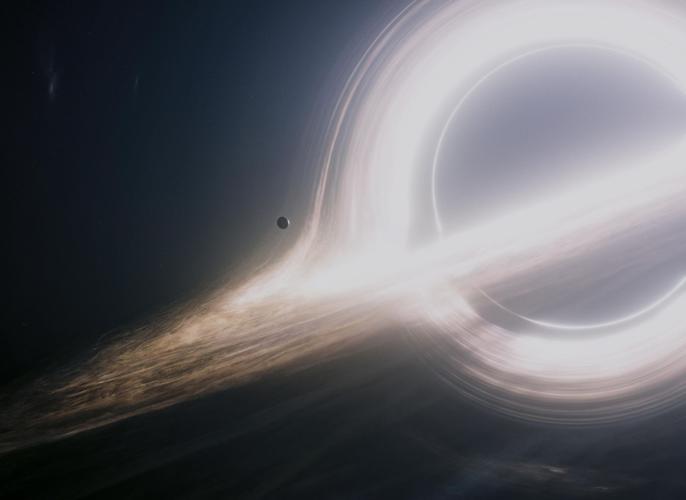
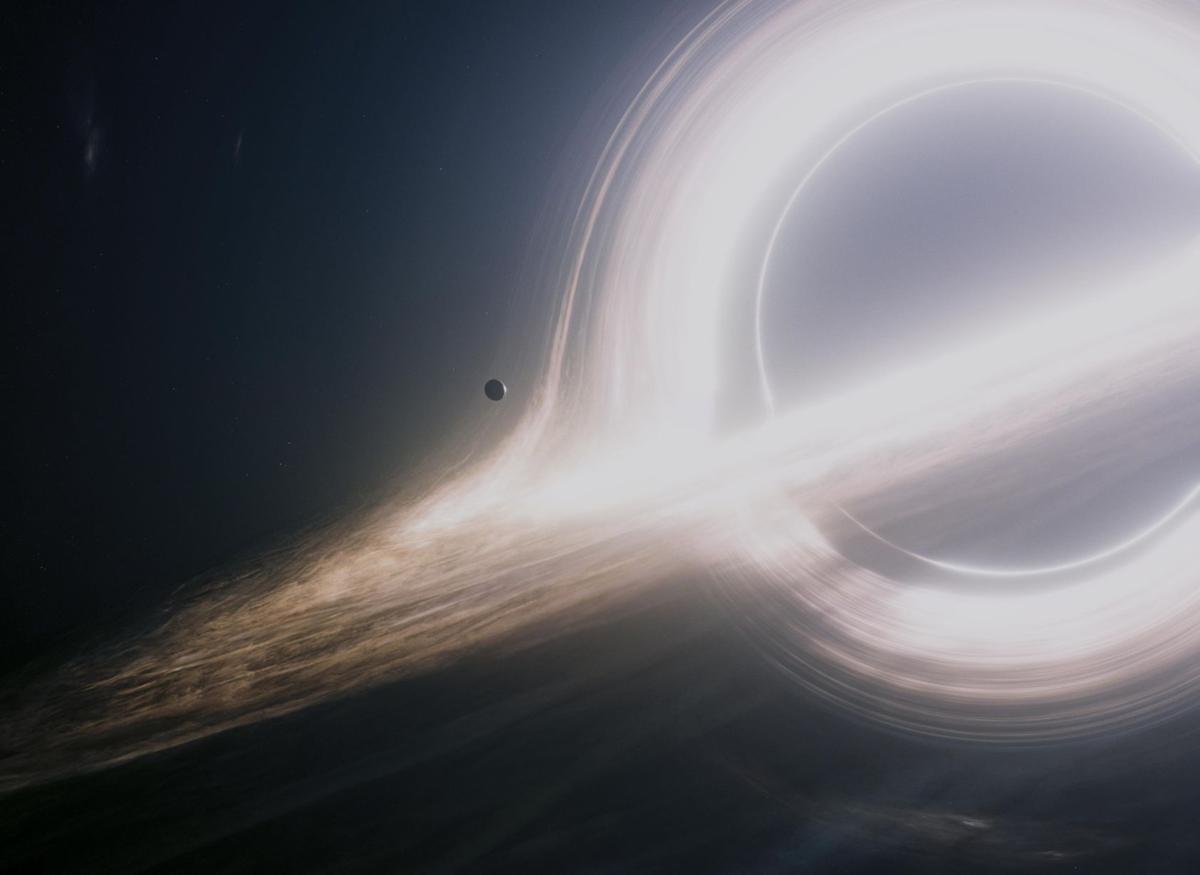
Finally, I cannot fail to point out an amusing connection to Hollywood — the movie “Interstellar” features a black hole named Gargantua which, if the plot is to make any sense at all, must rotate at 99.999999999999 percent the speed of light.
Will we soon hear Gargantua’s song? Only time will tell.

Sam Gralla, assistant professor of physics at the University of Arizona.