
A historic Sycamore Street house that served as a brothel in its early years dating back to 1848 may be welcoming people through its doors once again – only this time, as tenants in affordable housing apartments.
Preservation Buffalo Niagara, one of the city's leading nonprofits dealing with historic structures, plans to spend $3.2 million to renovate the former Eliza Quirk Boarding House in the Michigan Sycamore Historic District as part of a project that also involves the vacant lot next door.
The project, which has not yet been reviewed by the city, would bring six units of affordable housing and two commercial office spaces to the neighborhood just southeast of the Buffalo Niagara Medical Campus. And it would save a 172-year-old house with a salacious history as the home and business of Quirk, a notorious 19th-century high-end "courtesan" – a prostitute.
People are also reading…

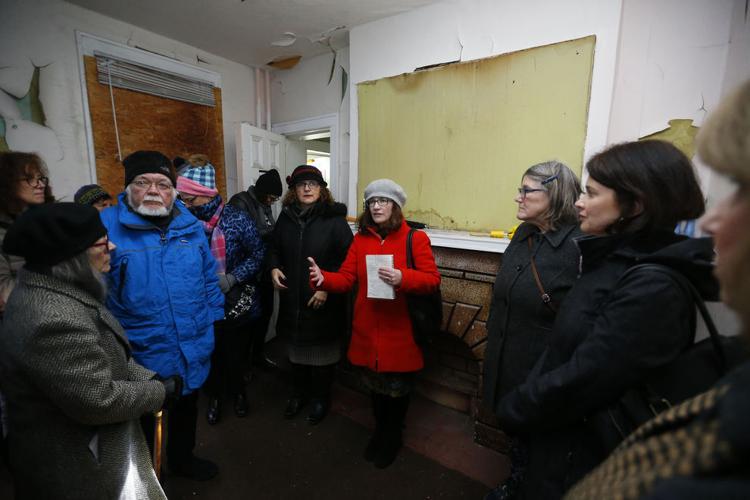
Jessie Fisher, executive director of Preservation Buffalo Niagara, speaks in what once was the sitting room for Eliza Quirk's "bawdy house."
According to plans by Flynn Battaglia Architects, PBN wants to renovate the 6,000-square-foot structure at 72 Sycamore, while constructing a two-story, 3,500-square-foot addition at 68 Sycamore that would be connected with a shared elevator and staircase.
The current four-story brick building would have four apartments – three one-bedroom units and one three-bedroom unit – on the upper levels, with a ground-floor commercial space that will be occupied by PBN's new Preservation Resource Center.
The group will keep its main offices and headquarters downtown at the Market Arcade Building, but would use the new location for community events, workshops, training and meetings.
The addition would house a first-floor office for Heart of the City Neighborhoods, which focuses on affordable housing development and housing programs in the city.
The organization is acting as PBN's housing consultant and will be managing the residential units. The second floor would have two two-bedroom apartments.

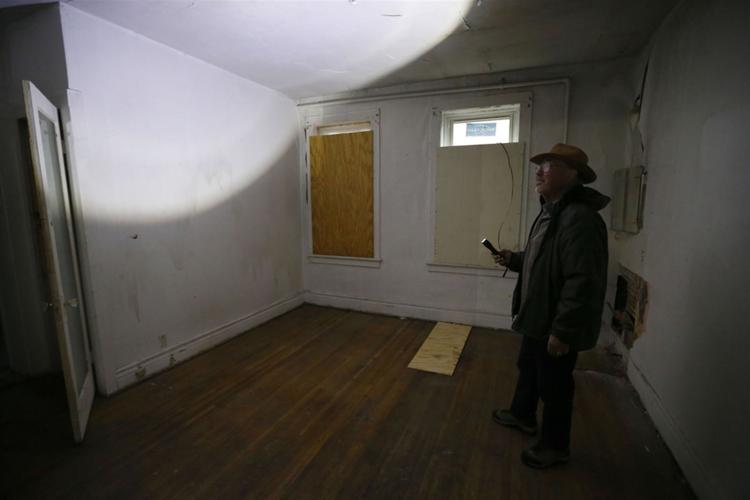
Tony Diina tours 72 Sycamore St. that was built as a brothel by Eliza Quirk in 1848.
PBN Executive Director Jessie Fisher said all of the apartments would be affordable to households earning 60% of the area median income. Fisher said the addition will also feature a green roof, and the project will use other environmentally friendly methods to manage stormwater on the site.
The project will be funded with a $359,000 Better Buffalo Fund grant that PBN already has, and the group is seeking an estimated $600,000 in state and federal historic tax credits. It's also applying to New York State Homes and Community Renewal for a $2 million grant from the Affordable Housing Fund. The rest of the financing will come from PBN's equity, through fundraising.
PBN began talking with the neighborhood about the plan last year, and Fisher said the group just submitted documents to the city to seek approvals from the Zoning Board of Appeals and Preservation Board, even before site plan approval. If the group is successful with its financing, Fisher said she hopes BRD Construction can start work in the fall, with completion by spring 2022.
The project would represent a victory for a preservation community that has seen many old structures in the city damaged by neglect, allowed to deteriorate past the point of repair, or even demolished to make way for something else. That was a serious risk in the case of the Quirk House just two years ago.
That pre-Civil War building – originally built as both Quirk's residence and business – was still used as a rooming house until 2016. That's when the woman who owned both the Quirk House and a neighboring two-story house at 68 Sycamore – from the same time period – lost her rooming-house license. She then sought to demolish the Quirk home in 2017, which alarmed and mobilized preservationists to try to save it by having it designated as a local landmark.

The history of this tattered landmark is a reflection of the hard and limited options available to a single, impoverished immigrant woman in the mid-19th century – and her success demands a kind of historical
But Housing Court Judge Patrick M. Carney wanted someone "that had experience and was a substantial enough new owner" in order to deny the demolition permit. So developer Rocco Termini stepped up to purchase the two properties and hold them until Preservation Buffalo Niagara could raise the funds to rehab them.
"We did a lot of advocacy around saving them," Fisher said. "Rocco really helped us."

The developer gives pre-Civil War-era building on Sycamore Street to preservation group.
Before he could complete his donation, though, the smaller house burned down in January 2018 after a squatter living inside started a small fire to keep warm. Termini turned over both properties to the preservation group in December 2019.