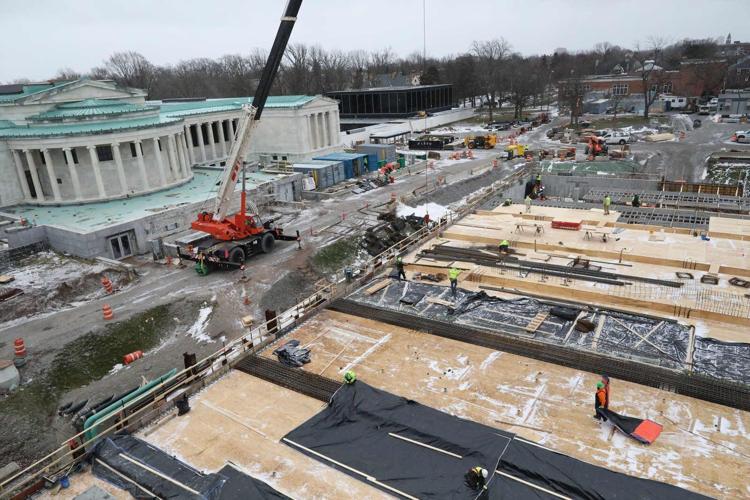
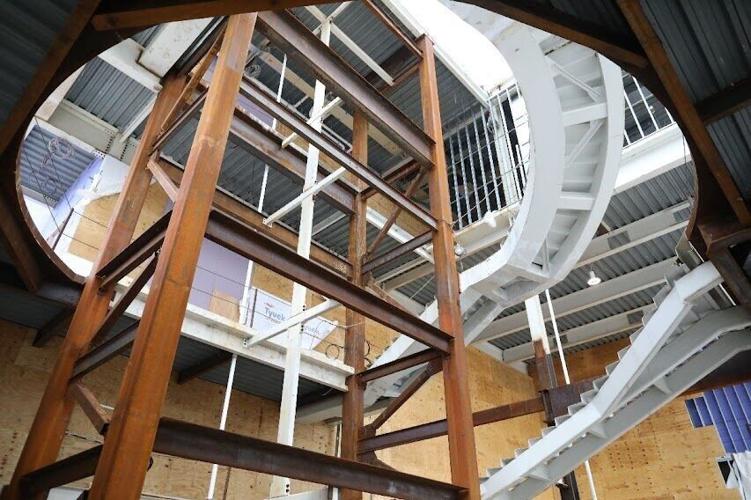
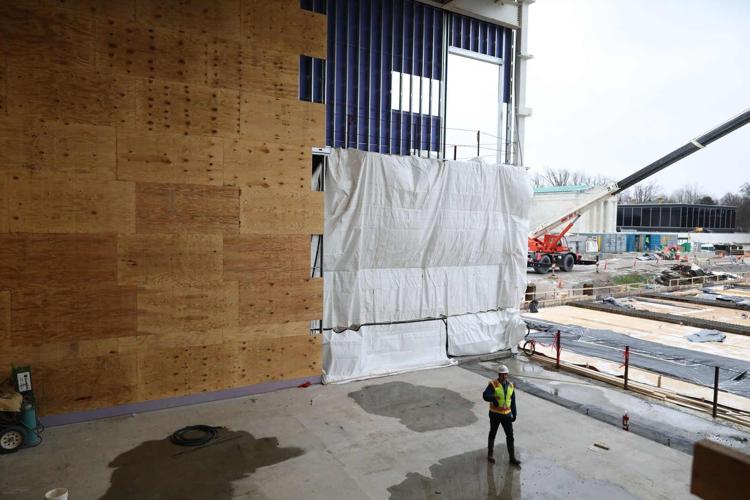
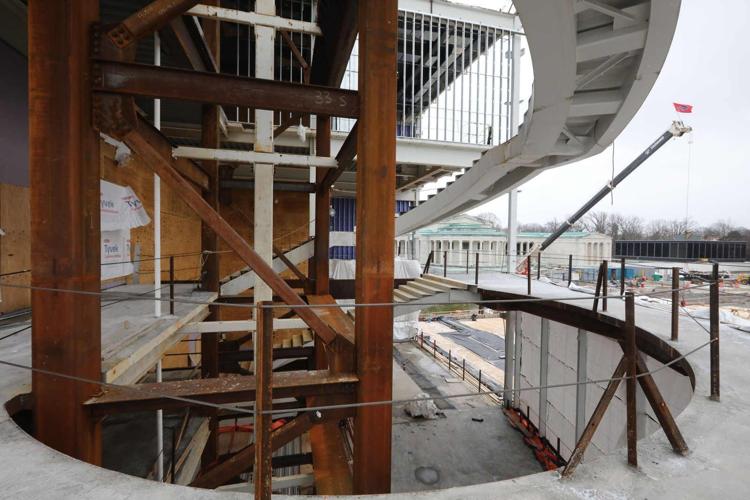
It is easy to see the progress of the Jeffrey E. Gundlach Building two years into construction on the Albright-Knox Art Gallery grounds – with a 38-foot-high entrance gallery and exhibit space on the third floor bigger than any before at the museum.
But here's what you don't see: 540 exterior glass panels still in Lithuania and 260 tons of structural steel in Germany needed to encase the new three-story translucent building before the museum reopens as the Buffalo AKG Art Museum.
Covid-19-related supply chain problems have delayed their arrival, and that means the reopening that had been planned for late this year will now be put off to the first half of 2023, said Janne Siren, the museum's director.
The disruption and higher shipping costs have also driven up project costs between $12 million and $20 million, he said.
People are also reading…

Museum Director Janne Siren voiced optimism about governments unloosening their purse strings, as the pandemic recedes, and the community's response to Jeffrey Gundlach's $2.5 million matching grant offer.
So even after the museum met its ambitious $168 million fundraising goal, Siren is now looking to state government for more financial help. New York State has already contributed $22.3 million toward the project – 13% of the funds raised.
"It is not possible for even the most dedicated fundraising team to complete this task if the government doesn't step up to the plate," Siren said. "We feel it is reasonable for us to turn to the government for Covid-related funds because the government will be the greatest beneficiary of this project."
The museum closed in November 2019, and work on the Shohei Shigematsu-designed Gundlach building began in January 2019. The supply chain problems didn't emerge until the fall.
Siren said the timing of the Gundlach Building work also depends on the weather.
The glass panels will come in different sizes, with the largest having a length of 26 feet and weighing 4,000 pounds.
"Putting it together in itself is a complex operation," Siren said. "Sealing the glass to the metal frame is something that cannot be done if the temperature is too low for the sealant to do its work.

Hundreds of people were in attendance Sunday, all of them among the 5,000 people projected to visit the Albright-Knox during its closing weekend, according to the
"If we had a very mild winter, which it doesn't look like right now, it can speed things up," Siren said. "But otherwise, it will slow the work down."
The good news, he said, is that renovations to the Knox and Wilmers buildings are on schedule.
Back to 1905 glory
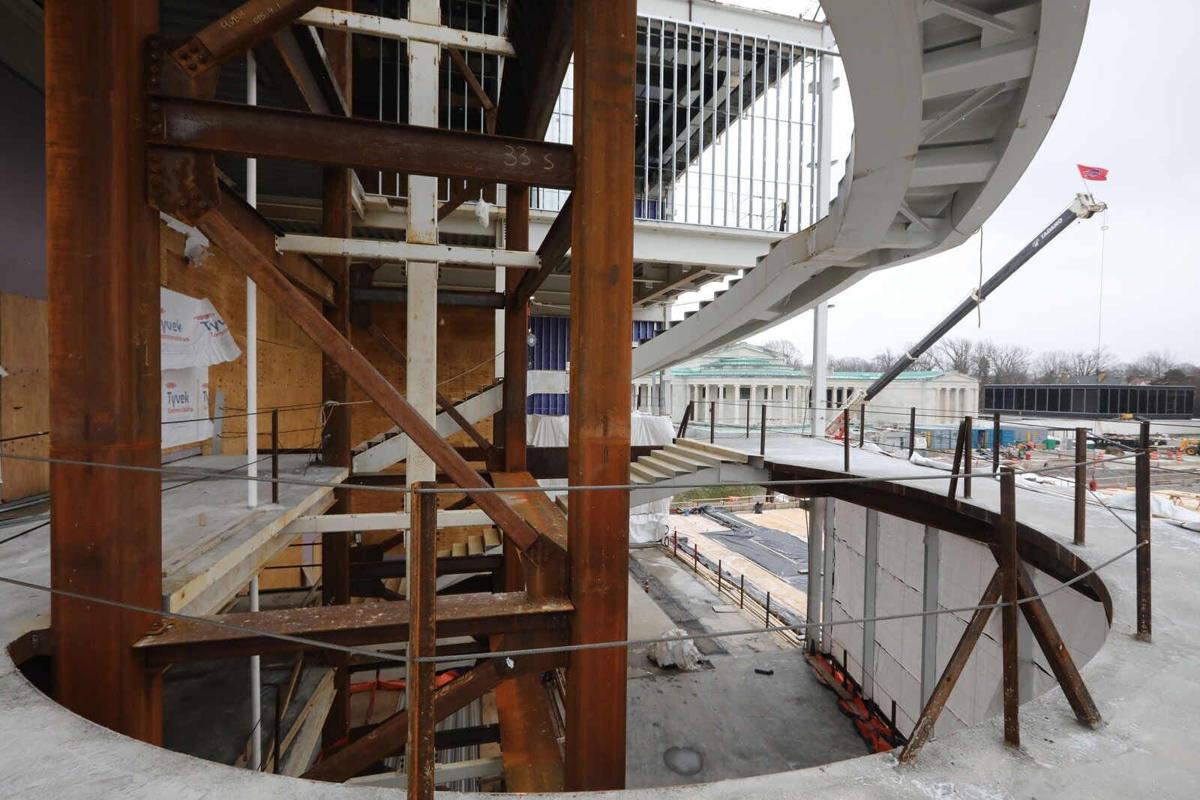
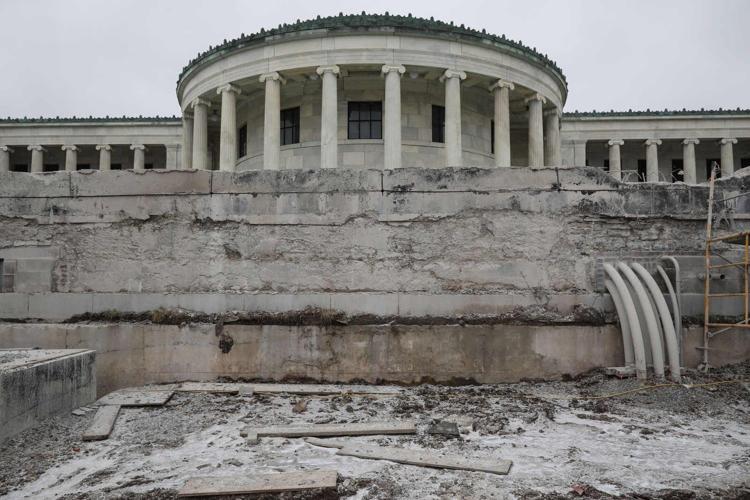
The new building's second-story wrap-around sculpture terrace offers striking views of the museum's other buildings, especially the E.B. Green-designed 1905 building, now named for Robert and Elisabeth Wilmers.
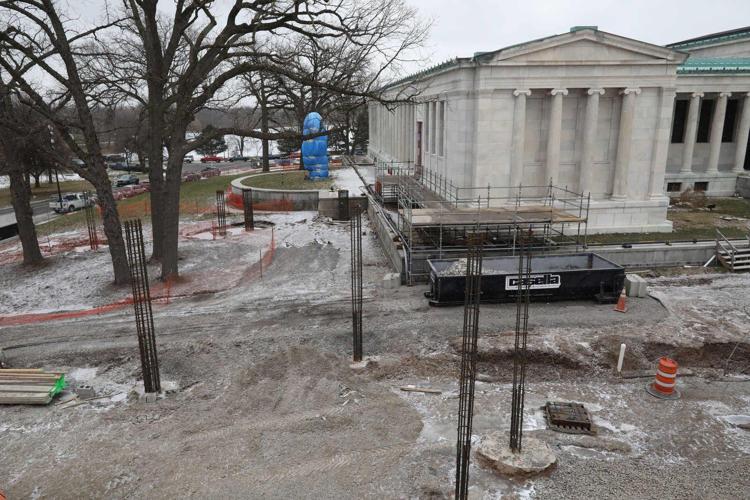
The marble in the neoclassical structure was cleaned to eliminate decades-old dirt – the first thorough scrubbing since 1962.
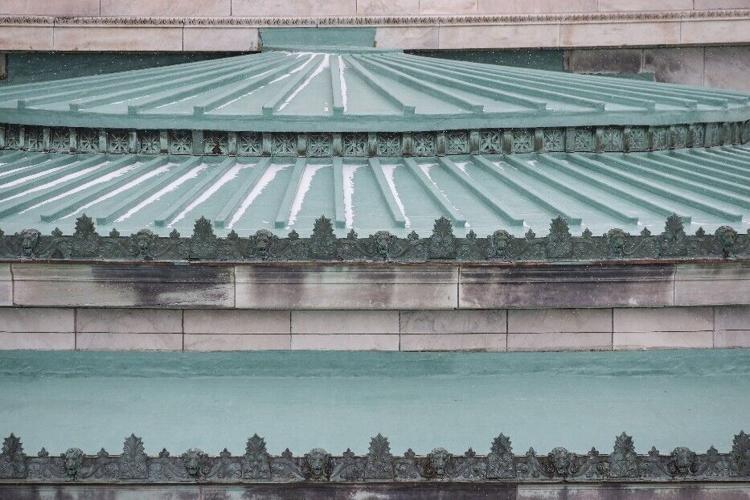
The 1905 building has a new roof for the first time since it opened, with a seafoam green color chosen to resemble the previous patina copper.
More than 100 small ornamental lion heads that form a circular pattern above the building's hemicycle were also taken down, repaired and restored.

"The building looks sensational," Siren said. "It is now back to its original 1905 glory."
The grand staircase – removed at the time of the 1962 Gordon Bunshaft-designed addition, now known as the Seymour H. Knox Building – will be recreated later this year.
The fire lane outside the Wilmers Building will remain, but beyond it will be a lawn covering an underground 80-vehicle parking garage for museum visitors. The pouring of the garage roof is expected as early as next month, also depending on the weather.
Support structures outline the path for the curvy, glassed-in John J. Albright Bridge that will connect the Wilmers and Gundlach buildings.

The $168 million expansion project broke ground on Nov. 22, 2019, and is expected to be completed in the second half of 2022.
'Scale is enormous'
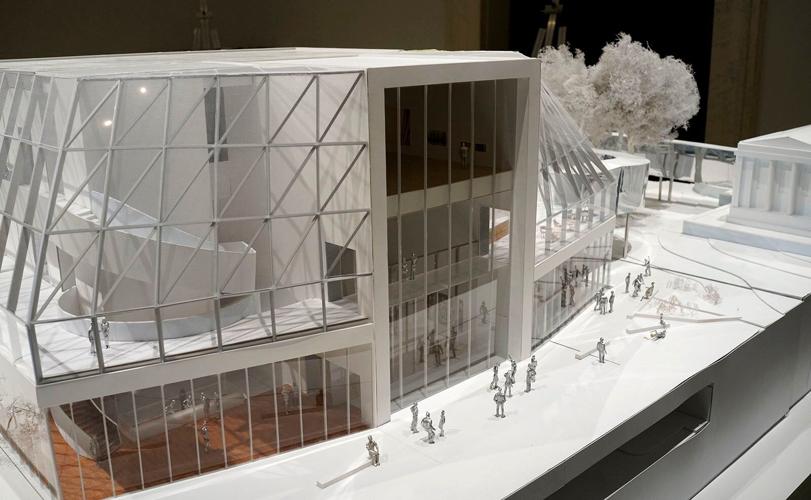
All of the Gundlach Building gallery spaces have been designed to be flexible for different shows and installations.
Six galleries with terrazzo floors on the first floor total 7,115 square feet. That includes a 1,200-square-foot glass box gallery with movable seating for projected media works and a nearly three-story-high multifunction gallery with a skylight overhead.
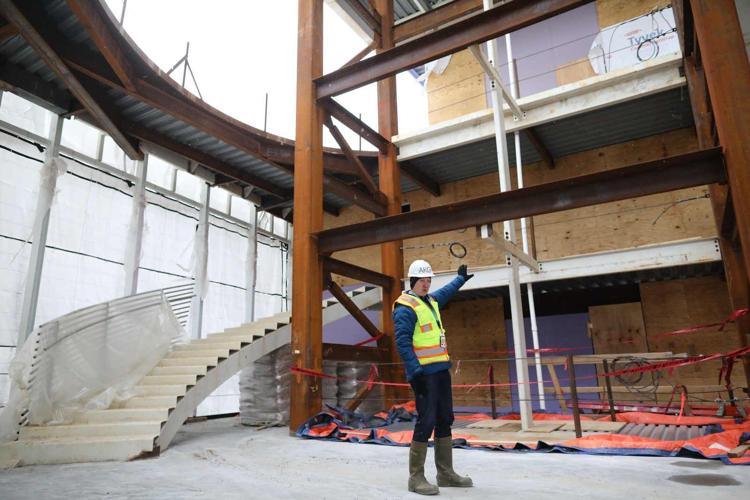
"The scale is enormous," Siren said. "There is no other indoor art space of this height in Western New York."
Two freight elevators for the movement of artwork are located away from the public. The elevator on the east side of the building will allow trucks to back up from Iroquois Drive to unload crated paintings, sculptures or installations, which will be lowered to an art handling area in the basement.
The other elevator will transport the artwork to the upper floors of the Gundlach Building or for transport across the bridge to the Wilmers and Knox buildings.
The second floor, though laid out differently, also has six galleries that can be reconfigured with movable walls and an identical amount of exhibit space.
The third floor has two gallery spaces, with the largest spanning 7,530 square feet – bigger than two tennis courts.
"This gallery will give that freedom for curators and artists to have space in which to realize their most wildest dreams that require space," Siren said.
A mezzanine level located between the first and second floors in one corner of the building provides office space.
The second floor sculpture terrace will allow visitors to see the Buffalo History Museum, Delaware Park and Scajaquada Creek from new vantage points, as will the third floor's glass-enclosed Juliet balcony.
. "You can visualize the campus and cityscape from new angles that are totally unprecedented," Siren said.

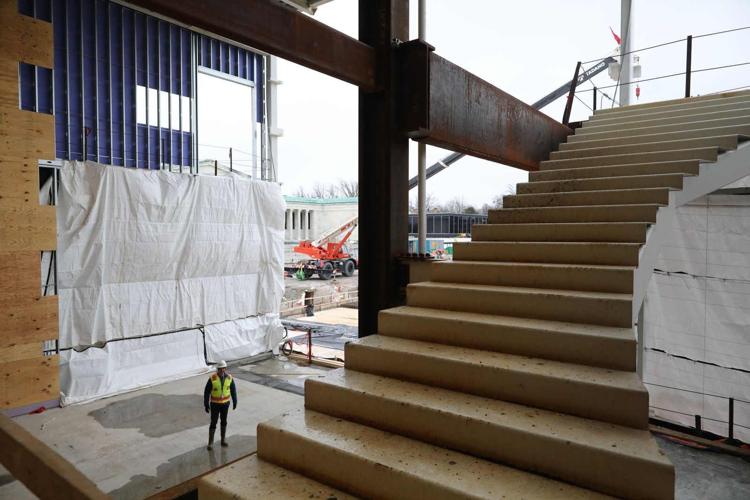
Peggy Pierce Elfvin Director Janne Siren stands in what will become the massive sculpture gallery as he gives a tour inside the new Gundlach Building under construction.
The view will also allow visitors to catch a glimpse of "Common Sky," a glass artwork designed by Olafur Eliasson and Sebastian Behmann and now being assembled in Germany. A freighter crossing the Atlantic will deliver the artwork in over 50 shipping containers, and it will be reassembled and installed in April at the museum's indoor Town Square.
Climate control
The Albright-Knox's engine room is in the Gundlach Building's sub-basement, where a dozen large air handling units delivered by crane last year are part of the climate control system for the entire campus.
"The complexity of everything that lives above lives down here," Siren said.
The system ensures that air temperature and humidity in each of the galleries and back-of-house art spaces meet museum standards.
Visitors who use the parking garage, one level up, will also be able to enter the museum through the basement lobby. There will be ticketing staff and coat check, lockers and bathrooms.

Workers build the mold for the concrete underground parking ramp in a view from the new Gundlach Building under construction at the Albright-Knox Art Gallery.
The entire space will be engulfed in a work of art by Swedish artist Miriam Backstrom, just as entering the Town Square will bring visitors into contact with "Common Sky."
"Go to any fancy museum, with the possible exception of the Guggenheim, and the lobby is a transactional, boring space that you want to get out of as fast as possible," Siren said. "This is really something no other museum has done, to my knowledge."
Economic impact
Siren said an economic impact study by the University at Buffalo Regional Institute demonstrates the project's economic value to New York State.

An architectural model depicts the glass-walled addition to the Albright-Knox Art Gallery.
The study found tax, tourism, employment and other benefits generated by the museum within two years of reopening will more than offset even the high-end estimate of $20 million needed to complete the project.
The study also found the construction benefit between 2020 and 2022 alone is expected to generate an economic impact of $281 million for New York State.
"We've never asked for more than what's reasonable, and we believe it is in balance with the economic ratio studies," Siren said. "For us to now somehow think we are going to raise an extra $15 million from private sources in Western New York is a pipedream.
"People have given generously," Siren said. "But it is now time for the government to look at this project, step up to the plate and finish it."

Anthony McCall’s “Dark Rooms, Solid Light” exhibition is the last exhibit before the museum closes for more than two years during the $160 million expansion
Siren has had success fundraising in Europe, where 53 people – only three of whom traveled to Buffalo – gave $8.7 million. He hopes to increase the total to $10 million.
"I think a lot of people in Western New York know the Albright-Knox and regard it as an important museum, but they do not know the global importance of this museum," Siren said.
The $8.7 million raised in Europe is more than the funds raised from individuals in Western New York, excluding the contributions of Albright-Knox board members.
Local fundraising is more difficult because fewer philanthropies and large corporations are based in Buffalo than in other cities with major art museums, including Cleveland and Pittsburgh, Siren said.
Another factor is cultural, he said.
"That notion of culture being instrumental in defining who we are and being a glue that holds society together is not something that is generally as prevalent in the U.S.," he said, drawing a contrast to Europe. "So to just point a finger at Buffalo and Western New York wouldn't be fair."

Peggy Pierce Elfvin Director Janne Siren stands in what will become a gallery entrance as he gives a tour inside the new Gundlach Building.
Siren said he's learned to embrace the project's unpredictability.
"When you get into a project like this, you have to have a little bit of a paratrooper's mindset in the sense that you never know what you're jumping into," said Siren, a Finnish native who enlisted at age 28 in the Finnish Army's Utti Jaeger Regiment, a special forces unit.
The museum's reopening next year, he predicted, will be a big moment for Western New York and beyond.
"It will be one of the biggest curtain calls that the art world has seen in a post-Covid world," Siren said. "Even those of us who work here have never seen this amount of art shown at one time."
Take a tour over the Albright-Knox Art Gallery, where construction is underway on a massive new campus expansion that will double the amount of the gallery's world-renowned collection that can be on display. The gallery will reopen in 2022 as the Buffalo AKG Art Gallery.
Mark Sommer covers preservation, development, the waterfront, culture and more. He's also a former arts editor at The News.