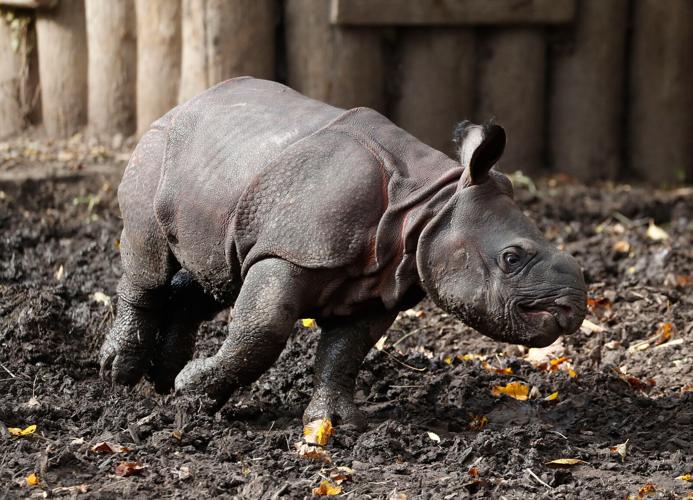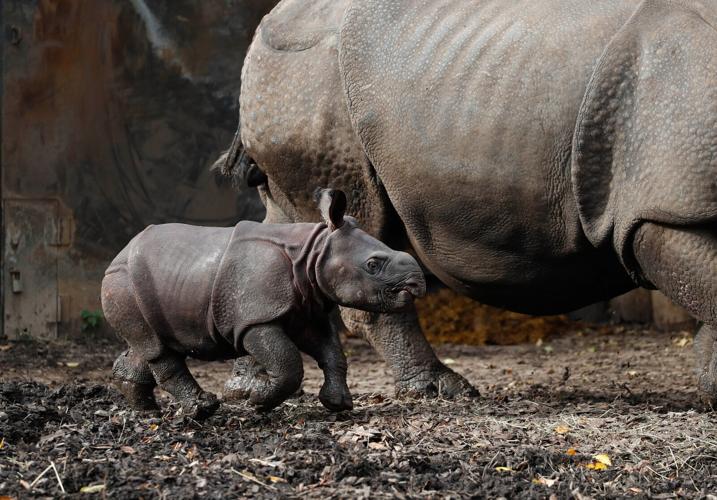
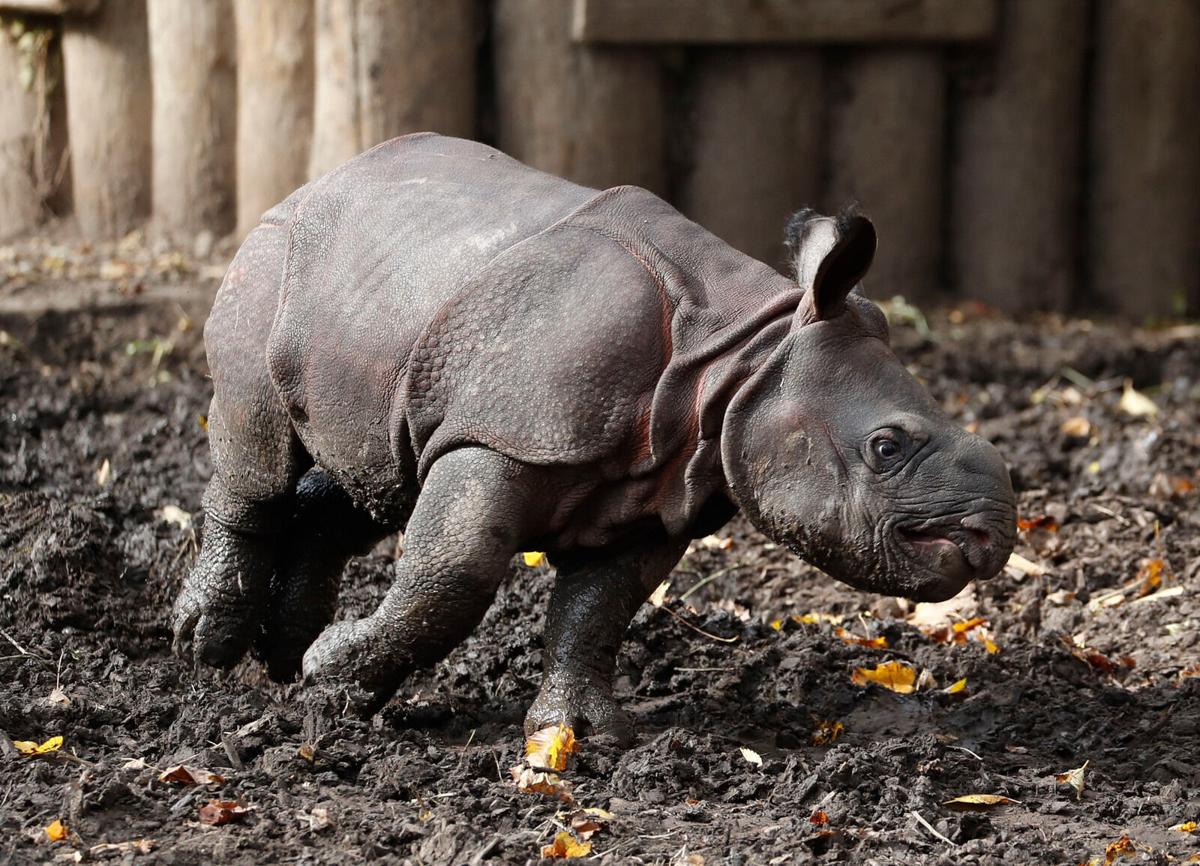
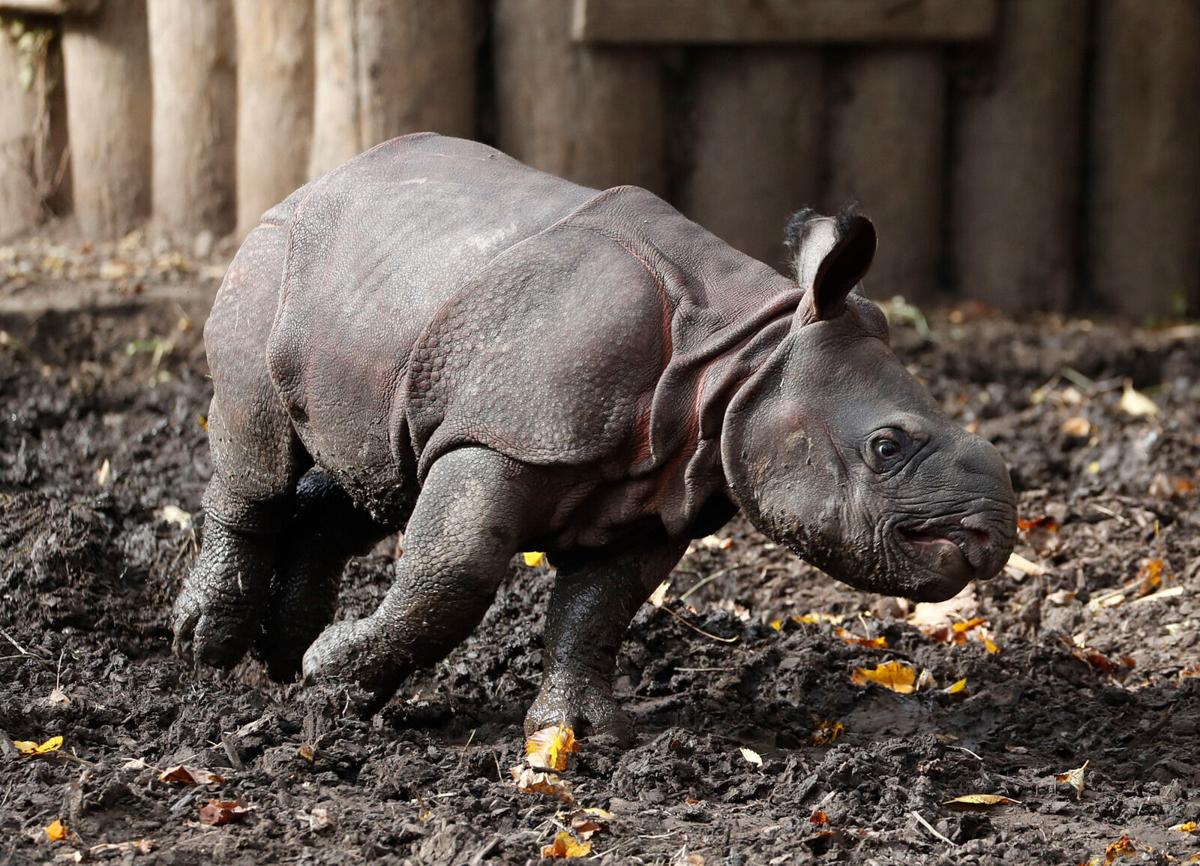
A frisky baby Indian rhinoceros, all perky ears and what looks like taut body armor, made her public debut at the Buffalo Zoo Thursday.
"She looks adorable," Lucas Szczesniak said. "Such a cute little rhino."

"It's so exciting watching her play," said Patti Thompson from Niagara Falls. "They're very cool-looking animals. Prehistoric."
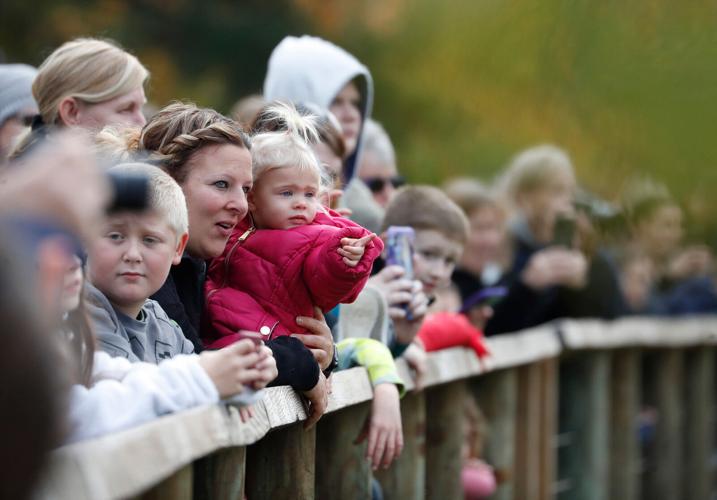
About 50 people who arrived early watched gleefully as the small rhino frolicked about and occasionally raced toward her mom in short bursts if she got too far away.
The rhino, the fifth offspring of 24-year-old Tashi, weighed 130 pounds at birth on Oct. 16.
Pumpkins on the ground were chomped on by mother and daughter. When the baby rhino realized Tashi stepped away to get an apple offered by an animal keeper, she rushed across the enclosure to catch up.
People are also reading…

She's less than a month old and already weighs 250 pounds.
"It is super cute," said Athena Smyntek, 9, of Lackawanna, with her mother, Kelly. "I love how the little baby rhino runs."
Sisters Brooke Skiba and Brittany Hensel brought children from Salamanca for the occasion. So did Lisa Harris of Geneva.
The baby rhino – her name will be chosen by the zoo in a forthcoming contest – has been gaining around 4 pounds a day drinking only mother's milk and weighs about 250 pounds. That's still a far cry from Tashi, who generally tips the scale at 3,700 to 3,800 pounds but ballooned to 4,500 pounds during the pregnancy, rhino keeper Sydney Hollasch said.
The baby rhino born at the Buffalo Zoo on Oct. 16, 2021, made her public debut on Thursday, Nov. 11, 2021, with her mother, Tashi.
Tashi, in 2014, was the first rhino to give birth from artificial insemination, using the sperm of a male rhino who died 10 years earlier and hadn't contributed to the genetics of the Indian rhino population during his lifetime.
George, the little rhino's father, was sent to the White Oak Conservation Center in northeastern Florida to breed with females there.
The Buffalo Zoo's plans for rhinos are crafted in conjunction with the Species Survival Plan of the Association of Zoos and Aquariums.
"It's good to see the species being carried on, and we're a part of it," said visitor Carol Johnston, as she watched the little rhino prance.

Watching the mother and baby rhinos are Lisa Berghorn and her 18-month-old daughter LuElla.
Indian rhinos, which live in the wild in drastically reduced numbers in India and Nepal, are distinguished from black rhinos, found in the dry grasslands of Africa.
Indian rhinos have thick folds, a single horn and bumpy skin. They also have poor vision, an excellent sense of smell and are territorial and solitary, except for mothers with recent offspring.
Rhinos are under assault from poachers who kill them for their horns and other body parts valued in Asia, and from a dramatic loss of habitat.
Three of the five rhino species – the black, Sumatran and Javan rhinos – are listed as "critically endangered" by the World Conservation Union. Indian rhinos are classified as "vulnerable."
Another Indian rhino calf, a male born in June 2019, is also at the zoo. So is a black rhino on loan from the Cleveland Metroparks Zoo until renovations there are completed.
Rhino keeper Don McGuire, who has been at the zoo for two other rhino births, is impressed by how much independence the little rhino has shown.
"She's probably the most precocious calf I've seen so far," McGuire said. "She's willing to walk out in front of her mom, whereas others haven't done that. She gets much more distance away from her mom already at this stage than I've seen others do."
The zoo will give updates when the rhino is on public view, a decision zoo spokesman Christian Dobosiewicz said will be weather-dependent.
McGuire said rhinos have a devoted following among zoo visitors.
"There are certain people who really like the rhinos and they come to see them," he said.
Mark Sommer covers preservation, development, the waterfront, culture and more. He's also a former arts editor at The News.