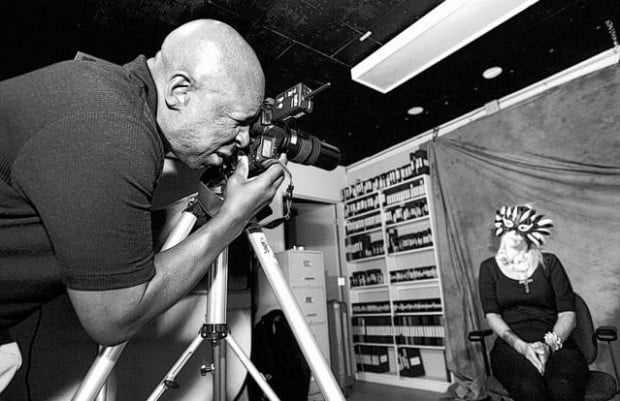
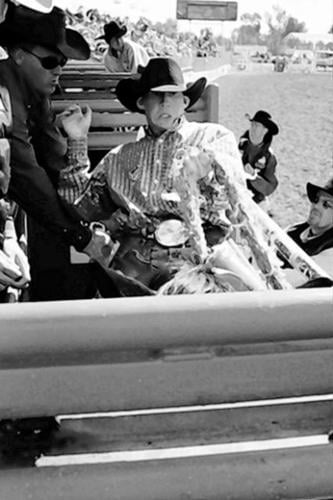
When photographer George Howard peers through his camera lens, the diverse cultural landscape of Tucson and Southern Arizona appears.
Black, white and brown cowboys. Buffalo soldiers. American Indian dancers, children and wise elders. Young women in long, flowing dresses on horseback in a charreada, a Mexican rodeo. A young black woman bejeweled with strands of African necklaces.
For 30 years, Howard has focused his artistic and commercial camera lens on the wide cultural touchstones that make our underappreciated borderlands unique.
"I love different cultural influences because that's where we all come from," said Howard. "We don't come from the same spot."
Howard, a commercial and artistic photographer whose work has been exhibited across the country, sees himself as having crossed multiple borders.
People are also reading…
His images and perspectives were nurtured while growing up in the Douglas and Sierra Vista corridor in Cochise County.
Howard's parents, George Howard Sr. and Gertrude Howard, moved to Douglas in 1954 when he was 2 years old. They moved from Brooklyn after his parents found civil service jobs at Fort Huachuca, once home to the Buffalo soldiers, the historic all-black regiments.
Howard's family arrived six years after President Harry Truman's landmark order desegregated the U.S. military in 1948.
Outside the Army installation, Sierra Vista — which in 1955 changed its name from Fry — was evolving from a frontier town into a family-oriented community.
From the bustling boroughs to the isolated border, Howard's family, including a sister, contended with cultural and racial challenges — and the enrichment that came from the differences.
The Howard family lived on and off the base, but the family members were always connected to it and the evolving community outside its main gate.
With just a handful of black families to find linkages, the young Howard found kinship with Mexican and Anglo kids. At Buena High School, from where he graduated in 1970, he added athletic connections while playing football and basketball.
Howard credits his pioneer-spirited mother for teaching him the merits of diversity. She encouraged the family to leave this nation's Northeast for Southeastern Arizona. She showed the way to bridge differences, Howard said.
After high school, Howard migrated to Tucson and enrolled at Pima College, thinking he would study art.
"I had wanted to be a painter, but I didn't have the patience," he said, sitting in his art-filled living room in the Tucson Mountains.
Instead he turned to photography, an art form that gave him "instant gratification."
Howard studied photography and art with George Welch, Don Winston and the late Louis Carlos Bernal. They were his mentors.
With a combination of moxie, charm and determination, Howard, who graduated from the University of Arizona, established his photo portfolio, building his business and adding clients who span the country and foreign lands.
Howard is multidimensional. He brings that same appreciation for diversity to his other artistic love — music.
Howard is an accomplished and recognized drummer, steeped in America's rhythms of jazz, blues and Latino.
"I'm doing stuff I love," said Howard, who also is a certified underwater diver/photographer.
For most of the 1970s, while creating his photography, Howard toured nationally with musical icons John Lee Hooker, Albert Collins, Charlie Musselwhite, Bo Diddley and the Godfather of Soul, James Brown.
Locally, Howard has led a series of ensembles, including one group, the Roadhouse Hounds, which went into the studio to record.
Howard was inducted into the Arizona Blues Hall of Fame in 1999.
Like his photography, Howard sees music as a critical cultural component in Tucson. Musicians, through their art form, have widened the scope of who we are, he said.
In recognition of those musical artists, who often went unrecognized, Howard has created the Tucson Musicians Museum.
It's an online museum, but Howard dreams of a day when Tucson's diverse musical pioneers are enshrined on a museum's walls.
Unfortunately, he lost a good chunk of his work in 1999 when a Central Arizona Project water line ruptured and water flooded his West Side home. A setback for sure, but he persevered and continues to explore the growing cultural changes around us.
"I feel blessed and fortunate to be exposed to diversity and to expose others," said Howard.
Neto's Tucson
Ernesto
Portillo jr.
DID YOU KNOW
Tucson has long been home to a diverse group of musicians, from those performing Mexican ranchera to Mississippi Delta blues to gritty industrial rock 'n' roll. Some musicians with national and international fame call Tucson home.
There is no museum dedicated to Tucson's rich musical history, but the beginning of one can be found online at: www.tucsonmusicians museum.org