

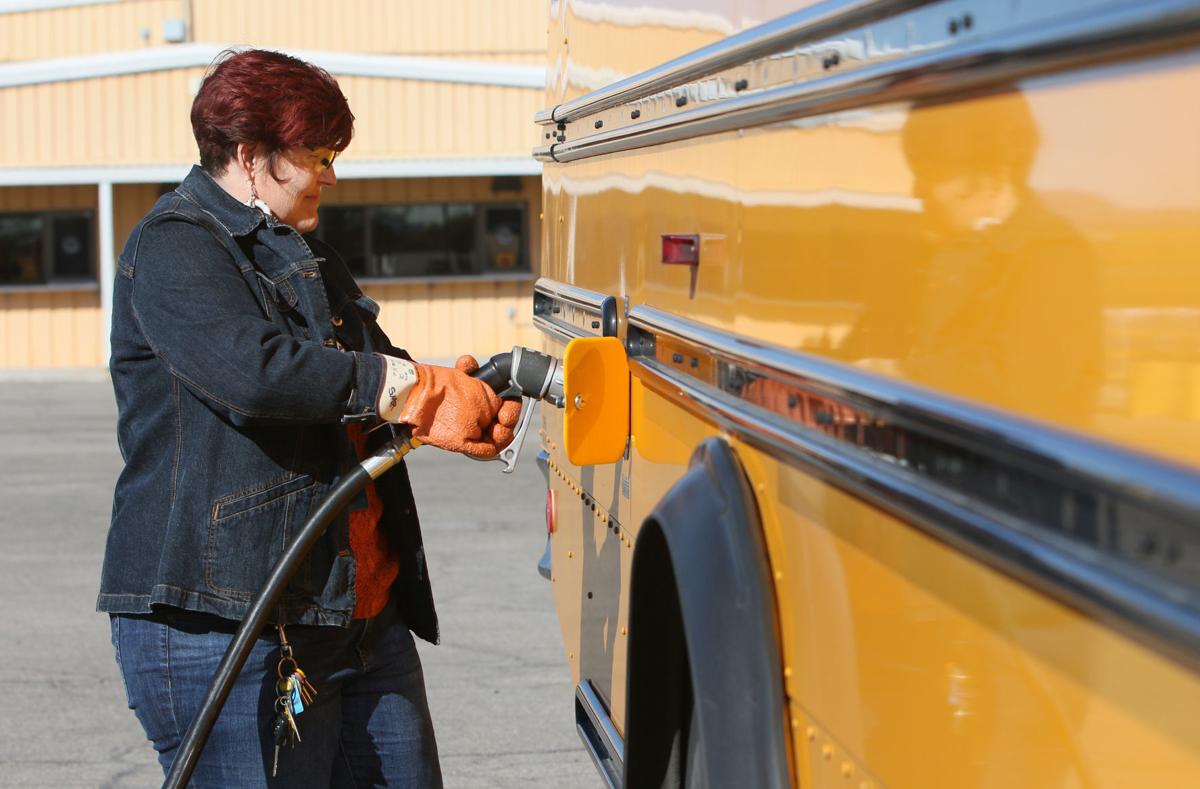
The use of propane buses, which are federally recognized as cleaner-emitting and more efficient vehicles, yielded an award for Amphitheater Public Schools and two other Arizona school districts.
The Green Leadership Fleet award was handed out by the Valley of the Sun Clean Cities within the U.S. Department of Energy and Propane Education and Research Council for “reducing both costs and pollution through clean, cost-efficient propane school buses,” officials said.
At least 19 other Arizona school districts are following suit by switching from diesel to propane school buses. Over 500 propane school buses are currently used in 22 Arizona school districts.
Amphi has operated its propane buses for five years, funded, in part, by grants after the administration discovered it was cost effective and more environmentally friendly, according to James Burns, the district’s executive manager of operational support.
People are also reading…
“We’re doing that just as citizens of the world to try to reduce our pollution, especially in the greenhouse gases but also because of the economics,” Burns said. “Propane is running about 86 cents a gallon but diesel fuel costs $2.21 a gallon. So, it’s quite a bit of efficiency on the financial side, which school districts are always looking for — finding ways to be better with our money.”
Ten propane buses are being used for transit and an additional 15 are used to transport students with special needs among the district’s 125-bus fleet. The remaining buses being diesel.
The Department of Energy said in a 2014 study that propane buses can save nearly 50% on cost per mile for fuel and maintenance compared with diesel buses.
“We’ll buy a propane bus when it makes the most sense for what we’re trying to replace and so our costs runs about 5% to 10% more than what a standard diesel bus would cost us, but we recoup that very quickly in our fuel savings,” said Burns.
Burns added that the switch has cut costs for fueling a fleet that logs 7,700 miles a day.
So far, the district has found that maintenance costs for propane buses are about even with diesel buses, but more data will be collected over the buses’ 15- to 20-year lifespans, said Burns.
The purchase of the vehicles also provided another need: refueling infrastructure, which was purchased mostly with a federal grant.
But there’s a catch. He said the propane vehicles have a shorter range than their diesel counterparts.
“We still will be using our diesel buses for those very long trips that athletic teams at times use,” Burns said. “But for the local routes that stay in town, especially for our special-needs students, those smaller buses, we’ll continue to buy propane buses as our need to replenish our fleet continues.”
The drawbacks of propane buses have led the Tucson Unified School District, Southern Arizona’s largest, to take a different road with managing its 320-bus fleet, according to the district’s transportation department.
“We do not have any future plans to explore this option,” the TUSD transportation department said in an email. “With the purchase of this type of bus, we would also have to purchase fueling stations. With three transportation facilities, this is not feasible or cost-effective. These types of buses also have a shorter range.”
TUSD uses 233 diesel, 56 gas and 31 compressed natural gas, or CNG, buses. Approximately 80 buses are more than 15 years old after the district purchased 32 new buses with money from a nationwide settlement from Volkswagen’s emissions lawsuit in 2019.
The Department of Energy said CNG buses are also known to reduce the release of potential harmful emissions such as hydrocarbons.
But the district has found its own drawbacks with CNG buses, the department said.
“We found the maintenance costs to be higher and reliability lower, with 15% to 20% of CNG buses being down at a time is the average,” the department said.
TUSD’s administration is also trying to find workers with the proper skill set to maintain its vehicles.
“Tucson Unified is struggling to find applicants for our current fleet and heavy equipment mechanics with the skill set needed to work on school buses,” said. “These types of buses also require technicians trained in this particular type of bus to maintain them.”
TUSD’s administration will continue working on gathering new, more efficient buses going forward, the transportation department said, adding that it will continue a two-pronged approach.
“Tucson Unified should continue to purchase new buses, replacing the older buses, and continue to work on routing our students to be more efficient while reducing idle times,” the department said.
Down the Road
More safety signs arriving at “A” Mountain: Visitors to Sentinel Peak Park will see more safety signs acknowledging the presence of bicyclists at an unveiling Monday afternoon.
The city of Tucson partnered with the Rob Dollar Foundation to “install signs that will remind motorists to share the road and to give people on bicycles ample room when passing,” officials said in a news release.
The unveiling will take place at the lower parking lot in the park, 1000 Sentinel Peak Road, at 3:33 p.m.
Contact Star reporter Shaq Davis at 573-4218 or sdavis@tucson.com
On Twitter: @ShaqDavis1

Shaq Davis
Reporter


 Nancy Guthrie's Tucson neighbors: Life with streamers 'unbearable'


