

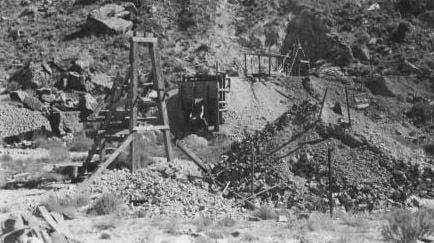
One of the more remote historical uranium mining localities in Arizona is Hack Canyon, 37 miles southwest of Fredonia in Mohave County.
Sitting in the Arizona Strip — which is the area of the state that lies north of the Colorado River — the area covers roughly 1,000 square miles in the northwest portion of the state, and is the last hard-rock uranium producer in the U.S.
The canyon was reportedly named after Haskell Jolly, who was known to locals as “Hack,” and owned a nearby spring and ranch. Active copper mining at the site occurred during World War I, and included the use of a tramway for ore transport down the canyon wall.
By 1948, the Hack Canyon Uranium Mine consisted of 14 unpatented claims owned by G.C. Harwood from Phoenix and three partners, including A.E. “Blondie” Jenson and Clair Pearson of Fredonia and Ray Pointer of Safford, who comprised the Canyon Copper Co.
People are also reading…
Having sent several shipments of copper ore to smelters toward the end of World War II, commercial uranium potential was soon afterward discovered through use of fluorescent lamps revealing fluorescence of radioactive minerals, including uraninite and zippeite found in sandstone and shale.
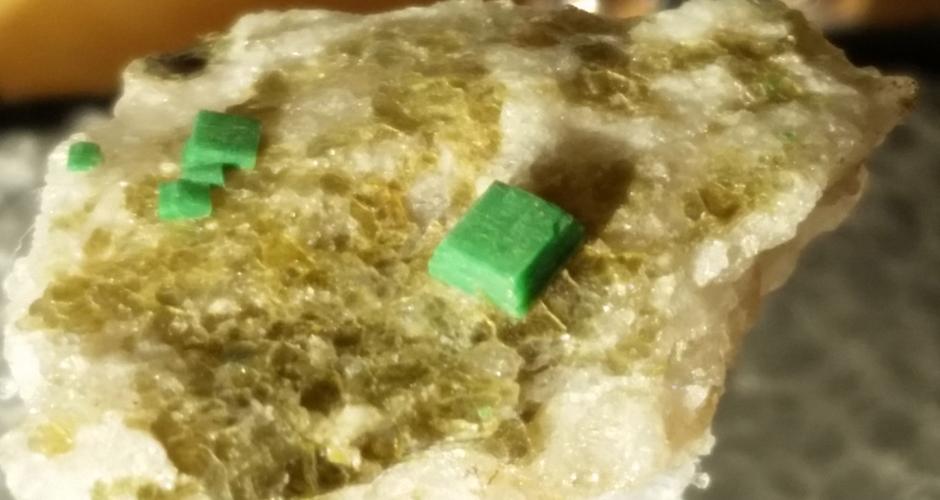
Geiger counters and spectrographic analysis yielded further confirmation. Torbernite, a secondary uranium-copper mineral which occurs in the oxidized portions of uranium deposits discovered at the Hack Mine, led to it becoming a uranium producer after the Atomic Energy Commission offered monetary bonuses to stimulate uranium production.
From the Hack Mine, 1,100 tons of uranium ore was shipped in 1951-52.
That same year, breccia pipes were determined as a source of high grade uranium ore. Breccia, an Italian term meaning broken rock, and breccia pipes are vertical cylindrical bodies of broken sedimentary rock.
Blind breccia pipes never reach the surface, and may yield larger deposits proven by the Hack 2 Pipe discovered in 1979 by Western Nuclear, yielding 7 million pounds of U3O8 uranium compound.
There have been multiple operators of the mine, including the Wasatch Mining Co. and the U-Rainbow Co., shipping 100 tons of uranium ore.
By 1962, the Hacks Mine consisted of a 30-foot shaft, two inclined shafts, a 45-foot adit and more than 200 feet of drifts and crosscuts. Energy Fuels Nuclear Co. initiated extensive drilling exploration at the site in the 1970s, resulting in production the following decade.
By the 1980s, there were eight mines on the Arizona Strip producing 19 million pounds of U3O8 from 7 breccia pipes. Extensive drilling in the region revealed ore-grade mineralization from 71 breccia pipes averaging 5 million pounds of uranium each. The Hack Canyon Mine produced some of the highest-grade and most profitable uranium in the U.S, an average grade of 0.64% U3O8 for a total of 9.5 million pounds.
Successful reclamation efforts using the waste rock and tailings as backfill into abandoned mine shafts and tunnels has masked the appearance of disturbed land of the Hack 1,2,3 mines and nearby Pigeon and Hermit mines after their closure in the early 1990s.
Uranium exploration continues today through the use of the airborne VTEM (Versatile Time Domain Electromagnetic) system used to conduct airborne geophysical survey in the Arizona Strip for blind breccia pipes, which may yield 200 million pounds of U3O8.
Although uranium mining has declined in Arizona over the years, Energy Fuels Resources Inc., one of the largest uranium producers in the United States, has recently won a court battle to reopen the Canyon Mine 6 miles from the South Rim of Grand Canyon National Park, near the town of Tusayan.
The Canyon Mine site encompasses 17 acres, including a 275-foot mine shaft, headframe, hoists and evaporation pond. Efforts are underway to further sink the shaft 1,200 feet for production, with a potential of 1.63 million pounds of U308.
Trucks will carry 25-ton loads of uranium ore containing concentrations of uranium of less than 100 parts per million from the mine site to the White Mesa Mill in Blanding, Utah.
Archivist, historian and author William Ascarza’s forthcoming book is “In Search of Fortunes: A Look at the History of Arizona Mining.” For more information, contact M.T. Publishing Co. at (812) 468-8022 or go to http://mtpublishing.com/index.php/soon/historical-publications/local-history/in-search-of-fortunes-standard.html#.VXnmF1Csi-0 online.

 Tucson to get a Teso Life store


