

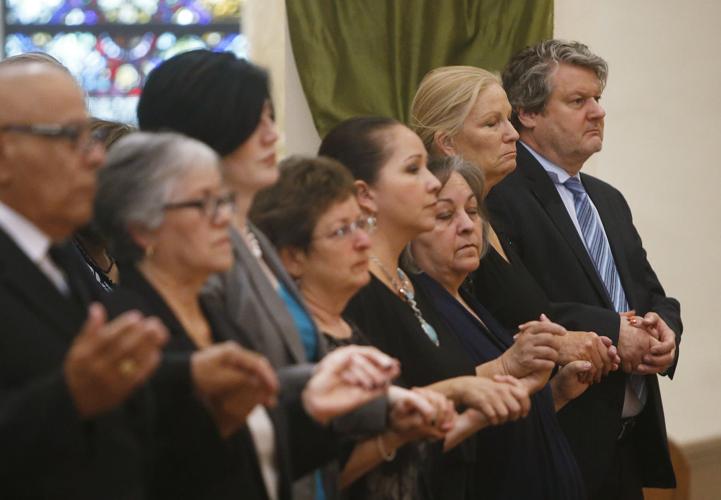

Family, community leaders and the public gathered at St. Augustine Cathedral on Friday for a memorial Mass bidding farewell to former Arizona Gov. Raúl Castro, who rose above poverty and discrimination to become the state’s first Mexican-American leader.
Castro, a Democrat, was Arizona’s 14th governor, and he also served as U.S. ambassador to El Salvador, Bolivia and Argentina. He died in his sleep April 10 in San Diego, where he had been in hospice care. He was 98.
Family members escorted Castro’s cremains from Nogales to the cathedral in downtown Tucson. Earlier in the day he was remembered in the border city during a memorial Mass at Sacred Heart Catholic Church, followed by a celebration of life.
In his later years, Castro lived in Nogales with his wife, Pat. There he practiced immigration, international business and real estate law. He retired in 2006 and the couple moved last year to San Diego to be near family.
People are also reading…
About 200 people gathered in Tucson — some arriving an hour before the 2 p.m. bilingual service — and listened to the soothing music of The Cathedral Schola under the direction of Carlos Zapien.
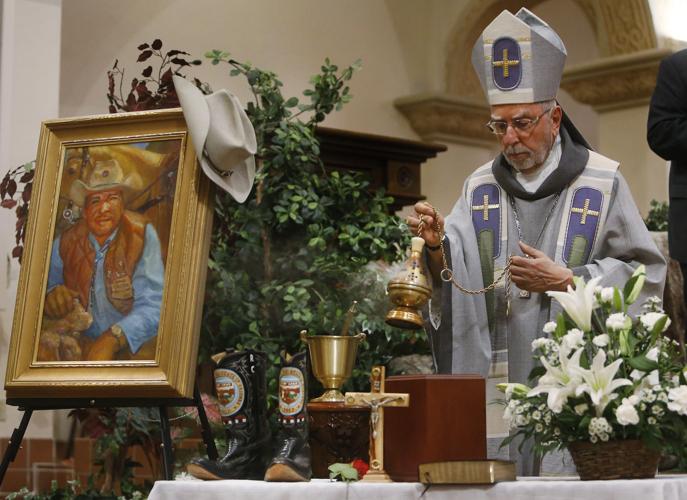
Castro’s grandniece, Frances Castro, sang “Ave Maria” and “Amazing Grace” in preparation for the memorial Mass concelebrated by Bishop Gerald F. Kicanas of the Roman Catholic Diocese of Tucson, the Rev. Gonzalo Villegas, rector of the cathedral, and the Rev. John Arnold, pastor of St. Mark Catholic Church in Oro Valley. Arnold’s father, Jack Arnold, worked on Castro’s gubernatorial campaign and was chairman of the Pima County Democratic party.
“ ‘Amazing Grace’ speaks about reflection — of what we have gone through in our lives. My uncle always said, ‘Adversity is my angel,’ ” Frances Castro said before the service. “Through all the adversity he faced, he was able to triumph, and that has been my inspiration.”
Castro’s cremains were placed in a wooden box near his cowboy boots and a painted portrait of him. His cowboy hat hung on a corner of the portrait’s wooden frame. His daughter, Beth Castro, was comforted by several dozen relatives. Castro’s widow was too ill to attend the service.
During the sermon, Bishop Kicanas said Castro proved to be a true man of integrity. “He fought the good fight, he ran the good race. Raúl Hector Castro was a fighter who fought in the ring, and he fought for social justice. ... History dealt him a tough hand, but in the end he made history,” he said, referring to racial injustice that Castro faced as a child and adult, and how he triumphed to become Arizona governor.
“He was wounded, but learned to heal the wounds. He knew that God had called him to do great things. He was ready. ... His life is a statement of what immigrants can achieve,” Kicanas said.
“Our community needs people of stature who know adversity and what it is to struggle. ... Only someone who knows what it is to be without owns that tested wisdom. Raúl’s life was full of challenges, but he met those challenges and prevailed,” said Kicanas.
Adelita Grijalva, president of the Tucson Unified School District Governing Board, explained that her father, U.S. Rep. Raúl Grijalva, could not be at the service. She said as a child “my governor was a man who looked like my tata, my father, like me,” she said of the state’s leader who climbed from poverty and discrimination and achieved justice for people in the judicial, legislative and educational systems.
She said his legacy will be honored as soon as there is congressional approval of a resolution to name the U.S. border crossing at Douglas for Castro.
After the Mass, daughter Beth said, “It is overwhelming. It is humbling to see and understand how he touched people’s lives.” Though he died in San Diego, she said, “His heart and soul never left Arizona.”
Dino DeConcini, brother of former U.S. Sen. Dennis DeConcini, was Castro’s chief of staff when Castro was governor. He said Castro told him that “throughout his life many doors were closed in his face, and then other doors opened.” DeConcini said Castro was prepared with a good public education and by his own tenacity, ambition and hard work.
Castro was born June 12, 1916, in the copper mining town of Cananea, Sonora, and moved as a child with his family to Arizona. They settled in Pirtleville near the border town of Douglas, where his father, Francisco, worked as a miner for Phelps-Dodge. His father died during the Depression in 1929, and his mother, Rosario, worked as a midwife to support her 13 children.
Castro was 12 when his father died. He worked panning for gold and later at the Douglas smelter.
“We survived because my mother would get paid with manteca (lard), flour, corn and beans. That’s what kept us going,” Castro said in a 2006 Star interview.
Castro attended a segregated school district, but excelled at his studies with the help of a couple of teachers who cared about him, challenging and inspiring him. He graduated with honors from Douglas High School in 1935, and went on to graduate in 1939 from Arizona State Teachers College in Flagstaff. That same year he became a naturalized American citizen.
However, he said in a 2009 Star interview, he could not find a teaching job because schools would not hire a Mexican-American teacher. He took to the rails, working in the fields and boxing for money at carnivals to help support his family.
Castro returned home and worked as a foreign service clerk for the U.S. State Department in Agua Prieta, Sonora, across from Douglas. He went on to law school at the University of Arizona in 1946, and worked as an adjunct teacher of Spanish. He graduated and passed the bar in 1949.
He opened a law office, then joined the Pima County Attorney’s Office in 1950. Four years later he ran for Pima County attorney and won. In 1958, he ran for and was elected a Superior Court judge. He was the first Mexican-American to hold either post.
In 1964, Castro was appointed U.S. ambassador to El Salvador by President Lyndon Johnson, and in 1968 was named ambassador to Bolivia. A year later Castro was dismissed by Republican President Richard Nixon and returned to practice international law in Tucson.
He ran for governor in 1970, but lost a close race to incumbent Republican Gov. Jack Williams. Castro ran again in 1974, and won by a close margin. He resigned as governor in 1977 when President Jimmy Carter appointed him ambassador to Argentina, a post he held until 1980. He returned to Arizona and practiced law, retiring at age 90.
Castro is survived by his wife; daughters Mary Pat James and Beth Castro; and grandchildren and great-grandchildren.
The official funeral Mass is set for 9 a.m. today at St. Mary’s Basilica, 400 E. Monroe St. in Phoenix. It will be followed by a celebration of life memorial at 11 a.m. at the Arizona State Capitol, 1700 W. Washington St.
Castro’s ashes will be interred in a private ceremony in Sedona.

Raúl H. Castro
Contact Carmen Duarte at cduarte@tucson.com or 573-4104.
On Twitter: @cduartestar

Carmen Duarte
Reporter


