A nonprofit that trains service dogs for disabled veterans in the Phoenix area is set to soon open a training facility in Tucson.
“Our goal is to have a grand opening sometime mid-May or so,” said Mik Milem, executive director of Soldier’s Best Friend.
The Peoria-based organization connects U.S. military veterans living with military-related Post Traumatic Stress Disorder (PTSD) or Traumatic Brain Injuries (TBI) with a service dog and companion.
The new Tucson office will allow the organization to support more veterans, he said.
The dogs
Soldier’s Best Friend has helped rescue more than 400 dogs, primarily from shelters, to train as service dogs, Milem said.
An adoption specialist visits and evaluates dogs who are considered for the program.
People are also reading…
“They’re looking for a dog that is calm and confident and is not reactive to people or to other dogs,” Milem said. “Calm because it’s going to work with a veteran with PTSD and confident because it’s a working dog.”
When a dog is selected, but it doesn’t take to the training, it is either returned to the shelter or put up for adoption by the organization.
“We never return a dog to a kill shelter, and we would never surrender a dog to the county or anything like that. So we make sure it finds a useful life,” he said.

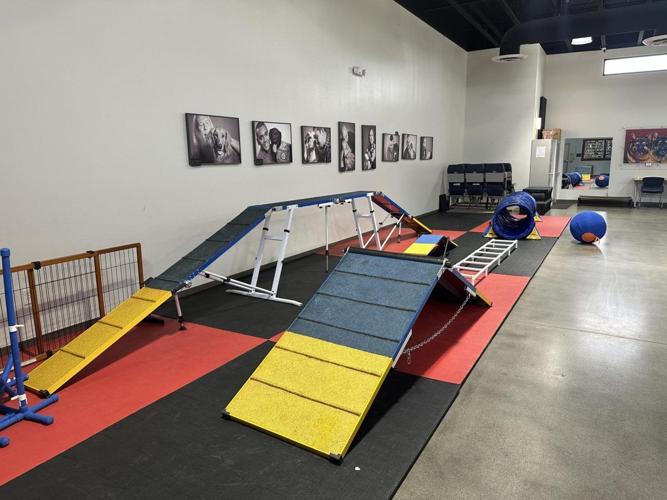
A ramp is set up in the dog training facility at Soldier’s Best Friend. Graduates are pictured on the back wall.
From the start, dogs are paired with a veteran who works with them throughout the training process.
“They train together in this program until the dog qualifies to be a service dog for the veteran,” Milem said.
Jessica Parker calls the training rigorous.
“They have to be in the program for six to nine months, and they have to meet with their trainer twice a week for the duration of the program,” said Parker, a Soldier’s Best Friend’s support specialist, handling administrative tasks and helping veterans through the application process. She has also worked as a dog trainer for the non-profit and graduated 12 dogs through the program.
She said dogs and handlers get homework outside of training, too.
“So they have to make sure that they’re training their dog seven days a week,” she said.
All of this training comes at no cost to the veteran.
“If we provide them a dog, that is free as well,” Parker said.
Veterans can also bring their own dog as long as it passes physical and temperamental evaluations.
“We’re just wanting to make sure that this dog is suitable for our program, and if so, then they’re good to go. Once they start, there’s no cost at all,” Parker said. “We even pay for medical expenses for the duration of the program.”
Parker said she loves to see the impact service dogs make in their companions’ lives. The dogs can help veterans become more independent and more confident leaving home.
“Just seeing that bond created is what made it so easy to continue doing what I’m doing,” she said.
The veterans
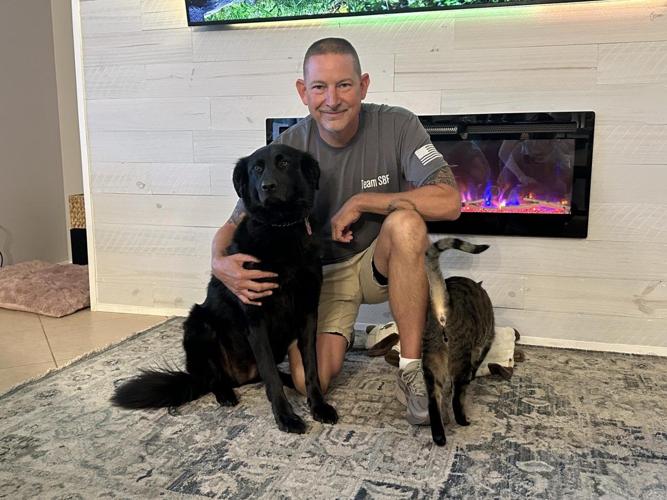
That’s the case for Mohammed Zantout and his friend Trigger.
Zantout has PTSD, and after retiring, looked into getting a service dog, but the fees and costs associated with getting one were “astronomical,” he said.
“So it was never an option financially,” he said. “Then when I talked to my psychologist at the VA, they referred me to Soldier’s Best Friend.”
He said he knew more than the physical or mental care he was already getting from the Department of Veterans Affairs.
“I needed companionship,” he said.
Three years ago, he began the process of getting and training a service dog through Soldier’s Best Friend with a home inspection and interview.
“We talked about Soldier’s Best Friend, what a service dog could help me with and what we would need to go through,” he said.
The next step was finding a dog.
Zantout’s first choice was his dog Milo, but Milo failed the physical examination. So Soldier’s Best Friend found Trigger, a 3-year-old black lab.
Trigger passed all of the physical examinations, but there was one problem.
“She had no confidence, head was always down, tail was between her legs,” Zantout said. “I didn’t know anything about training a dog, and I don’t think she knew anything about learning, so we were really both at ground zero.”
Zantout’s dog trainer gave him and Trigger homework, and they would work together every day.
“I would get up early before work, take her for a walk. Come home, take her for a walk, train a lot through the evening. And we were just learning and bonding as we grew together,” he said.
With hard work and determination by both parties, Trigger began to come around. And Zantout started to see the benefits of having such a loyal companion.
“(Trigger) allows me to not be such an introvert and be able to have, you know, human contact without anything negative,” he said. “That’s really what she’s done for me is open doors my PTSD has told me to close.”
Funding friends
That’s why Milem loves running the organization.

Mohammed Zantout with his service dog Trigger in Zantout’s home. Trigger helps Zantout to stay calm when the outside world becomes overwhelming.
“When the veterans interview to come into the program, most of them are recluse, nervous, and anxious,” he said. “When they graduate they stand in front of a crowd of people, and are able to share what the program has done for them, and that they can now go out in public and do things they never thought they could do again.”
Soldier’s Best Friend is able to support partnerships like Zantout and Trigger’s through corporate and individual donations, he said.
As a qualifying charitable organization in Arizona, they are eligible for a dollar-for-dollar tax credit in Arizona taxes, he said. That has helped them find the funds needed to expand from Peoria with a second training facility in Tucson, which is expected to open in May.
“The expansion of our own facility in Tucson is an important step to show our commitment and dedication to the veterans of Pima County,” said Milem. “While we’ve been in Tucson since 2014, having a home there allows us to better serve the veterans.”
Arizona Sonoran News is a news service of the University of Arizona School of Journalism.