

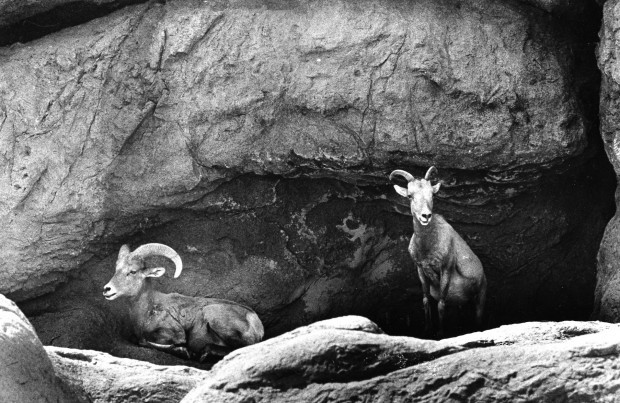
Today's "tail" includes a two year old bighorn ram reaching "ramhood".
Arizona Daily Star, March 21, 1990
2 ewes are expecting at Desert Museum
A young desert bighorn ram, captured in the wild and taken to the Arizona-Sonora Desert Museum 16 months ago, had two main missions:
Reach sexual maturity.
Prove it.
The ram apparently has accomplished these assignments promptly and efficiently.
“We saw him mating with both of the ewes in the enclosure last October,” said Peter Siminski, curator of birds and mammals at the museum.
“And now both females appear to be pregnant and due very soon,” Simisnki said yesterday. “The ram is about 2 years old, so it looks like he bred just about as early as he was able to.
People are also reading…
“We’re pleased. We can’t wait to see what happens.”
The ram, captured by state wildlife officials in the New Water Mountains of western Arizona in November 1988, was brought to the museum as a replacement for a beloved mature ram slain by an intruder in December 1987.
The 6-year-old animal was shot and beheaded by someone who entered the bighorn enclosure during the night, according to museum officials.
The slain bighorn’s pregnant mate, apparently unharmed in the attack, gave birth to a ewe in February 1988. In August 1988, law officers arrested Stephen Richard Doyle, a California man officers described as a “survivalist type.”
Doyle allegedly had the slain ram’s horns in his possession when he was arrested in Susanville, Calif. On charges of armed robbery in another case.
Jesse Figueroa, a deputy county attorney in the Pima County Attorney’s office, said yesterday that Doyle faces charges of theft, burglary and criminal damage in connection with the ram slaying.
County authorities are seeking to have Doyle extradited to Arizona, but so far Doyle has been successful in fighting the extradition, Figueroa said.
Siminski said he had been confident that the ram would propagate promptly with both ewes.
“I kind of expected this because he adjusted well to the exhibit (enclosure) and to his mates,” he said.
“It took him a while to stop being dominated by the older ewe, but as soon as the breeding season arrived the whole relationship changed,” Siminski said. “He rules the roost down there now.
“He had no competition, so he bred both the ewes as soon as they came into season.”
Lauray Yule, the museum’s public relations officer, said the older ewe appeared yesterday to be on the brink of giving birth.
“She’s as big as a barn,” Yule said.
Siminski said, “There’s some possibility the ewe could have twins. It’s unlikely, but possible.”
He said the lambs would be kept in the same enclosure with the adult bighorns for the next year.
The adults will be allowed to breed again next season, Siminski said.
“They’re in great health with no medical problems at all,” he said. “So I think we’ll see them breeding again in late summer or early fall.”
Je said the lambs born this year probably will be placed in other zoos eventually “because if more lambs are born it could start to get a little crowded.”
Siminski said officials of the Ecology Center in Hermosillo, Sonora, and the Dallas Zoo have expressed interest in receiving bighorns from the Desert Museum.
Transfer of the animals to other zoos would require approval from the Arizona Game and Fish Department, he said.

 Tucson to get a Teso Life store


