In the Sonoran Desert, it takes fall and winter showers to bring spring flowers.
So what do no showers bring? Pretty much what you’d expect.
Traditional wildflower hotspots across Southern Arizona are experiencing their worst bloom in years as a result of unusually dry conditions over the past year.
“We’ve got nothing, unfortunately,” said Steven Haas, manager of Catalina State Park. “It’s just been so dry.”
Haas has worked at the park for 11 years, and he said this year’s crop of wildflowers is the worst he has seen. The landscape right now is as brown and colorless as you might expect to see it in June.
And to make matters worse, Haas said, roughly 30% of the park was scorched by last year’s Bighorn Fire, including several areas popular among bloom chasers.
People are also reading…
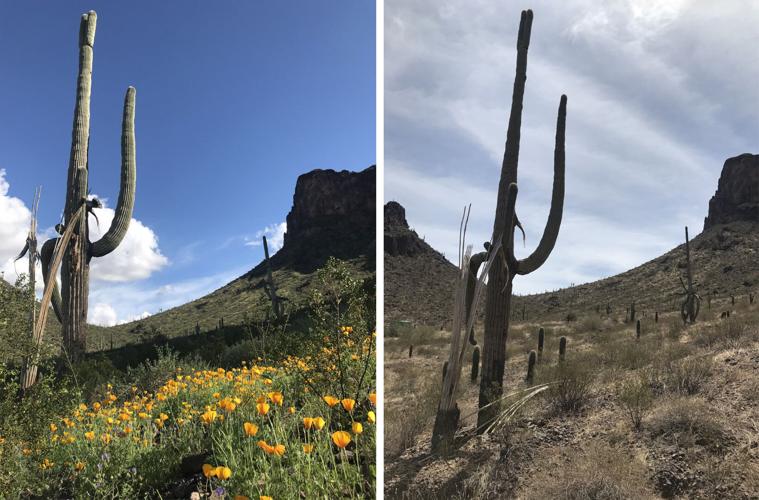
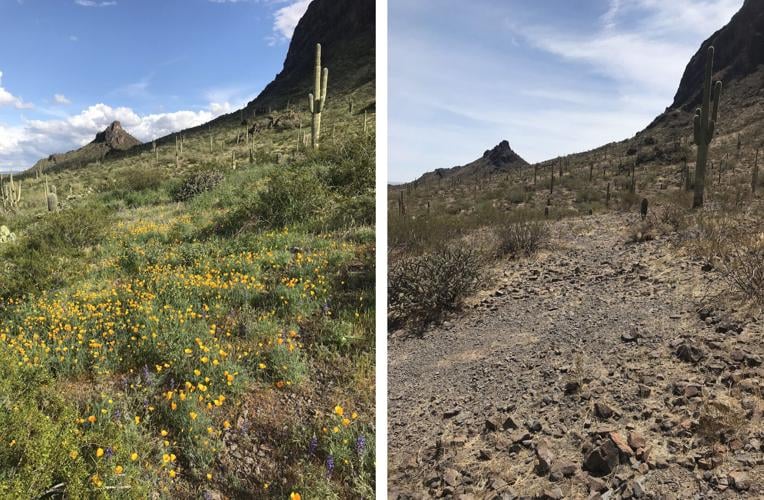
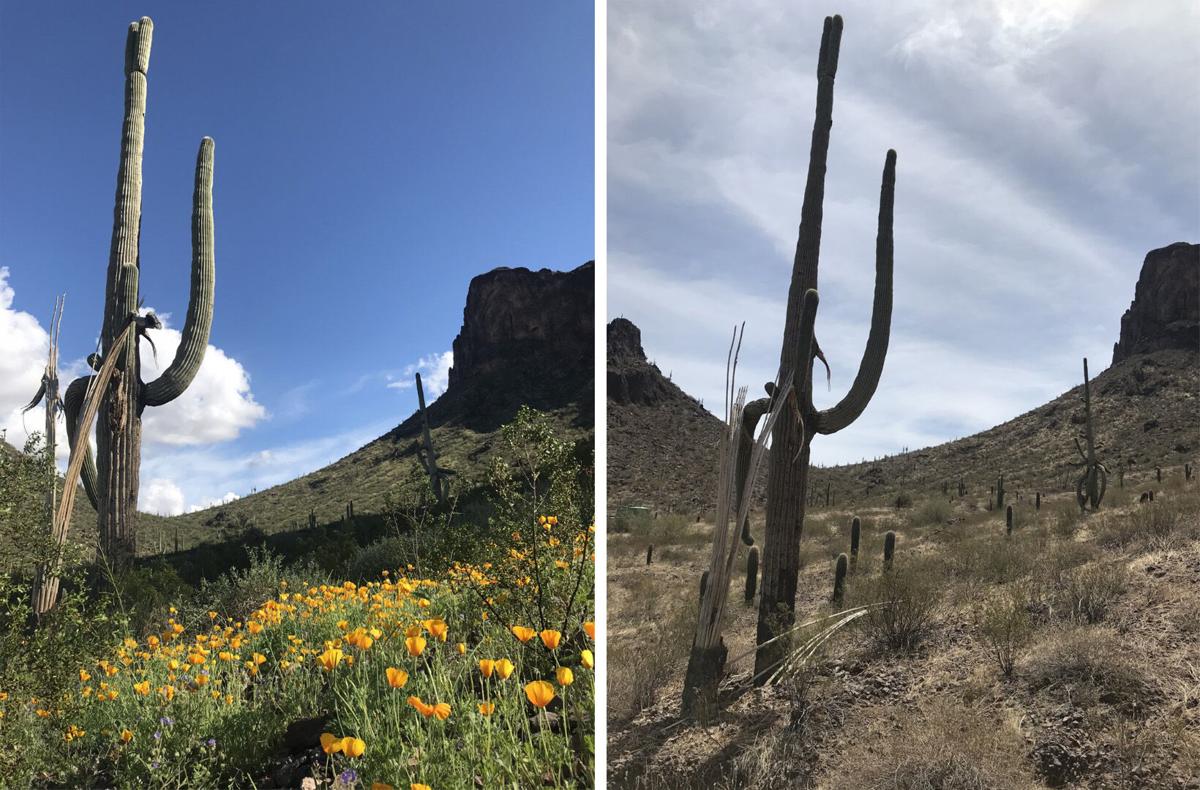
Picacho Peak State Park didn’t experience a large fire last year, but it seems primed for one. Rocky slopes that were blanketed in orange, yellow and purple blossoms a little over a year ago now sport crunchy patches of dry stubble.
The park 40 miles northwest of Tucson was coming off two springs in a row with impressive wildflower displays, but the only blooms to speak of there now are a few isolated annuals along the roads.
“It was pretty much a wipeout this year,” said park manager Carolin Miller.
It’s hard to know if the lack of springtime color has impacted traffic through the park, she said, because nothing has been normal there since the pandemic hit last year.
“The last 12 months we’ve seen highly unusual visitation,” Miller said, with crowds showing up at unexpected times and lingering into the heat of summer. “It’s apples and oranges.”
State parks spokeswoman Michelle Thompson said last year’s impressive wildflower display came as a bit of a surprise, especially after the enormous bloom in 2019. That kind of luck was bound to run out eventually.

Wildflowers at Picacho Peak State Park. Photo at left is from March 8, 2020. Photo at right is from April 14, 2021.
“We thought three years in a row would have just been unheard of, and we were correct,” Thompson said.
Massimo Boscolo is a horticulturalist at the Arizona-Sonora Desert Museum, where 2020 ranked as one of the driest years on record.
He said it takes a specific set of circumstances to produce a big bloom in the desert.
“What you need is a very good rain event in the fall,” Boscolo said, usually a downpour of an inch or more sometime before Thanksgiving to “stimulate mass germination.”
Those new plants then need periodic rain over the winter to sustain them until it is time to bloom in March and April.
“We didn’t get any of that,” Boscolo said.
But even in a good year, wildflowers in Southern Arizona are “always very localized, always sporadic,” he said, just as our rain showers often are.
That’s why large-scale blooms tend to happen no more than once a decade or so. That’s what makes them so special, Boscolo said.
It’s too soon to tell how this year’s bloom will unfold on Mount Lemmon.

Few wildflowers can be seen along the Sutherland Trail in Catalina State Park.
There probably won’t be any flowers at all in places most heavily damaged by the Bighorn Fire, said Heidi Schewel, public affairs officer for the Coronado National Forest.
But in other spots, where the flames moved through quickly and with comparatively little heat, the ash left behind could serve as fertilizer for a stunning crop of annuals, she said.
At higher elevations, the wildflower season generally doesn’t start until late summer, about the time the monsoon storms kick up.
“There’s a lot more unknowns than knowns at this point,” said Schewel, who has a background in botany and used to lead plant-identification walks on Mount Lemmon.
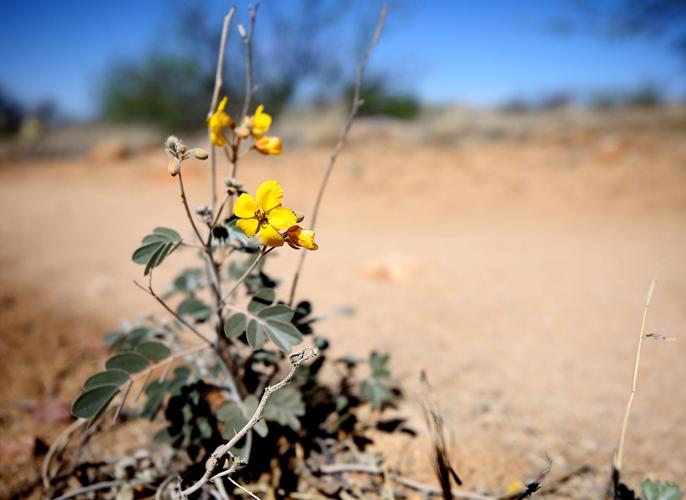
But even on the dry desert floor, there is some color to be found. The palo verde trees around Tucson are in full flower, and the saguaros and other cactuses are getting ready to join them.
Fortunately, that perennial show is not so dependent on perfectly timed rain, and the saguaros at least should continue to bloom for the next month or two.
“That’s something to look forward to,” Haas said.
You can also find flowers on other native plants such as ocotillo, creosote and brittlebush, especially along roads and washes and other places where water collects.
Boscolo said the stress of the drought may keep plants from flowering as intensely as they usually do, but they should still bloom.
In other words, don’t let the lack of showy annuals keep you from getting out and enjoying springtime in the Sonoran. As Schewel put it, the desert is plenty beautiful all by itself.
Photos: Wildflowers in bloom around Tucson, 2020
Wildflowers around Tucson, 2020

A Blue Lupines stands out from the Gold Poppies and purple Owl's Clover on the Sutherland Trail in Catalina State Park.
Wildflowers around Tucson, 2020

Diane Stowell, front, hikes past a group of Mexican and California Gold Poppies and Blue Lupines with her husband Curt Stowell on the Sutherland Trail in Catalina State Park.
Wildflowers around Tucson, 2020

Light shines on a group of Desert Chicory on the Sutherland Trail in Catalina State Park.
Wildflowers around Tucson, 2020

A Penstemon stands next to a trail on the Sutherland Trail in Catalina State Park.
Wildflowers around Tucson, 2020

A hiker walks past a trail lined with Mexican and California Gold Poppies as he heads back to the main trail on the Sutherland Trail in Catalina State Park.
Wildflowers around Tucson, 2020
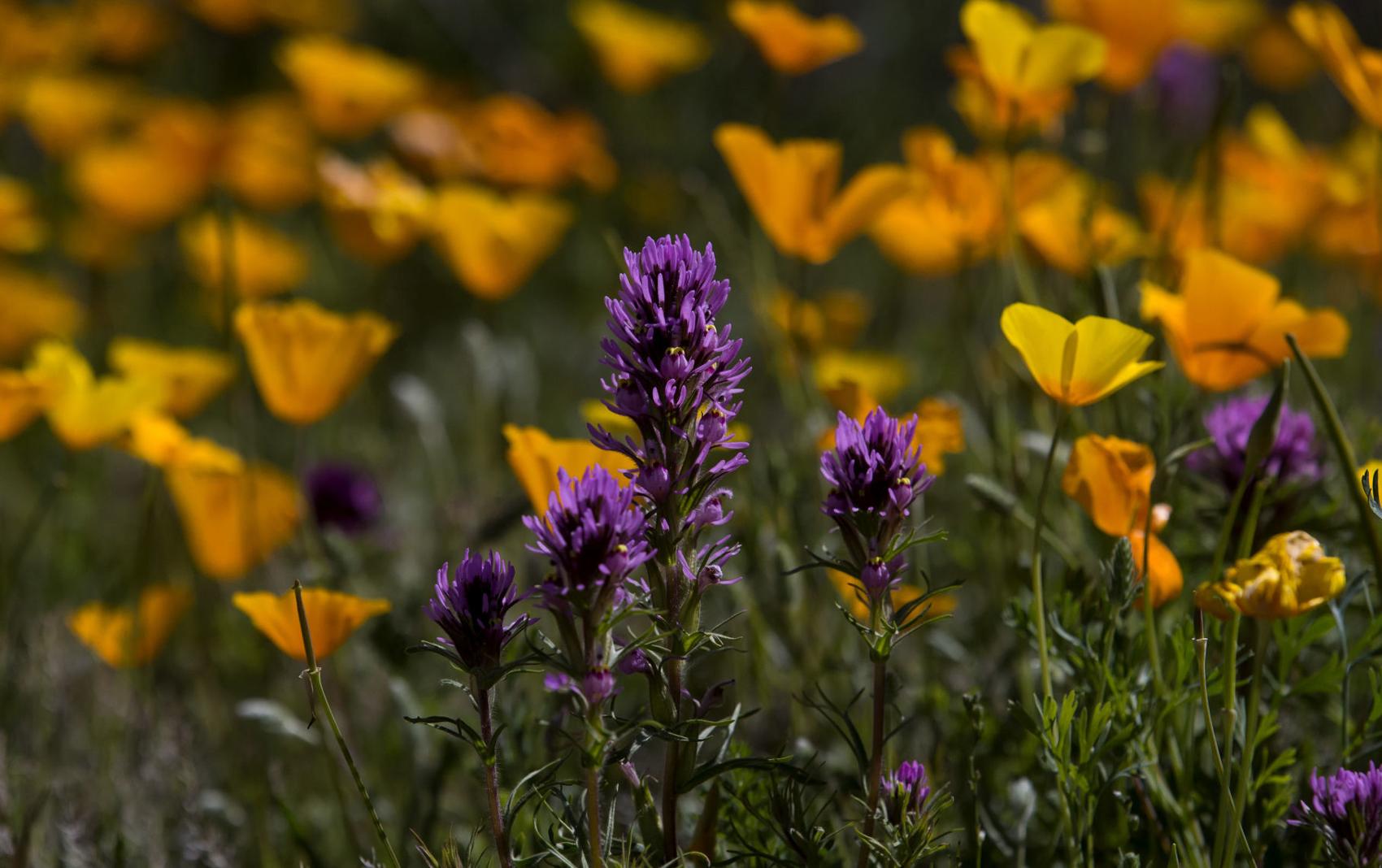
A group of Purple Owl's Clover stand out in front of a bed Gold Poppies on the Sutherland Trail in Catalina State Park.
Wildflowers around Tucson, 2020

Edita Navratilova, right, takes pictures of a group of Mexican and California Gold Poppies on the Sutherland Trail in Catalina State Park.
Wildflowers around Tucson, 2020

From left to right, Gabriella Porreca, Edita Navratilova and Frank Porreca hike past a bed of Mexican and California Gold Poppies on the Sutherland Trail in Catalina State Park.
Wildflowers around Tucson, 2020

Desert Blue Bells bloom in front of a home in River View Estates, in Tucson, Ariz., on March 29, 2020.
Wildflowers around Tucson, 2020

A group of Penstemon bloom in front of a home in River View Estates, in Tucson, Ariz., on March 29, 2020.
Wildflowers around Tucson, 2020

Matthew Halteman, left, and Stephanie Halteman walk with their daughter Brady Halteman, 2, along a line of wildflowers in bloom on E. Old Spanish Trail in Tucson, Ariz., on March 29, 2020. The Halteman family decided to go for a walk to get out of the house. East Old Spanish Trail is a popular street lined with wildflowers.
Wildflowers around Tucson, 2020

An Aloe Vera plant's flower stalks bloom along a wall on E. Wrightstown Rd., in Tucson, Ariz., on March 29, 2020.
Wildflowers around Tucson, 2020

A group of Lupines and Desert Globemallow begin to bloom along N. Kolb Rd., in Tucson, Ariz., on March 29, 2020. Along N. Kolb Rd., between N. Sabino Canyon Rd. and E. Sunrise Dr., the street is lined will Brittlebush and other wildflowers.
Wildflowers around Tucson, 2020

A Penstemon in bloom along Tangerine near Sage Brook and the Verde Ranch neighborhood, Saturday, March 28, 2020, Tucson, Ariz. Wildflowers are blooming long both sides of Tangerine in the area.
Wildflowers around Tucson, 2020

A few varieties of wildflowers are popping up in an island at Wilson Avenue and Juanita Street in Catalina Vista, Saturday, March 28, 2020, Tucson, Ariz.
Wildflowers around Tucson, 2020

Flowers sprouting up from the curb in Poets Square, on March 28, 2020.
Wildflowers around Tucson, 2020

Flowers outside the neighborhood garden in Dunbar Spring, on March 28, 2020.
Wildflowers around Tucson, 2020

A bee lands on a flower in the community garden in Dunbar Spring, on March 28, 2020.
Wildflowers around Tucson, 2020

Flowers bloom in the Dunbar Spring community garden, on March 28, 2020.
Wildflowers around Tucson, 2020

Flowers bloom in the Dunbar Spring community garden, on March 28, 2020.
Wildflowers around Tucson, 2020

Flowers against a wall of a home in Dunbar Spring, on March 28, 2020.
Wildflowers around Tucson, 2020

A group of Brittlebush bloom in front of a house along N. Kolb Rd., in Tucson, Ariz., on March 29, 2020. Along N. Kolb Rd., between N. Sabino Canyon Rd. and E. Sunrise Dr., the street is lined will Brittlebush and other wildflowers.