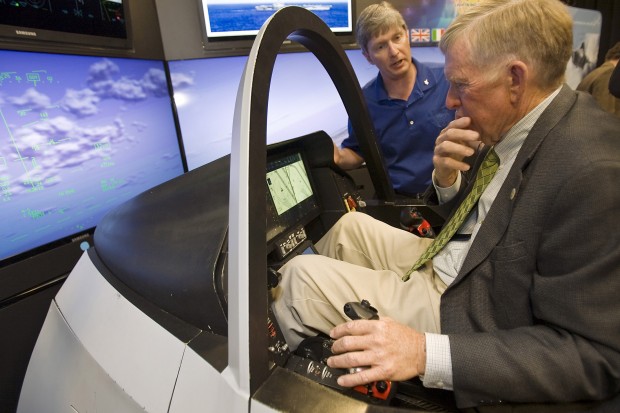
The nation's next-generation fighter jet "flew" into Marana on Wednesday as prime contractor Lockheed Martin touted the military and economic benefits of the stealthy F-35 at local subcontractor Sargent Aerospace & Defense.
But it was only an F-35 flight simulator - presented to a mostly friendly crowd of employees, local VIPs and media - or it might have attracted a crowd of sign-waving activists opposed to the new aircraft.
The F-35, also known as the Joint Strike Fighter, is designed to maintain America's air superiority in the coming decades with a radar-evading stealth design and advanced, networked electronics.
But as the first planes are being delivered for flight testing, the issue of where they will be deployed for training and regular duty has become the subject of heated debate in Tucson and other Air Force host communities. Opponents decry the higher noise levels, vibration and flight danger posed by the new craft, while supporters tout the military importance and economic benefits of the F-35.
People are also reading…
None of that controversy was evident Wednesday at Lockheed Martin's demonstration, part of a long-running road show meant to highlight the program's benefits - and perhaps to bolster support for the F-35.
Sargent Aerospace President Scott Still said growing work on the F-35 prompted the company to build a new, 70,000-square-foot building at the company's existing location along Interstate 10 south of North Cortaro Road.
"We built this because of the JSF (Joint Strike Fighter) and the future business that's out there for our company and our employees," Still said. "We're growing, we're hiring good aerospace-type employees, high-paying jobs."
The company makes more than 70 flight-critical components on the F-35, ranging from specialty bearings and fasteners to engine seals and hydraulic components.
Largely because of the F-35, Sargent has boosted its local workforce from about 250 to 280 in the past year and is still hiring, Still said.
"We believe this aircraft will strengthen our military, the economy, and most importantly, our local community," he said.
Marana Mayor Ed Honea - who got first crack at flying the F-35 simulator - said he and the town are firmly behind the F-35 and hope the new jet will find a home in Southern Arizona.
Tucson's Air National Guard base was not on a list of preferred training sites the Air Force issued in 2010, though Luke Air Force Base west of Phoenix made the cut.
"These F-35s are coming to Arizona, and some of them are going to go to Luke, and if we can get people in this region to support bringing them here - and the town of Marana does support that - we'll have them here as well," said Honea.
"It creates a lot of jobs, it creates a lot of business, puts wealth in our community, keeps our community safe. The military is so important to us that we really need to keep all aspects here," said Honea, who served in a Navy "Seabees" construction unit during the Vietnam War.
A Lockheed Martin official said the F-35 is critical to maintaining America's air superiority, noting that the average age of the U.S. fighter fleet - including the F-16s, F-18s and A-10s the F-35 is mainly designed to replace - is more than 22 years.
"There are some pilots who are almost that age, if not younger, that are flying those planes, and it's making it a little bit difficult for the services to maintain those airplanes," said Bob Rubino, director of Lockheed's Navy F-35 program and a former Navy fighter pilot.
The F-35 program is also an economic boon to suppliers and communities that support it, Rubino said, noting that even at the current low initial manufacturing rate of about three aircraft per month, the program supports 1,300 suppliers and 140,000 jobs nationwide, with an $18 billion annual economic impact.
Arizona has a relatively small slice of that pie, with 17 suppliers including Sargent and Phoenix-based Honeywell Aerospace, supporting some 1,100 jobs with an annual impact of $91 million, according to Rubino.
Those figures could multiply rapidly as the military ramps up to produce some 2,400 F-35s for the Air Force, Navy and Marine Corps, along with about 700 for allied nations, in the coming years, said Rubino. The company expects to reach a production level of 18 to 20 planes per month in the next six to seven years.
The current cost per copy for the Air Force version is about $70 million, close to the planes it's designed to replace, Rubino said, and that cost will go down as production ramps up. He said the program - plagued with delays in the past - is ahead of schedule about a quarter of the way through the flight-testing process.
Currently, 153 aircraft have been appropriated and the first 11 production jets have been delivered to the Air Force and Marines, Rubino said.
But where the F-35 ends up has become a hot-button issue in Air Force communities, including Tucson and Phoenix.
A local group, Tucson Forward, contends that the F-35 makes too much noise and poses new hazards for an urban setting such as Tucson International Airport, home to the Arizona Air National Guard 162nd Fighter Wing, or Davis-Monthan Air Force Base.
The nonprofit group contends basing the F-35 here will harm the local quality of life, pose health hazards for people and animals and decrease property values.
"It's an important aircraft for the future, but we don't think it's appropriate to be based at a commercial airport in an urban, metropolitan area," said Robin Gomez, a retired midtown resident and a director of Tucson Forward.
Gomez said the Air Force's own documents show the F-35 is twice as loud during landing as the F-16s now flown from the local Air Guard base.
Lockheed's Rubino - a former F-18 pilot - downplayed the noise issue, saying the F-35 will be only slightly louder than the F-18.
Tucson Forward also is concerned about safety, citing the F-35's scant flight experience and array of new technologies.
Gomez - a Navy veteran who says he supports a strong military - said Lockheed's F-35 road show straddles a line between business and politics. "It's the military-industrial complex. It's not illegal, but there's something wrong when you try and mobilize the base. It becomes very political."
But military officials weren't involved in Lockheed's F-35 demo event, and company officials referred questions on deployment decisions to the Air Force, which is expected to announce initial training sites this summer.
Sargent's Still was somewhat circumspect as well. "It's a great concern for the local community, I don't know which way they're going to go," he said. "But it seems like Arizona, and especially Tucson, is a logical spot - with the infrastructure that we have right now, it's just a natural fit to me. But who knows?"
Did you know?
Sargent Aerospace & Defense, formerly Sargent Controls and Aerospace, was founded in 1920. In 1985 it became a subsidiary of Dover Corp. Sargent moved to Tucson from California in 1990 and today makes a variety of commercial aerospace products as well as military components for the Black Hawk helicopter, Virginia-class nuclear-attack submarines and the F-35 stealth fighter.
The company has about 280 employees in Marana, its headquarters, and a total workforce of about 800 including sites in California, Indiana, Florida, Canada and India.
COMING TUESDAY
In our Tucson Tech column, read a firsthand account of what it's like to "fly" the F-35 simulator.
By the numbers
The economic impact of the F-35 program in Arizona
17
F-35 program suppliers in Arizona
1,100+
Jobs statewide associated with the program
$91 million
Estimated annual economic impact in Arizona
Source: Lockheed Martin
Contact the Star's David Wichner at dwichner@azstarnet.com or 573-4181.