


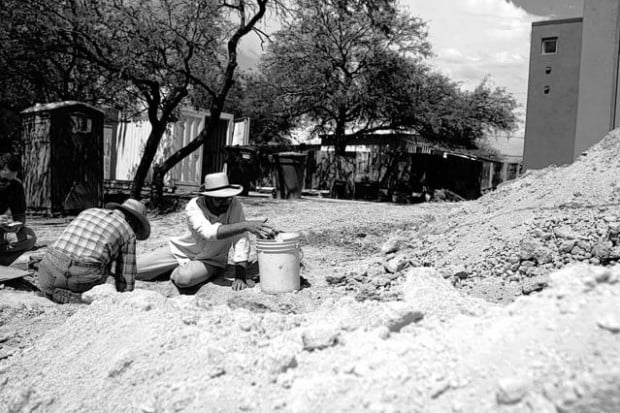
The 150- to 300-year-old skeletal remains of one, and possibly two, American Indians were unearthed this week in an area of Downtown Tucson where six others have been found in the last half century.
The latest discovery is further evidence there was an Indian cemetery in the area, likely from the Pima or Apache tribe, both of which had settlements in the area, said Homer Thiel, project director for Desert Archaeology Inc.
Two skeletons were discovered in 1995 next door to the remains found this week. A skeleton was found across the street in 1996. In 1954, three were unearthed when the city was putting in a sewer line in the same block, Thiel said. "It's very unusual," he said. "There has been only one other burial found in the barrio."
The Star is not revealing the location because officials expressed concern about protecting the site from looters.
People are also reading…
The remains — likely of a man who died between ages 20 and 30 — are from either the proto or early historic period, said Thiel, who dug up the bones Friday.
He and colleague Susan Hall discovered more bones in the grave late in the afternoon that may be those of a second person or could be misplaced bones from the same person, he said.
On Monday, Thiel and partners will hand-dig the upper portions of the remaining 15 feet of trench where the bones were first discovered to see whether there are more skeletons, he said.
"The likelihood that there are additional burials is extremely high," Thiel said.
The discovery occurred at about noon Wednesday when a backhoe digging a trench for an electrical line hit the bones, which were about 1 foot below ground level.
"I saw a rib bone, and I started to look around more, and I found a forearm bone and a tooth," said Jesse Thompson, 25, who works for First Choice Excavating. "That's when I stopped."
Thompson and fellow workers had been told that other ancient artifacts had been discovered in the area and were talking earlier that day about what it would be like to find some.
"Turns out, two or three hours later we are digging up ancient bones," Thompson said.
After police detectives and medical examiners determined that the bones weren't recent, the Arizona State Museum was contacted in accordance with state law, said Jonathan Mabry, principal planner for historic preservation with the city of Tucson.
The city contacted the property owner and informed him of his responsibility to have the skeleton and any other remains properly removed.
The city has agreed to incur some of the costs of doing that, which could be a few thousand dollars, Mabry said.
The Tohono O'odham Nation has been notified and has agreed to the planned steps to be taken, he said.
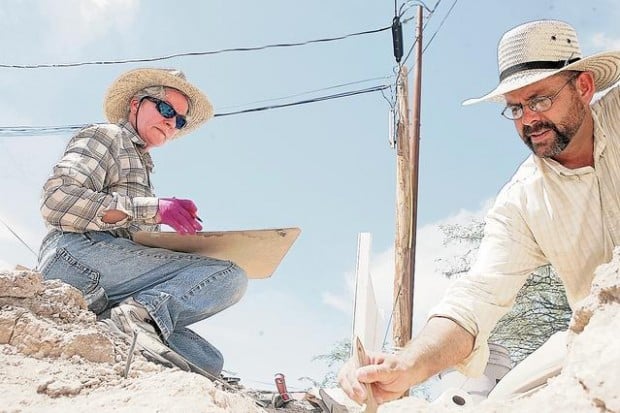
Thiel and Hall, an archaeologist with Desert Archaeology, spent Friday conducting the meticulous removal process.
Kneeling in the dirt across from each other, Thiel chipped away dirt and brushed off the bones while Hall drew the position of each bone on grid paper.
They removed the bones one at a time, wrapping each one carefully in a paper towel and putting them in separate paper bags, making notes on the fronts of the bags.
They made an unusual discovery beneath the pelvis: a pouch of reddish/purple pigment that may have been buried as one of the deceased's possessions or for spiritual purposes, Thiel said. A body found in the area in 1995 was covered in red ochre pigment.
The bones will be handed to the state museum, on the University of Arizona campus, where someone will make a final determination of how old the bones are, the sex of the person and whether there are any visible signs of disease, Thiel said.
Though evidence continues to mount that there are burial sites in the area, the city does not plan to dig up the street, Mabry said.
Officials will make sure city staff members who review construction permits know about the presence of burial sites and pass that information on to property owners, he said.
"It's just more evidence that there was an informal, unmarked cemetery in that area," Mabry said.
"The likelihood that there are additional burials is extremely high."
Homer Thiel, project director for Desert Archaeology Inc.
 Former Sam Levitz building sells for $8.6 million


