The new African American Veterans Monument at the Buffalo and Erie County Military & Naval Park will not be ready for Memorial Day. Work is underway, and a dream that took years to come together is expected to be unveiled with full ceremonies in September.
Yet the close connection between the effort to create a monument and the mass killing that happened two weeks ago at Tops Markets is raw and obvious to Warren Galloway. He is an Air Force veteran of the Vietnam War who has served as both a formal and emotional chairman of the long effort to bring this landmark to the waterfront.

Rendering of the African American Veterans Monument at Buffalo and Erie County Naval & Military Park.
“African Americans in the military always fought two wars,” he said, meaning: Black men and women in the Army, Navy, Air Force, Coast Guard and Marines provided centuries of valor and sacrifice in honor of American ideals of liberty and equality, only to return as veterans to communities where those ideals were too often denied.
People are also reading…
On Memorial Day, then – amid collective shock from mass murder by an accused white supremacist on Jefferson Avenue – the aching question is where does an entire grieving community, facing such loss, go from here?
In stark fashion, Galloway sees the message of the memorial as unbearably reaffirmed: Generations of Black veterans risked everything to nurture and defend the absolute American essence of what a killer in body armor went to Tops to specifically disavow and take away.
“These 10 people who died at the store,” Galloway said, “they were all great citizens who led lives of great meaning despite dealing with racism throughout their lives.”
He zeroed in on the ultimate, monstrous contradiction. Based on a racist diatribe posted online, the 18-year-old assailant was driven by “replacement theory,” the poisonous and deep-seated lie that Black women and men are of lesser meaning, of lesser humanity, than white people they might somehow “replace” within the nation.

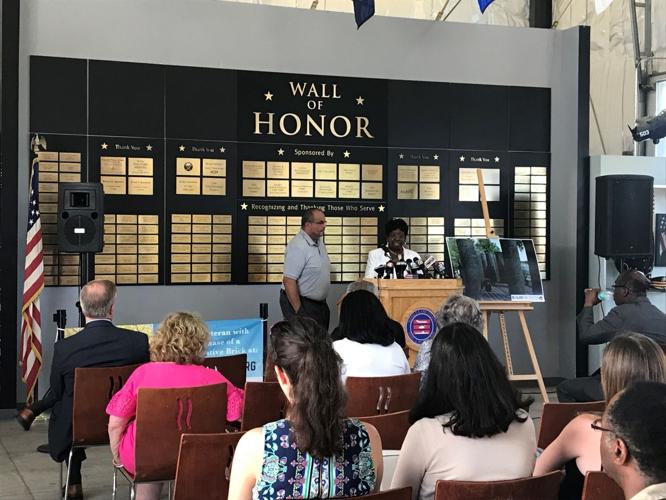
Assembly Member Crystal Peoples-Stokes and Warren Galloway, chairman of the effort, discuss the schedule for planning the African American Veterans Monument in the early days of the effort.
It is madness on any level, as Galloway lays bare with a fact of history: Crispus Attucks, the first American colonist to die 252 years ago in the Revolutionary War, was of African and Native American descent. Originally brought here through duress, Black Americans have spent centuries contributing to the foundation of the American experiment, Galloway said, beginning even before the great 19th and 20th century waves of immigrants from abroad who helped shaped so many cities.
“Replacement,” then, starts and ends at the ridiculous. But the other truth Galloway underlines is this: The lives snatched away at Tops represent a civic sweep of commitment, diligence and love, an impact evidenced by the mountain of flowers and spontaneous monuments near the store.

“Too often you can walk around with a hard shell when inside you feel like you’re disintegrating,” said Tommy McClam, who with Daniel Robertson coordinates Breaking Barriers – a program for young men of color.
What the killer did through his ruthless assault, by throwing a spotlight of grief on each of those women and men, is to remind a nation of the fabric that holds true in the heart of Buffalo.
For all those reasons, at the end of Monday’s annual 10 a.m. Memorial Day ceremony at the military park, organizers will read these names and ring a bell after each one:
There was Pearl Young, a great-grandmother, food pantry leader and volunteer who also was a passionate teacher, both as a long-term substitute in the Buffalo schools and at Sunday school.
There was Katherine “Kat” Massey, community activist and Fruit Belt loyalist dedicated to prosperity and safety for her neighborhood, including her long quest for a federal shutdown of illegal gun trafficking that escalates city bloodshed.
There was Deacon Heyward Patterson, a guy revered in his church who performed a task appreciated by anyone who ever has gone without a car: He routinely went out of his way while driving home shoppers, burdened with heavy groceries.

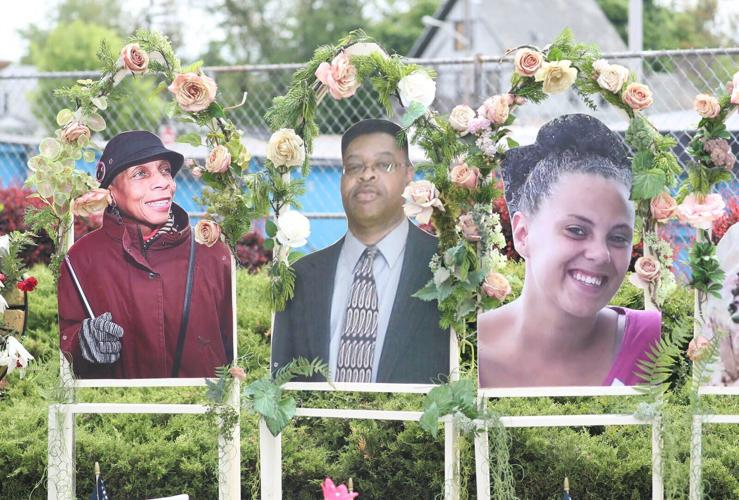
Many continue to visit the memorial on Jefferson Avenue, dedicated to the 10 men and women killed in a racially motivated mass shooting at Tops supermarket on May 14. Photo taken Wednesday, May 25, 2022.
There was Roberta Drury, a young woman of memorable warmth whose character was summarized by her decision to move to Buffalo from greater Syracuse: She came here to help her brother, in treatment for leukemia.
There was Andre Mackniel, shot to death during an intimate, familiar routine: He was picking up a birthday cake for a son turning 3.
There was Geraldine Chapman Talley, lauded by family and colleagues as a cook and baker, who stopped at Tops for that kind of in-and-out we all know, simply to pick up a few everyday items.
There was Margus Morrison, father and school bus aide who had planned to see his mother, children and brother after stopping by the store, but did not make it home.

Three friends of Aaron Salter, the retired police officer killed in the Tops Markets massacre on May 14, are at the center of a scholarship at Hutchinson Central Technical High School, where Salter graduated almost 40 years ago. The annual award will go to a student “mechanically inclined and interested in improving upon existing technology in such a way that would make life easier and better for future generations,” someone whose work ethic and civic passion echo Salter’s.
There was Ruth Whitfield, whose family – including a son who served as Buffalo fire commissioner – describe her as a tireless mom who would do anything for her kids, a woman devoted to an 88-year-old husband in a nursing home and a citizen mourned at her Saturday funeral by Kamala Harris, vice president of the United States.
There was Celestine Chaney, grandmother and maestro of strawberry shortcake, a survivor of several serious illnesses whose jobs included helping to make hats for major leaguers at an old New Era cap factory.
And there was Aaron Salter Jr. – father and husband, inventor, retired police officer and security guard whose decision to exchange gunfire with the killer cost Salter his life, but almost certainly kept the list of 10 from growing even longer.
The murderer, in assaulting such bedrock Buffalo, thought he would somehow make a cold-blooded point about who and what really matters.
In a way contrary to everything he intended, he did.
Such to-the-limit grief is now impossibly compounded. Not even two weeks after police say an 18-year-old in body armor used a semiautomatic weapon in Buffalo to commit mass murder, another teenager – who reportedly purchased his own similar weapons just after his 18th birthday – killed 19 girls and boys and two educators at a school in Uvalde, Texas.
This happened while mourners were still dropping to their knees outside Tops.
All of it, then, comes down to a choice. It would be easier, as it is always easier, to let go of this moment. It would be easier to allow all the empathy and outrage to gradually drain away and to settle back into an unfathomable status quo – knowing all the forces that ignited such wrath remain in motion and that somewhere it is just a matter of time.
Or, confronted by all of it, we could pivot from such hopelessness and take another route.
We could think of the children and teachers of Uvalde and the grandparents and so many beloved others on a routine swing through Tops, look straight at these lives of enormity in decency and purpose, and take from them the courage to face obvious truths about escalating hatred, or the way a couple of profoundly disturbed teenagers had such easy access to weapons and armor capable of this life-rending destruction, or the vivid results of longtime patterns of civic intolerance that we have pushed away for too long.
We could reflect upon the horror of everything we witnessed and make a passionate choice to move collectively and thoughtfully – two words it seems we left behind us, long ago – toward the kind of true American community, in practice and in law, for which Galloway reminds us that so many gave their lives.
And we could embrace that path in Buffalo, as both goal and lifetime promise, even as we awaken to Memorial Day.
Sean Kirst is a columnist with The Buffalo News. Email him at skirst@buffnews.com.
In this Series
Complete coverage: 10 killed, 3 wounded in mass shooting at Buffalo supermarket
-
Updated
Hochul pledges pursuit of justice after shooting, calls on sites to crack down on white supremacist content
-
Updated
Sean Kirst: In Buffalo, hearing the song of a grieving child who 'could not weep anymore'
-
Updated
Recently retired police officer, mother of former fire commissioner both killed in Tops shooting
- 249 updates



 Tucson's iconic Arizona Inn to add rental homes to its property