The developer of the Copper World mine has backed off from an earlier, much-promoted plan to produce finished copper on site rather than export copper concentrates overseas to China and other countries.
While Hudbay Minerals Inc. still holds out the possibility of someday producing finished copper at its mine site in the Santa Rita Mountains south of Tucson, its new Copper World feasibility study makes it clear that's currently not in the company's short- or long-term plans for the mine.
Instead, the feasibility study says the technique of producing and selling "Made in America" copper — which Hudbay heralded in earlier plans — is now a "future upside opportunity."
The technology involves leaching the copper concentrate from ore.
The study comes four years after the company put out a draft feasibility study laying out specific plans for its mine operations. Among other highlights is that it projects production of copper concentrate at the Copper World site will rise from 60,000 tons per day when mining begins to 90,000 tons per day in its fifth year of operations.
People are also reading…
Hudbay and its Copper World partner, Mitsubishi Corp., announced Wednesday, the same day the study was released, that they plan to start mining at the long-contested mine site in 2029. Hudbay also says it plans to start construction by the end of 2026.
The new study shows the cost of building facilities to produce finished copper in the form of cathodes has ballooned from $367 million to $703 million since the company produced its draft feasibility study in 2023. Copper cathodes are typically produced in long, flat sheets containing 99.99% pure copper, through a lengthy, detailed mining and refining process.
But the higher cost wasn't a factor in Hudbay's delay in using this technology — it's other factors such as "strategic timing and market opportunities," the company told the Star.
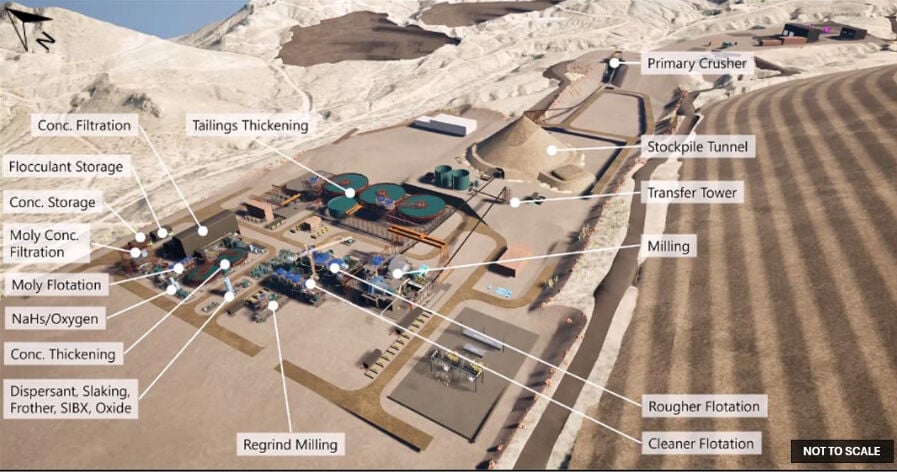
General plant site arrangement for the Copper World mine as shown in its new feasibility study.
"The decision to continue evaluation of the concentrate leach facility allows the technology to be further refined while providing the opportunity to evaluate and prioritize processing efficiencies and environmental benefits,' Hudbay said Friday in an email to the Star.
The technology is being considered for both Copper World and the company's newly acquired Cactus project, planned to be located near Casa Grande in Pinal County north of Tucson.
Mine waste disposal tool
At the same time it announced the indefinite delay in the on-site production of finished copper, the new study brought back a mine waste disposal tool that Hudbay and its predecessor at the site, Augusta Resources Corp., had promoted years ago but later planned to delay until after Copper World's first 16 years of operations.
Hudbay will use dry stack tailings at the site starting in Copper World's fifth year of operations to reduce the mine's water use at one-third of its total disposed tailings.
The dry stack tailings are also supposed to reduce the risk of any polluting materials used at the site from seeping through the tailings into groundwater. The tailings, fine-grained materials left over after copper is extracted from ore, would be heavily dewatered by high-pressure filters, thickeners or centrifuges.
The new study also reduces the mine's possible life span from up to 44 years in its earlier, draft feasibility study to up to 37 years now. But it holds out the possibility of extending the mine's life longer if it turns out that some mineral resources are found to be of higher quality than now known to be.
A feasibility study such as this is typically released at the same time a company formally decides to start construction and ultimately production at a mine site, says Canadian Mining Magazine, an industry trade publication.
Previously touted environmental benefits
When Copper World announced its plans to produce copper cathodes on site in 2022, it promoted it as a way to ensure that copper mined in Arizona would be sold in the U.S. rather than overseas.
It said this technology would offer major environmental benefits, in the form of reducing heat-trapping greenhouse gas emissions and the project's overall carbon footprint.
That would happen because the finished copper would not have to be shipped nearly as far to get to market. In turn, that would reduce the mine's energy use that would typically require the burning of carbon-rich fossil fuels.
Previously, the mine project had come under severe criticism from opponents at public hearings who decried the prospect of the copper being "exported to China" for final processing.

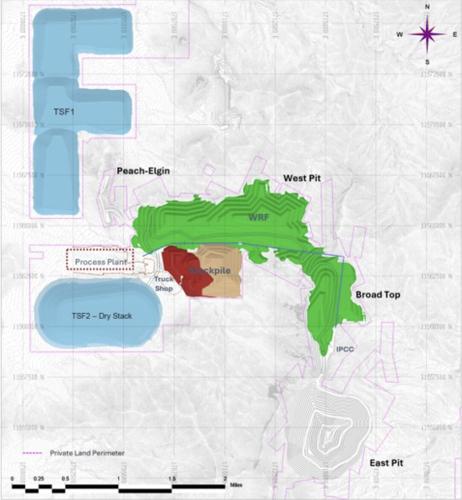
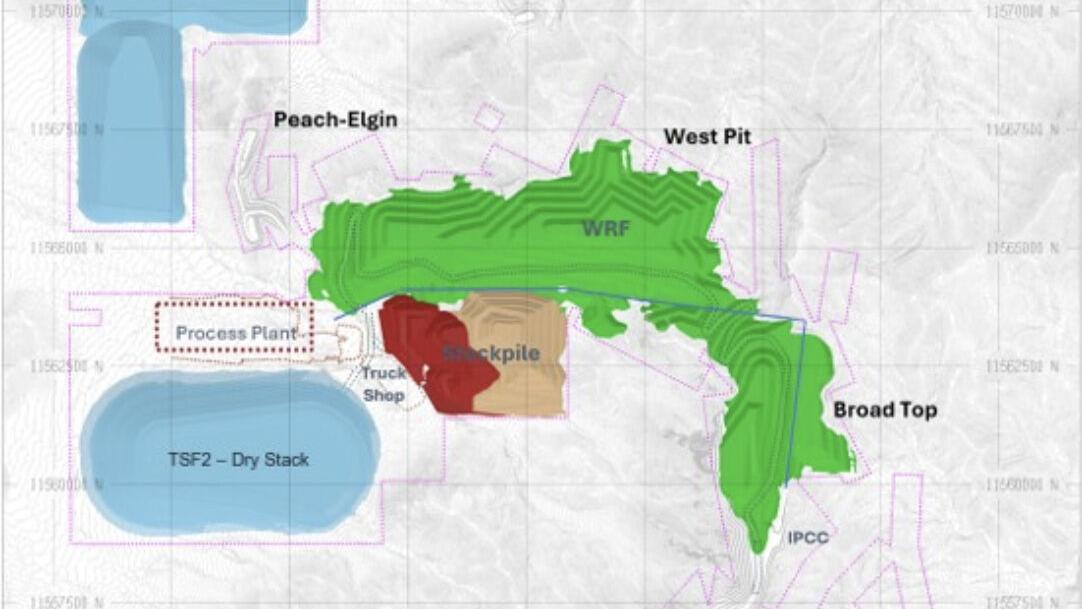
Copper World is designed as a conventional open-pit, truck-and-shovel mining operation across four primary pits, East, Broadtop, West and Peach-Elgin. The overall mine plan shown here integrates supporting infrastructure, including waste rock facilities (WRFs), grade-segregated ore stockpiles, a tailings storage facility (TSF), and an in-pit crushing and conveying (IPCC) system.
Back in 2022, Hudbay also said it was switching from shipping its copper overseas to shipping it to U.S. customers because, first, “the types, grades, and amounts of ore are very different” from the original Rosemont Mine project.
Second, “local sourcing and reducing greenhouse gas emissions have become significantly more important in the 16 years since the Rosemont project was proposed,” the company said.
It was referring to the proposed Rosemont Mine that had been planned to be built on the Santa Ritas' east slope before its construction was halted by a federal court ruling in 2019. The Copper World project, by contrast, is planned for the Santa Ritas' west slope for its initial mining, although Hudbay still plans to try to get a permit to mine the east slope over the coming decade.
But by 2023, Hudbay was already retreating from its concentrate leaching plan. It announced that it would introduce the technology in year 5 of its operations. In its new feasibility study, the company was more indefinite in saying when it would use the leaching technology.
But at the same time, the new study devoted considerable space to describing the benefits of this technology and noted that a key element in the technology, the use of solvent extraction through a process known as electrowinning, was "fully proven."
"The concentrate leach facility is 100% fully permitted and backed by advanced engineering. It represents a key future upside opportunity that provides unique strategic flexibility and will allow Hudbay to leverage synergies created by its recent acquisition of Arizona Sonoran Copper Company and the Cactus project," the company said.
"Those synergistic opportunities require rigorous evaluation and will influence timing for construction of the concentrate leach facility. Keeping it as a value-add, future option allows for optimal deployment," Hudbay said in its email on Friday.
Access to forest lands eventually needed
The feasibility study also made it clear how strongly the mine project's long-term future depends on Hudbay's ability to get access to national forest lands located outside the private lands where the company plans to start mining.
The original plan for the mine back in the 2000s and the 2010s was for copper to be mined on the Santa Ritas' east slope, relying on both private land and U.S. Forest Service land. Much of the private land was to be devoted to an open pit from which the copper would be extracted, mainly on private land. Much of the forested land was to be used for disposal of mine tailings and waste rock.

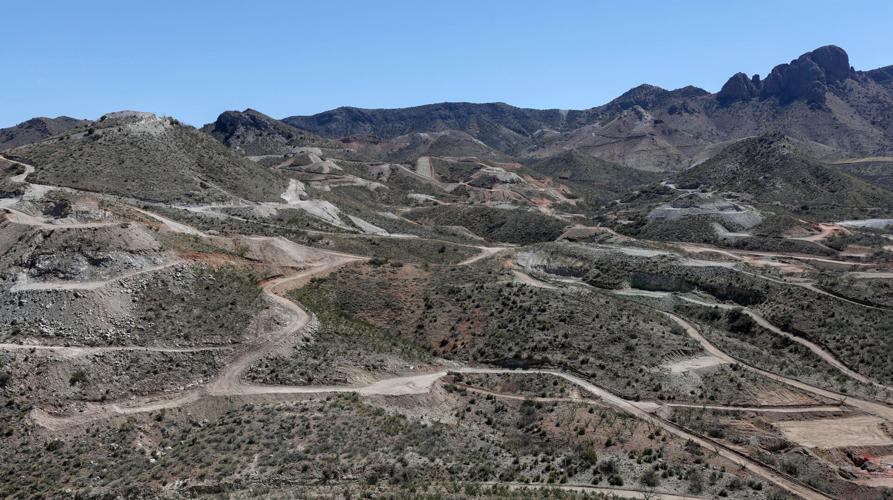
The Santa Rita Mountains' site of the planned Copper World mine, where there will be four open pits. The site is about 30 miles south of Tucson.
But a 2019 federal court ruling overturned a Forest Service decision to allow the use of its lands for mine waste disposal.
The company has said it wants to move operations onto Forest Service land by Copper World's 10th year of copper production. But that would require it to obtain permits to use those federal lands, which would require Hudbay to find a way around the 2019 court ruling.
In the new feasibility study, Hudbay said: "An important constraint on the mine production schedule is the limited space for disposing ot waste rocks, tailings, and low-grade stockpiles, resulting in a sub-optimum mining sequence from a strict economic standpoint."
"Despite that, the current mine plan allows the mine to operate in a sustainable manner for 15 years," Hudbay said. In response to a question from the Star, Hudbay added that it means the mine would operate sustainably both economically and environmentally.
"Securing federal permits earlier would unlock significant benefits to the project by removing these important constraints on the mining schedule, and likely allow more tons and/or better grades to be mined earlier than currently planned," Hudbay wrote in its new study.
The study breaks Hudbay's mine plans into two phases: one covering the first 15 years, the other covering the remaining 22 years.
But those plans still assume that Hudbay would able to start mining on federal land in Copper World's 10th year of operations.
To be able to accomplish that, proposed legislation has been pending for three years in Congress that would essentially overturn the 2019 federal court ruling and allow mining companies to dump their wastes on federal land. It is being fought hard by environmentalists.
If such legislation fails to pass, Hudbay will face the same obstacles that it and its predecessor, Augusta Resources, faced in efforts to get Forest Service approval to use the federal land for its operations.
It will have to go through a formal review of the project and its environmental effects, as required for any federal project by the National Environmental Policy Act. It will also have to be reviewed for its possible effects on endangered and threatened species. Also, the federal government would have to consult with the Tohono O'odham and other tribes that have an interest in the development and protection of the federal lands.
To get that permission before, Augusta and ultimately Hudbay, which acquired the mine proect in 2014, took 12 years to get all the necessary federal permits to build the mine. Unless Hudbay and the mining industry in general can get current federal laws changed, the company will have to go through a similar process again if it wants to use federal lands.
Contact Tony Davis at 520-349-0350 or tdavis@tucson.com. Follow Davis on Twitter@tonydavis987.

Tony Davis
Reporter


 Mitsubishi buys 30%, $600M stake in Copper World near Tucson