

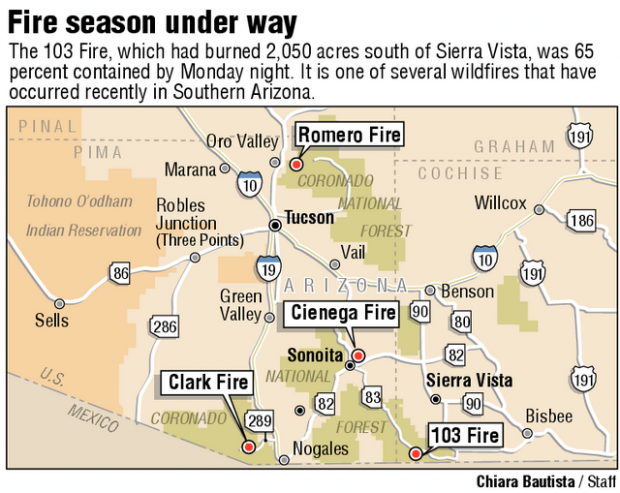
The 103 Fire burning south of Sierra Vista is now 65 percent contained, as crews caught a break from tame winds and higher humidity, a Coronado National Forest spokeswoman said late Monday.
Crews worked Monday night to create a buffer zone to keep the 2,050-acre wildfire from reaching the Coronado National Memorial.
The 103 Fire remained 1 1/2 miles away from the memorial's visitors center and within a mile of 15 homes scattered on the east side of the Huachuca Mountains, said spokeswoman Marylee Peterson.
It burned away from the visitors center, where an unspecified number of workers had evacuated as a precaution. Winds have since pushed the fire away from the building, but Peterson said crews were using bulldozers to create a clear space so flames would not reach the memorial.
Peterson said residents of the homes on the east side of the Huachuca Mountains had been warned that they might have to leave if conditions worsened, but no evacuations have been ordered.
People are also reading…
The Forest Service described the fire as about 15 miles south of Sierra Vista, while the Southwest Fire Coordination Center's Web site said it was about eight miles south of the city.
Peterson said there was no time estimate for full containment.
The fire, which started Saturday about two miles north of the Mexican border, was believed to be human-caused, but authorities said it was still under investigation and did not cite a specific human cause.
The fire has run into previously burned areas to the south and has stopped advancing that direction, Peterson said.
Airplanes, six water-dumping helicopters and 434 firefighting personnel have been working on the north, west and east fronts, focusing especially on the upper ridge west of Ash Canyon to keep from evacuating the area.
In other wildfire news around Arizona:
Romero Fire grows to 860 acres
The Romero Fire, near Pusch Ridge on the western side of the Catalina Mountains, jumped a primary line and grew 30 acres to 860, but crews are still calling it 95 percent contained.
The fire is still behind the secondary perimeter line.
"Progress on both these fires has been very encouraging," Peterson said.
Sonoita-area fire contained
The Cienega Fire northeast of Sonoita, reported at 2 p.m. Monday, charred 115 acres but was fully contained by the end of the day, authorities said.
Knife Fire nears I-40
A wildfire in the Coconino National Forest grew to 560 acres by Monday night but was 80 percent contained, officials said.
The Knife Fire, about 14 miles east of downtown Flagstaff, wasn't threatening any homes or buildings, but it was within less than a mile of Interstate 40, which hadn't been closed.
About 120 firefighters were battling the blaze, which authorities believe was human-caused. Full containment is expected by Wednesday evening.
Fire west of Prescott 75 percent contained
Firefighters completed a containment line on the southern end of a 1,100-acre blaze 17 miles west of Prescott and were focusing on two other flanks.
The Cornfield Fire in the Prescott National Forest wasn't threatening any homes or buildings, though a ranch within a mile of the blaze was evacuated as a precaution, said Debbie Maneely, spokeswoman for the fire crews.
The fire, reported midday Sunday, is 75 percent contained and full containment is expected by tonight.
Authorities said they have cited people who are suspected of starting the blaze.
On StarNet: Share your best wildfire shots with us and view other readers' contributions to the gallery at www.azstarnet.com/wildfire
● Coronado National Memorial, first designated in 1941 and formally established by President Truman in 1952, commemorates the first major European exploration of the American Southwest.
The memorial lies on the U.S.-Mexico border within sight of the San Pedro River Valley, through which the Coronado Expedition first entered the present United States in search of the fabled Seven Cities of Cibola.
It is set in 4,750 acres of grasslands and oak woodlands, which are home to abundant wildlife including coatimundis, hummingbirds, Mexican jays and male barking frogs.
— Source: National Park Service


 Nancy Guthrie's Tucson neighbors: Life with streamers 'unbearable'


