

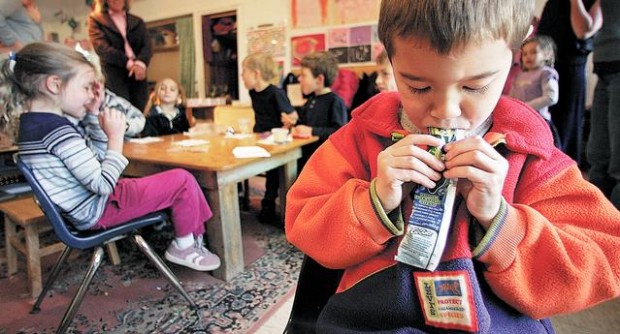
One of Tucson's best-known child-care centers was cited recently by state regulators for slicing fresh peaches as a snack for preschool kids.
A center in Vail was cited for serving children mini-bagels with cheese, and little pizzas made with English muffins.
State health inspectors found the centers in violation of rules the centers never knew existed.
But unless child-care centers have licensed, commercial-grade kitchens — as most do not — they are now being told to stick to pre-packaged foods and beverages to reduce the risk of contaminated food.
Center directors say the policy undermines their efforts to help children adopt healthful eating habits early in life — efforts the kids' parents wholeheartedly support.
"This is the most aggravating thing I've ever had to deal with in 25 years in child care," said Sharon Taddeo, director of Cottonwood Preschool and Extended Care in Vail. "It's just so nonsensical, and that's what's so frustrating."
People are also reading…
It's also an issue that's never come up before, said Julia Butler, director of Second Street Children's School, where a health inspector witnessed the slicing of peaches last September.
"We've been in business for 17 years, and we've never been cited for inappropriate food service before," Butler said. "I feel like we're caught up in this strange bureaucratic confusion."
The frustration extends to public-health and child-care officials. Many were unaware until fairly recently of the rules that seem to outlaw fresh, wholesome food.
It all started in December 2004, when a Tucson child-care center named Satori contacted the Pima County Health Department for help with a diarrhea outbreak.
Investigators determined the diarrhea was caused by a common virus and had nothing to do with food the children had eaten at the center.
But while the investigators were at Satori, they saw an organic vegetable garden where children could pull raw carrots and herbs from the ground, learn how they grow and enjoy them in soup brought in from a restaurant.
They learned that the kids also helped make muffins from scratch — a way to learn about measuring and another lesson in healthful eating.
"That sounds wonderful. That's exactly what we want them to do," Lindsay Brown, a children's dietitian with the University of Arizona, said last week.
But there was a problem, investigators decided two years ago. Satori didn't have a commercial-grade refrigerator, dishwasher and stove. It had no Pima County Health Department license to prepare and serve food.
There was no way to sanitize pots and utensils. There were no stainless-steel countertops.
The inspectors contacted the Arizona Department of Health Services, which licenses child-care centers but leaves kitchen inspections up to the county. The state Health Department cited Satori and fined the center $350 for food violations.
"It was just horrendous," said Phyllis Gold, Satori director. "They said it's fine to grow the vegetables, but you can't eat them without a food permit. I understand where they're coming from, but the way it was handled was unbelievable."
Gold spent $5,000, she said, to outfit her center with a commercial-grade dishwasher, refrigerator-freezer and triple sink — to wash, rinse and sanitize dishes with a bleach solution.
"I didn't do the stove because we don't cook," Gold said. "I wanted to continue to have fresh fruits and vegetables, and be able to mix a can of juice with water. I couldn't do that before because it's considered preparing food."
Second Street School and Cottonwood Preschool are two of several centers cited since the Satori case.
County health inspectors have given child-care centers a list of do's and don'ts. For those without a licensed kitchen, the don'ts include:
● No perishable food. A regular home-style refrigerator will not always maintain accurate temperatures for safe storage.
● Perishable food can be kept cold in a regular refrigerator for a few hours, but it can't be stored overnight.
● Foods that require peeling, cutting, slicing or can-opening are off-limits because utensils can't be properly sanitized without a triple sink.
● Bottled water can be served, but it can't be stored for later use. Children can serve themselves from drinking fountains, but they aren't allowed to drink water poured from a pitcher — again because the pitcher can't be guaranteed sterile.
Previously, most centers asked parents to send their kids' lunches each day, while the centers provided morning and afternoon snacks.
Now centers are looking for new snack foods that meet state and county requirements, or they're asking parents to send snacks from home.
Brown offered some suggestions. Small bags of baby carrots, plastic-wrapped tubes of low-fat string cheese, packaged whole-grain crackers, and small bags of dried fruit would be good choices, the dietitian said.
But parents are frustrated.
"These children are running around outside, wiping their noses with their hands, touching doorknobs that everyone else touches, going to the bathroom — who knows if they're washing their hands afterward?" said Maria McCracken, the mother of two preschoolers enrolled at Cottonwood. "There are germs all over the place. That's life."
Lissa Gibbs, whose daughter attends Second Street School, said she's happy to make up snacks for her daughter to take with her each day. But she regrets that her child is missing out on the opportunity to learn about food and food choices, and to share the same snack with her classmates, family style.
"Now they're trying to make snack time like a picnic, with big baskets to hold the kids' snacks," Gibbs said. "But what about the children in low-income neighborhoods? It may mean those children don't get to eat because their parents don't have the finances or can't get it together to send their kids with snacks every day."
Kathi Ford, a Pima County Health Department nurse who consults with child-care centers, said she understands the frustration of parents and child-care directors. Ford and Sharon Browning, the county's consumer health and food safety director, are meeting with child-care directors and parents to sort through the regulations and come up with new approaches.
"It is difficult to understand," Browning said, but the state Health Department, which licenses centers, requires them to follow the county's kitchen rules. But the county's rules are adopted word for word from the state's, Browning said.
"I think there are too many rules and misunderstood things right now," Browning said. "But if I had a child in child care, I would hope the person who fixed my child a snack would wash her hands first. But some facilities don't have a hand-washing sink. And some don't have a sanitary surface for preparing food."
Ford said: "We want food preparation to be safer, but we also want kids to have fresh, healthy foods. We are trying to work together to make this the best possible scenario."
Use our searchable child-care-violation database to check your child-care provider at go.azstarnet.com/childcare
Do they dare to serve a peach?
The rules for serving food in child-care centers can be baffling. Take peaches, for example.
The rules say a center can't prepare food unless it has a licensed, commercial-grade kitchen. Not all centers have those, and many of the others have switched to serving prepackaged foods.
A can of peaches would seem to be a good choice.
But how do you open the can? Has your can opener been washed, rinsed and sanitized with a bleach-and-water solution in a triple sink?
Does your center even have a triple sink?
You chose canned peaches because you can't cut up a fresh peach unless you have a commercial-grade kitchen.
Cutting up a peach is considered food preparation.
Besides, you need the three-part sink to sanitize the knife you use to slice the peach.
Maybe you could give each child a whole peach with the skin still on. No preparation there — just rinse the peach in running water.
But what if a child doesn't want to eat the skin? And what about the peach pit? Isn't that a choking hazard?
As it turns out, the children can eat peaches after all — even fresh peaches, sliced right in front of them.
How? By making peaches part of a lesson plan. Set the peaches side by side, or cut a peach into several slices for the children to count.
The peaches aren't food after all. They're part of the curriculum.
Jane Erikson


 Hotel on the rise at Tucson’s Uptown project


